

The Unique Allure of the chocolate french bulldog
The French Bulldog, affectionately known as the “Frenchie,” has captured the hearts of dog lovers worldwide with its distinctive bat ears, compact muscular frame, and deeply affectionate personality. Among the dazzling array of coat colors that this breed exhibits, the Chocolate French Bulldog stands out as an exceptionally striking and highly sought-after variant. Unlike the standard colors recognized by traditional kennel clubs—such as brindle, fawn, and cream—the chocolate hue is considered a “rare” or “fad” color. It boasts a rich, warm, brown coat that can range from a light milk chocolate to a deep, dark cocoa. But what exactly gives the Chocolate Frenchie its unique appearance? The secret lies deep within its genetic code, specifically involving a recessive gene located at the B locus.

as a French Bulldog expert and breeder and breeding expert, I often encounter questions about these beautiful dogs. Beyond their stunning coats, Chocolate French Bulldogs frequently exhibit mesmerizing eye colors, starting with bright blues in puppyhood that transition into golden, green, or light brown shades as they mature. Furthermore, the genetics behind the chocolate coloration also affect other pigmented areas of the dog’s body, such as the nose, paw pads, and eye rims. Understanding the complex interplay of genetics that creates the Chocolate French Bulldog is crucial not only for breeders aiming to produce healthy litters but also for owners who want to fully appreciate the unique biological makeup of their beloved companions.
Related Reading: Training & Behavior | Frenchie Puppy Guide | Best Food for Frenchies
In this comprehensive guide, we will delve deep into the science of the b/b gene, explore the fascinating mechanisms behind their eye color changes, discuss responsible breeding practices, and address the specific health and care considerations for Chocolate French Bulldogs.
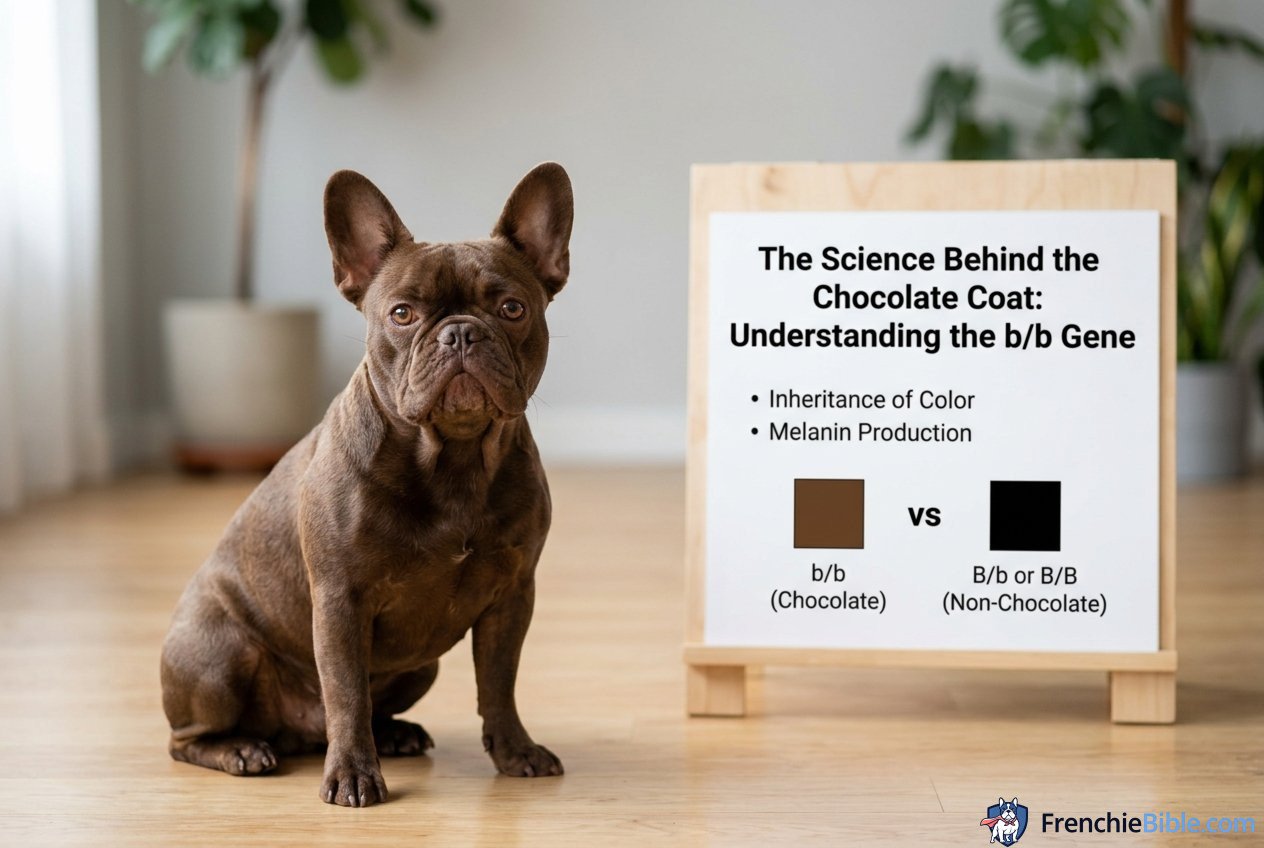
The Science Behind the Chocolate Coat: Understanding the b/b Gene
To fully grasp how a Chocolate French Bulldog gets its signature color, we must take a journey into the world of canine genetics. A dog’s coat color is determined by various genes acting at different locations, or “loci,” on their chromosomes. Each locus controls a specific aspect of pigmentation, such as the type of pigment produced, its distribution across the coat, and its intensity.
The Foundation of Pigment: Eumelanin and Phaeomelanin
All coat colors in dogs are created from just two base pigments:
1. Eumelanin: This is the black pigment. However, as we will see with the chocolate color, eumelanin can be modified by other genes to appear brown, blue (gray), or lilac (isabella).
2. Phaeomelanin: This is the red/yellow pigment. It is responsible for colors ranging from deep red (like an Irish Setter) to pale cream or white.
The gene responsible for the chocolate color specifically affects eumelanin. If a dog has a solid chocolate coat, it means the eumelanin pigment in its hair shafts has been altered from black to brown.
The B Locus: The Switch for Brown
The locus responsible for changing black eumelanin to brown is known as the B locus (Brown locus). At this specific location on the chromosome, a gene determines whether the black pigment will remain black or be diluted to a brown/chocolate shade.
There are two primary alleles (versions of a gene) that can exist at the B locus:
- B (Dominant Black): This allele dictates that the eumelanin pigment will remain black. Because it is dominant, a dog only needs one copy of the ‘B’ allele to have a black coat (or a coat with black hairs, like a brindle).
- b (Recessive Brown): This allele causes the eumelanin to be modified into a brown or chocolate color. Because it is recessive, a dog must inherit two copies of this allele—one from each parent—to express the chocolate coloration.
The Magic of the b/b Genotype
Every dog inherits two alleles for the B locus, one from its sire (father) and one from its dam (mother). This results in three possible genetic combinations, or genotypes:
- B/B (Homozygous Dominant): The dog has two dominant black alleles. It will produce standard black eumelanin. This dog will never pass on a chocolate gene to its offspring.
- B/b (Heterozygous): The dog has one dominant black allele and one recessive brown allele. Due to the dominance of ‘B’, the dog’s eumelanin remains black. However, this dog is a “carrier” for the chocolate trait and can pass the ‘b’ allele to its puppies.
- b/b (Homozygous Recessive): The dog has inherited two recessive brown alleles. This genetic combination successfully modifies all black eumelanin in the dog’s body into brown. This is the genetic signature of the true Chocolate French Bulldog.
It is important to emphasize that the b/b genotype affects all black pigment on the dog. Therefore, a true Chocolate French Bulldog will not have a single black hair on its body. Furthermore, the skin pigment will also be affected. A dog with black eumelanin will typically have a black nose, black eye rims, and black paw pads. In contrast, a b/b dog will have a brown or liver-colored nose, brown eye rims, and brown paw pads. This is one of the most reliable ways to visually identify a true chocolate dog.
The Complexity of French Bulldog Genetics
While the b/b gene is the primary driver of the chocolate color, French Bulldog genetics are rarely simple. Other genes can interact with the b/b genotype to create variations in the coat’s appearance:
- The D Locus (Dilution): If a b/b dog also inherits two recessive ‘d’ alleles (d/d) at the Dilution locus, the chocolate pigment is further diluted to a pale, silvery-brown color known as Isabella or Lilac.
- The K Locus (Dominant Black) and A Locus (Agouti): These loci interact to determine whether the dog is solid-colored, brindle, or has tan points. A Chocolate Frenchie can be solid chocolate, chocolate brindle (where the dark stripes are brown instead of black), or chocolate and tan (like a Doberman, but with brown instead of black).
- The S Locus (Spotting): This locus controls the presence of white markings. A b/b dog with recessive spotting genes can be a “Chocolate Pied,” featuring patches of chocolate on a white background.
Understanding these genetic combinations is essential for breeders who are utilizing DNA testing to plan litters and predict the colors of their puppies.
Eye Color Changes in Chocolate Frenchies: A Fascinating Mechanism
One of the most captivating features of a Chocolate French Bulldog is its eyes. While standard Frenchies typically have dark brown or black eyes, those carrying the b/b genotype often exhibit striking eye colors that undergo a remarkable transformation as the dog matures.

The Puppy Stage: The Allure of Blue Eyes
When Chocolate French Bulldog puppies are born and first open their eyes around two weeks of age, their eyes almost always appear blue. This is a common phenomenon in many mammals, including human babies, and is not exclusive to the chocolate color. However, in b/b dogs, this initial blue coloration is often more pronounced and lighter in shade.
The blue appearance of a puppy’s eyes is not due to blue pigment. Instead, it is an optical illusion caused by the scattering of light. The iris (the colored part of the eye) is composed of several layers. In young puppies, the front layers of the iris have very little to no melanin pigment. When light enters the eye, it passes through these unpigmented layers and scatters as it hits the tissues behind them. Because blue light has a shorter wavelength, it scatters more easily than other colors, causing the eye to appear blue. This effect is similar to why the sky appears blue.
In dogs with dominant black pigment (B/B or B/b), the production of melanin in the iris usually kicks in very quickly, rapidly darkening the eyes from a murky blue to brown within the first few weeks of life.
The Impact of the b/b Gene on Eye Pigmentation
This is where the recessive brown gene makes its mark. The b/b genotype not only dilutes black pigment in the coat and skin but also significantly reduces the amount and density of melanin produced in the iris.
Because the chocolate gene restricts pigment production, the darkening process of the eyes is delayed and often incomplete compared to standard-colored dogs. This leads to the striking eye colors associated with mature Chocolate Frenchies.
The Transition: From Blue to Green, Gold, or Amber
As the Chocolate Frenchie puppy grows, usually between the ages of 4 and 10 weeks, the cells in the iris begin to slowly produce and deposit melanin. As this yellowish-brown pigment mixes with the structural blue of the unpigmented iris, the eye color begins to shift.
- Green/Hazel: The initial deposition of melanin often turns the eyes green or a greenish-hazel color. This is a transitional phase for many puppies, though some Chocolate Frenchies retain striking green eyes into adulthood.
- Gold/Yellow (Bird of Prey Eyes): As more pigment is added, the eyes can take on a bright, piercing golden or yellow hue. This is sometimes colloquially referred to as “bird of prey” eyes due to its intense appearance.
- Light Brown/Amber: For most Chocolate French Bulldogs, the pigment deposition eventually settles into a light brown, amber, or light hazel color. This final shade is usually much lighter than the dark, almost black eyes of a standard Frenchie, perfectly complementing their rich brown coat.
It is important to note that the final eye color is highly variable and depends on the specific genetic makeup and the exact amount of melanin the individual dog’s body produces.
The Tapetum Lucidum and the “Red Eye” Effect
Another fascinating ocular trait associated with the b/b genotype is the reflection of the tapetum lucidum. The tapetum lucidum is a reflective layer of tissue located behind the retina in many animals, including dogs. Its purpose is to reflect visible light back through the retina, increasing the light available to the photoreceptors and enhancing night vision.
When you shine a light into a dog’s eyes at night (such as taking a flash photograph), you see the reflection from the tapetum lucidum. In most standard-colored dogs, this reflection appears greenish-yellow or bluish-green.
However, in Chocolate French Bulldogs (and other dogs with liver or brown pigment), the reduction of melanin in the eye tissues alters how light is reflected. When you take a flash photo of a b/b dog, their eyes will almost always reflect back a bright, glowing red or orange color. This is sometimes called “red-eye glow.”
This distinct red reflection is a highly reliable indicator that a dog possesses the b/b genotype. Breeders often use a simple flash photograph of a puppy’s eyes in a dark room to quickly confirm if the pup is a true chocolate, even before the coat color fully develops or DNA testing is completed.
Breeding Chocolate French Bulldogs: An Experienced Breedererinary Perspective
as a French Bulldog expert and breeder and breeding consultant, I must emphasize that breeding for specific, recessive color traits requires a profound understanding of genetics and a steadfast commitment to the health and welfare of the dogs. Breeding Chocolate French Bulldogs should never be undertaken lightly or solely for profit.

The Challenge of the Shrinking Gene Pool
The most significant challenge in breeding “fad” or “rare” colors like chocolate is the restriction of the gene pool. Because the b/b genotype is recessive, a breeder must find two dogs that either express the trait (b/b) or carry the trait (B/b) to produce chocolate puppies.
In the past, when the chocolate color was first becoming popular, some irresponsible breeders prioritized color over health. They would frequently breed closely related dogs (inbreeding or tight linebreeding) simply because both dogs carried the necessary ‘b’ allele. This practice is incredibly dangerous.
While inbreeding can lock in desired traits like coat color, it simultaneously locks in undesirable, hidden genetic mutations. This leads to a phenomenon known as “inbreeding depression,” which can manifest as:
- Reduced fertility and smaller litter sizes.
- Weakened immune systems.
- Increased prevalence of congenital defects (e.g., cleft palates, spinal deformities).
- Shorter lifespans.
Responsible Breeding Practices
Ethical breeders who focus on Chocolate French Bulldogs must work twice as hard to ensure the health of their lines. This involves several critical steps:
- Outcrossing: The most vital practice is expanding the gene pool. This means breeding chocolate dogs (b/b) or chocolate carriers (B/b) to standard-colored dogs (fawn, brindle) that do not carry the chocolate gene but possess exceptional health, structure, and temperament. While this pairing will not produce chocolate puppies in the first generation (all puppies will be B/b carriers), it introduces fresh, healthy genetics into the line. The resulting carrier puppies can then be carefully bred back to other healthy carriers or chocolates in subsequent generations.
- Health Testing is Non-Negotiable: Before any dog is bred, regardless of its color, it must undergo rigorous health screening. For French Bulldogs, this includes:
- Spinal Radiographs: To check for hemivertebrae and other spinal anomalies common in the breed.
- Tracheal Hypoplasia Screening: To ensure the airway is adequate.
- Cardiac Exams: To rule out congenital heart defects.
- Patellar Luxation Checks: To ensure knee joint stability.
- OFA Eye Exams: Conducted by An Experienced Breedererinary ophthalmologist to rule out hereditary eye diseases (like early-onset cataracts or PRA). This is especially important for dogs with altered eye pigmentation.
- DNA Profiling: Modern breeders utilize comprehensive DNA panels. This not only confirms the color genetics (testing for the b locus, d locus, etc.) but, more importantly, screens for known hereditary diseases specific to the breed, such as Degenerative Myelopathy (DM), Juvenile Cataracts (JHC), and Hyperuricosuria (HUU).
- Prioritizing Structure and Breathing: The French Bulldog is a brachycephalic (flat-faced) breed, making them prone to Brachycephalic Obstructive Airway Syndrome (BOAS). Ethical breeders prioritize dogs with wider nostrils, slightly longer muzzles, and clear airways over any specific coat color. A dog that struggles to breathe should never be bred, no matter how beautiful its chocolate coat is.
The Misconception of “Color-Linked” Health Issues
A common myth in the canine world is that certain colors are inherently linked to poor health. For example, some believe that chocolate dogs are naturally unhealthier than standard dogs.
From a genetic standpoint, the B locus gene simply dictates the color of the eumelanin pigment. The ‘b’ allele itself does not cause health problems. A properly bred Chocolate French Bulldog is genetically just as healthy as a properly bred brindle or fawn Frenchie.
The health issues sometimes observed in “rare color” populations are entirely the result of poor breeding practices—specifically, severe inbreeding and ignoring health testing to quickly produce a profitable color. The problem lies with the breeder, not the color gene itself.
Specific Care Considerations for the Chocolate French Bulldog
Owning a French Bulldog is a joy, but it comes with significant responsibilities. Chocolate Frenchies require the same diligent care as any other color variant, with a few specific considerations related to their pigmentation.
Sun Protection and Heat Susceptibility
- Sunburn: Because the b/b gene dilutes the dark melanin pigment in the skin, a Chocolate French Bulldog’s nose, eye rims, and skin (especially where the coat is thin, like the belly or ears) offer less natural protection against ultraviolet (UV) rays. They are more susceptible to sunburn than a dog with solid black pigment. If your dog spends significant time outdoors in bright sunlight, you should apply a pet-safe sunscreen to their nose and vulnerable areas.
- Heat Stroke Risk: As a brachycephalic breed, all French Bulldogs are highly susceptible to heat stroke. They cannot pant efficiently enough to cool themselves down in hot weather. While coat color does not significantly alter their internal anatomy, darker colors (like deep chocolate) can absorb more radiant heat from the sun than lighter colors (like cream). Owners must be extremely vigilant. Walks should be restricted to early mornings or late evenings during summer, and the dog must always have access to shade, air conditioning, and fresh water.
Skin and Coat Maintenance
French Bulldogs are prone to sensitive skin and allergies (atopic dermatitis, food allergies). This is a breed-wide issue and not specific to the chocolate color.
- Diet: Feed a high-quality, biologically appropriate diet rich in Omega-3 fatty acids to support skin health and maintain the luster of their chocolate coat.
- Bathing: Use gentle, hypoallergenic oatmeal-based shampoos. Over-bathing can strip the coat of natural oils, leading to dry, itchy skin.
- Fold Care: The adorable wrinkles on their face and around their tail pocket must be kept clean and dry to prevent bacterial or yeast infections. Use a soft, damp cloth or veterinary-approved wipes to clean these areas daily.
Eye Care
Given the unique pigmentation of their eyes, routine eye care is essential.
- Watch for Irritation: Frenchies have prominent eyes that are prone to injury (corneal ulcers) and issues like “cherry eye” (prolapse of the third eyelid gland) or entropion (inward rolling eyelids).
- Regular Vet Checks: Ensure your veterinarian examines your dog’s eyes during annual checkups. While the light eye color itself isn’t a disease, any signs of excessive tearing, squinting, or cloudiness should be addressed immediately by a professional.
Weight Management
French Bulldogs are incredibly prone to obesity. They are food-motivated and have a sturdy build that can quickly hide excess pounds. Carrying extra weight puts severe strain on their spine, joints, and compromised respiratory system. Strict portion control and regular, moderate exercise are absolutely vital for extending their lifespan and improving their quality of life.
The Future of the Chocolate French Bulldog
The popularity of the Chocolate French Bulldog shows no signs of waning. Their stunning appearance, combined with the classic, clownish Frenchie personality, makes them highly desirable companions.
However, the future health of this beautiful color variant rests entirely in the hands of breeders and buyers.
- For Breeders: The focus must shift definitively from “color first” to “health, structure, and temperament first.” Utilizing DNA testing responsibly, outcrossing to expand the gene pool, and rigorously health-testing all breeding stock is the only path forward.
- For Buyers: Prospective owners must do their due diligence. Never purchase a puppy based solely on its color. Demand to see the health testing results of the parents (OFA, DNA panels). Visit the breeder’s home, observe the conditions, and meet the parents to assess their temperament and breathing. Be prepared to wait for a healthy puppy from an ethical breeder, and be willing to walk away from breeders who prioritize profit over animal welfare.
When bred responsibly and cared for diligently, the Chocolate French Bulldog is a robust, loving, and spectacularly beautiful companion that brings immense joy to any household.
Frequently Asked Questions (FAQ)
1. Can a Chocolate French Bulldog have a black nose?
No. Genetically, a true Chocolate French Bulldog (b/b) cannot produce black pigment anywhere on its body. If a dog has a brown coat but a solid black nose and black eye rims, it is not a true chocolate. It may be a dark red or sable dog, or it may possess other genetic modifiers, but it does not have the homozygous recessive b/b genotype. A true chocolate will always have a brown, liver, or self-colored nose.
2. Do all Chocolate French Bulldogs have light-colored eyes?
While the b/b gene significantly reduces melanin in the iris, the final eye color can vary. The vast majority will have eyes much lighter than standard Frenchies, typically ranging from light amber or golden yellow to light greenish-brown. Very rarely, a dog with high overall pigment production might have darker hazel eyes, but they will still lack the deep, solid black/dark brown appearance of a B/B or B/b dog.
3. How can I tell if a puppy is a true Chocolate Frenchie before its colors fully develop?
The two most reliable methods are:
- The Red Eye Glow Test: Take a flash photograph of the puppy in a dark room. If the eyes reflect a bright red or orange glow (instead of green/yellow), the puppy almost certainly has the b/b genotype.
- DNA Testing: This is the definitive method. A simple cheek swab sent to a canine genetics laboratory can confirm the presence of two recessive ‘b’ alleles at the B locus.
4. Are Chocolate French Bulldogs recognized by kennel clubs like the AKC?
The American Kennel Club (AKC) breed standard for the French Bulldog specifically lists standard colors (brindle, fawn, white, brindle and white, etc.). Colors like solid black, mouse (blue), liver (chocolate), and black and tan are considered disqualifying faults for the show ring. While you can register a purebred Chocolate Frenchie with the AKC, they cannot compete in conformation shows. However, they can fully participate in companion and performance events like agility and obedience.
5. Why are Chocolate French Bulldogs more expensive?
The higher price tag is primarily due to supply and demand, coupled with the difficulty of breeding them responsibly. Because the trait is recessive, it takes careful planning and specific pairings to produce them. Unfortunately, the high price also attracts unethical “backyard breeders” who breed solely for profit, cutting corners on health testing. Always invest your money in a breeder who prioritizes health over color, even if it means paying more for a well-bred puppy.
6. Do Chocolate Frenchies have more health problems than standard colored ones?
The chocolate gene (b/b) itself does not cause health problems. A Chocolate Frenchie bred by an ethical breeder who performs all necessary health screenings will be just as healthy as a standard fawn or brindle dog. However, if the dog comes from a breeder who used severe inbreeding to achieve the color while ignoring health, the dog may suffer from a range of genetic and structural issues. The health depends entirely on the breeding practices, not the color of the coat.
7. What is a “Lilac” or “Isabella” French Bulldog, and how does it relate to Chocolate?
A Lilac (or Isabella) French Bulldog is essentially a diluted chocolate. Genetically, the dog must have two copies of the recessive chocolate gene (b/b) AND two copies of the recessive dilution gene (d/d). The dilution gene acts on the brown pigment, washing it out to a pale, silvery-grayish-brown color. Therefore, every Lilac Frenchie is genetically a Chocolate Frenchie that has been further diluted.
Disclaimer: We are not veterinarians and do not hold veterinary medical licenses. The information provided in this article is based on years of breeding and daily care experience and is for educational purposes only. It should not replace professional veterinary advice. Always consult with a licensed veterinarian if you have concerns about your French Bulldog’s health or before starting any new treatment.