Disclaimer: The information provided in this article is based on my 10 years of clinical experience as a specialized veterinarian and French Bulldog breeder. It is for educational purposes only. Always consult with your veterinarian regarding your puppy’s specific vaccination schedule before exposing them to high-risk environments.
“He’s terrified of bicycles,” the owner sighed, watching her 8-month-old French Bulldog cower behind her legs as a cyclist rode past. “And he barks aggressively at anyone wearing a hat. I don’t understand, I love him so much, why is he like this?”
Related Reading: Health & Diet | Frenchie Puppy Guide
The answer to this heartbreaking question almost always lies in what happened—or rather, what didn’t happen—during the first 16 weeks of that dog’s life.
As a veterinarian and a breeder, if there is one concept I could shout from the rooftops to every new French Bulldog owner, it is the critical importance of early socialization. The period between 3 and 16 weeks of age is a fleeting, magical window in a puppy’s neurological development. During this time, their brain is like a sponge, soaking up experiences that will dictate their personality, their fears, and their reactions for the rest of their lives.
Miss this window, and you risk raising an anxious, fearful, or reactive dog. In this comprehensive guide, we will explore the science of the socialization window, debunk the “wait until fully vaccinated” myth, and provide you with the ultimate, vet-approved socialization checklist to raise a confident, bomb-proof French Bulldog.
The Science of the “Golden Window” (3 to 16 Weeks)
To understand socialization, you must understand canine brain development.
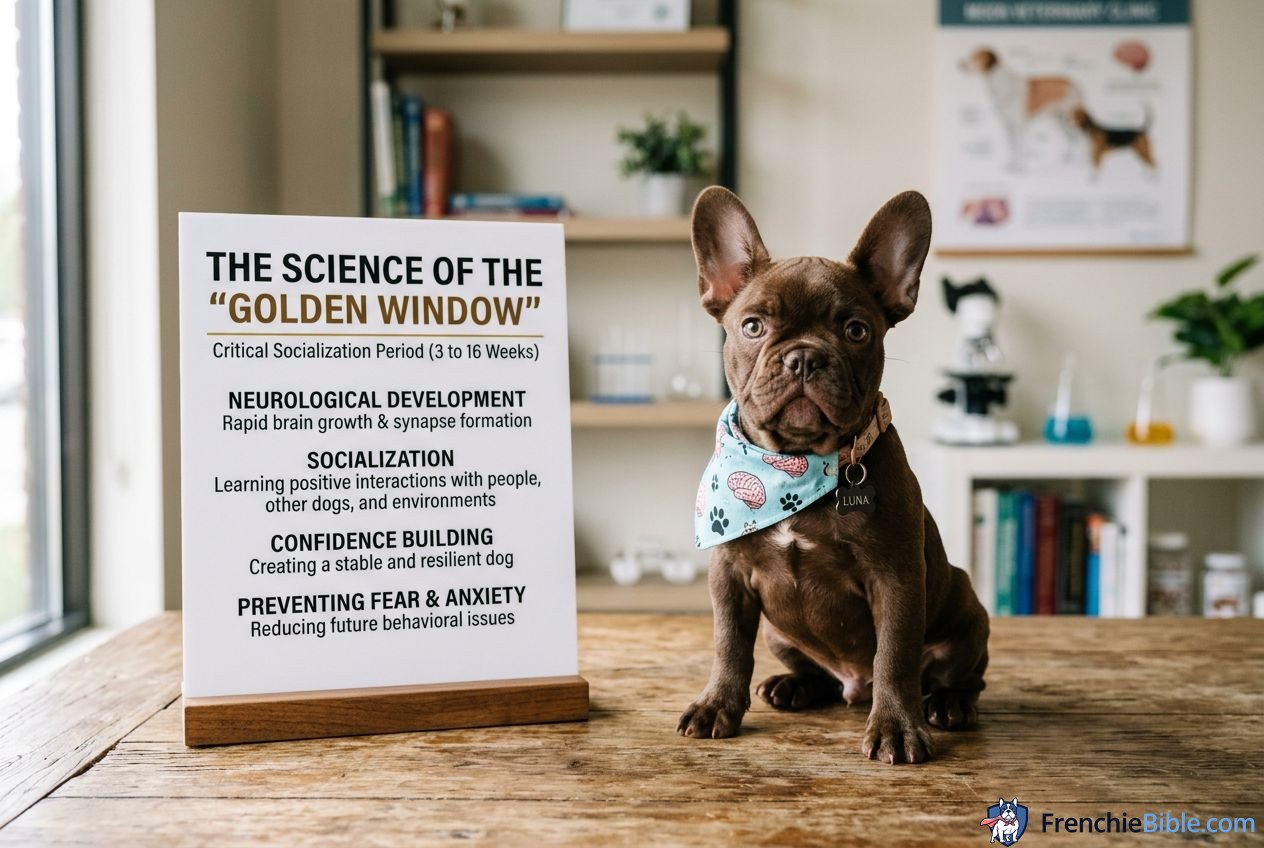
From birth to about 3 weeks, a puppy is basically a sensory input machine. But at around week 3, their senses fully awaken. This marks the beginning of the “Sensitive Period for Socialization.”
During this window (peaking around 8-12 weeks and rapidly closing at 16 weeks), a puppy’s brain is biologically programmed to accept new experiences, sounds, sights, and textures as “normal.” If a puppy encounters a loud vacuum cleaner, a tall man with a beard, or a strange floor texture during this time and nothing bad happens, their brain files it away as “safe.”
The Fear Imprint Period
Conversely, around 8-11 weeks, puppies go through a “Fear Imprint Period.” If they experience severe trauma or are completely isolated during this time, they can develop deep-seated, lifelong phobias.
Once the window slams shut at 16 weeks, their neurological plasticity dramatically decreases. Introducing a 6-month-old dog to a novel, scary stimulus (like a skateboard) is no longer socialization; it is behavior modification, which is exponentially harder, slower, and often less successful.
The Great Vaccine Debate: Socialization vs. Parvovirus
This is the most stressful conflict for new owners. Your veterinarian tells you, “Do not let your puppy touch the ground where other dogs have been until they have all their shots at 16 weeks, or they could catch Parvovirus and die.”
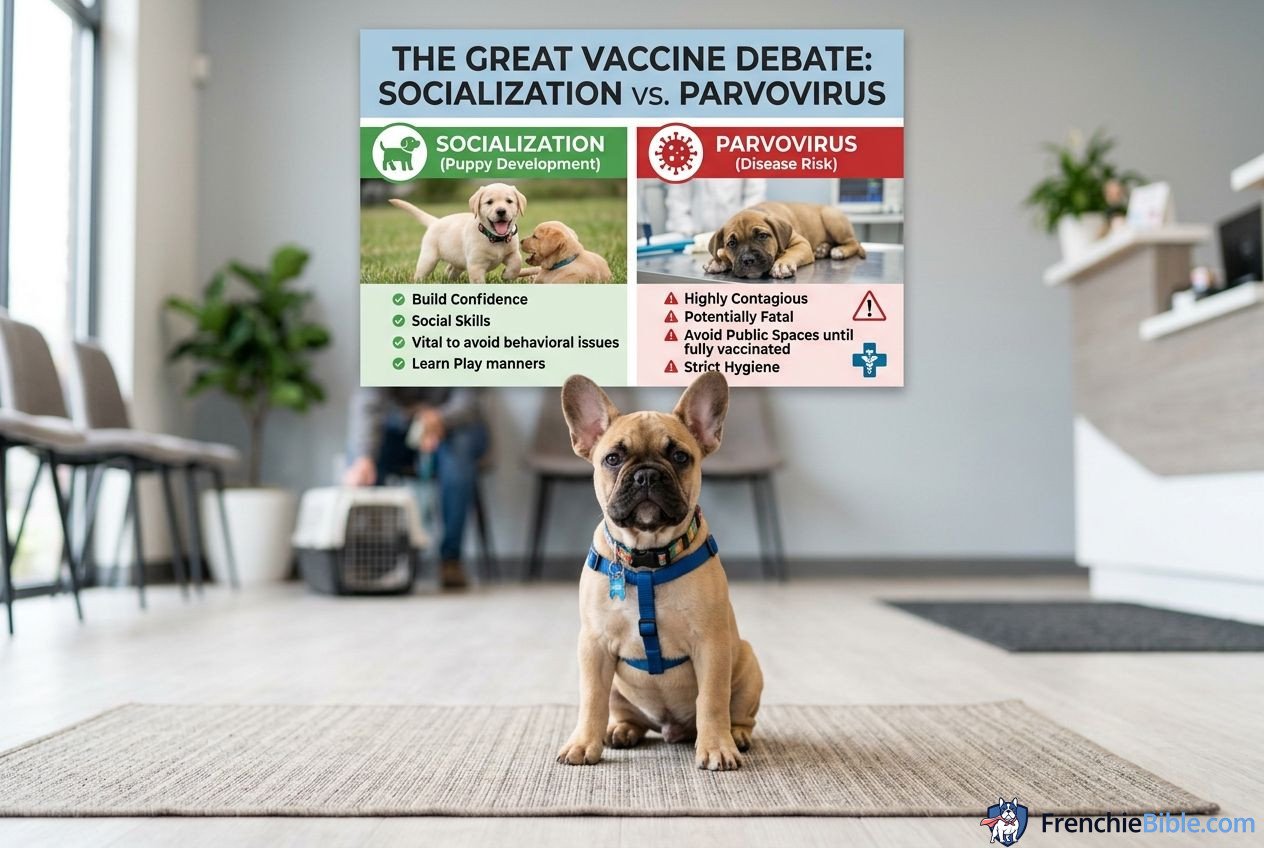
But animal behaviorists tell you, “If you don’t socialize your puppy before 16 weeks, they will develop behavioral problems.”
So, who is right? Both are.
The American Veterinary Society of Animal Behavior (AVSAB) explicitly states that the behavioral risks of not socializing a puppy far outweigh the medical risks of infectious disease. Millions of dogs are euthanized in shelters every year due to severe behavioral issues stemming from a lack of early socialization.
How to Socialize Safely
You must practice “Safe Socialization.” This means exposing your puppy to the world without putting them in high-risk environments.
– DO NOT take your puppy to a public dog park.
– DO NOT let them walk on heavily trafficked city sidewalks.
– DO carry them in a dog sling or backpack through busy areas so they can see and hear the world safely.
– DO set up playdates in your private, fenced backyard with adult dogs that you know are healthy, friendly, and fully vaccinated.
– DO take them for car rides with the windows cracked.
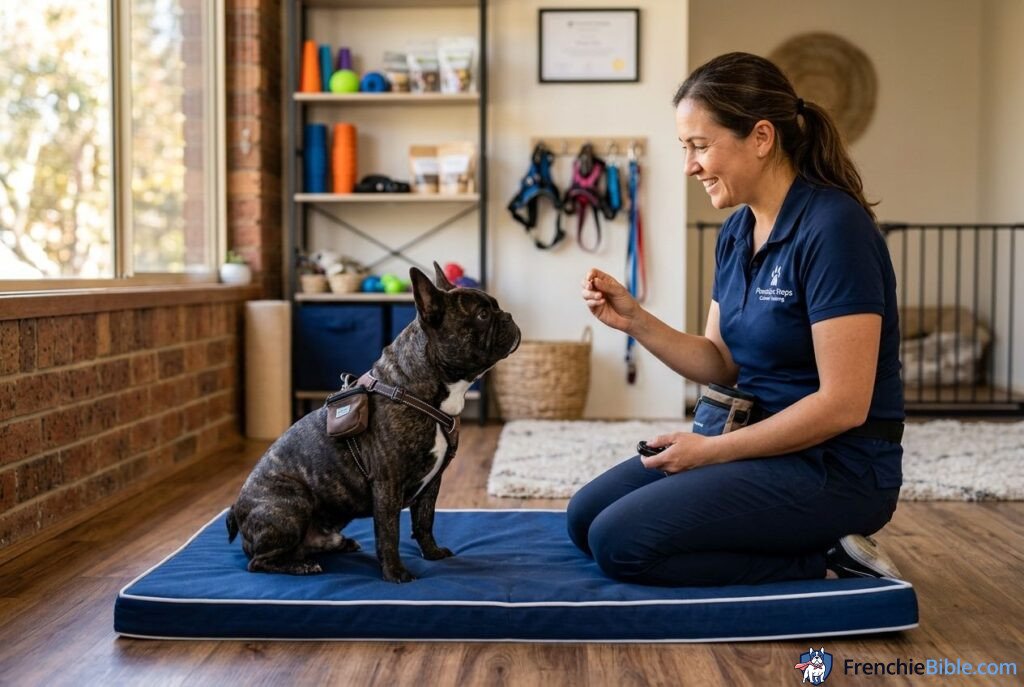
– DO enroll them in a reputable “Puppy Kindergarten” class where the facility requires proof of at least the first round of vaccines and sanitizes their floors.
The Ultimate French Bulldog Socialization Checklist
Your goal is to expose your Frenchie puppy to as many of these stimuli as possible before they hit 16 weeks, ensuring every experience is positive. Bring high-value treats (like tiny pieces of boiled chicken) and reward them constantly while they observe these new things.
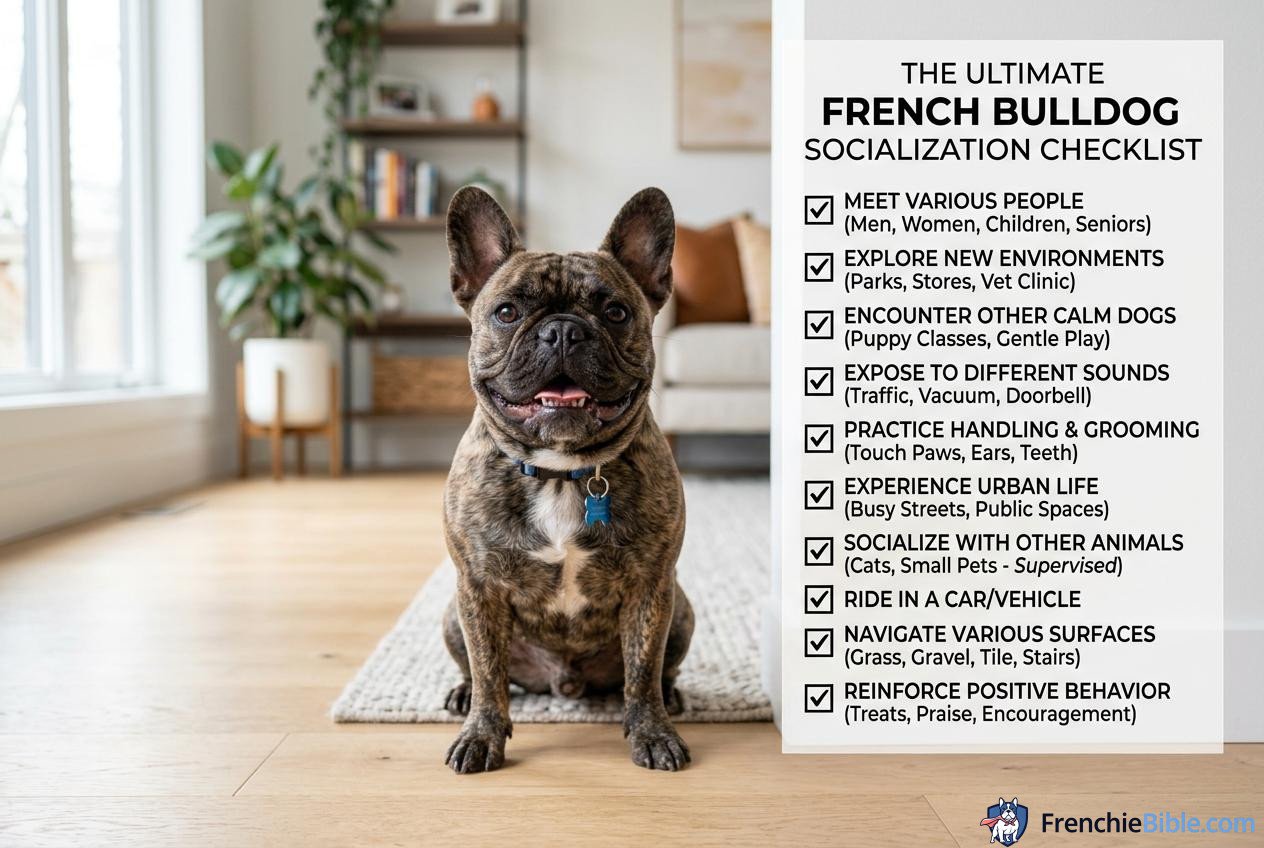
1. People and Appearances
Frenchies are inherently friendly, but they need to learn that humans come in all shapes and sizes. Introduce them to:
– Tall people, short people, men with deep voices.
– People wearing hats, sunglasses, bulky winter coats, and face masks.
– People carrying umbrellas or large boxes.
– Children of various ages (Supervise closely! Ensure the children are calm and do not pull the dog’s ears).
– People with mobility aids (wheelchairs, walkers, crutches, canes).
2. Sounds and Noises
Desensitization to noise is crucial to prevent noise phobias (like fireworks or thunderstorm anxiety).
– Household Sounds: Vacuum cleaners, blenders, hair dryers, washing machines, dropping pots and pans. (Start from a distance and give treats).
– City Sounds: Sirens, garbage trucks, motorcycles, honking horns, construction noise. (Carry them near a busy street and feed them chicken).
– Artificial Sounds: Play YouTube videos of thunderstorms, fireworks, and crying babies at a low volume while they eat, gradually increasing the volume over weeks.
3. Textures and Surfaces
Puppies who only ever walk on carpet can become terrified of slippery floors. Let them explore:
– Hardwood floors, linoleum, and tile.
– Wet grass, dry leaves, dirt, and gravel.
– Metal grates (like manhole covers or storm drains).
– Wobbly surfaces (like a wobble board or a slightly deflated air mattress).
– Stairs (wood, carpeted, and concrete).
4. Handling and Grooming
This is vital for future vet visits and grooming sessions. Touch them everywhere while giving treats.
– Look inside their ears and gently wipe them.
– Open their mouth and touch their teeth and gums.
– Handle their paws, separate their toes, and touch their nails with a metal spoon (to simulate clippers).
– Gently lift their tail and wipe their “tail pocket.”
– Hold them in awkward positions (gently on their back) like a vet would for an exam.
5. Environments and Objects
- Elevators and automatic sliding doors.
- Veterinary clinic lobbies (just go in, get a treat from the receptionist, and leave. Make the vet a happy place!).
- Bicycles, skateboards, scooters, and strollers moving past them.
- Umbrellas opening suddenly.
The Rule of Quality over Quantity
Socialization is not about forcing your puppy into overwhelming situations. If you drag a terrified puppy toward a loud garbage truck while they are panicking, you are not socializing them; you are traumatizing them.
Watch their body language. If their ears are pinned back, their tail is tucked, or they are trying to flee, stop. Move further away from the scary object until they relax. Give them a treat. Let them observe from a safe distance until they feel confident enough to approach on their own.
Conclusion
The first 16 weeks of your French Bulldog’s life dictate their future. By dedicating time, effort, and treats to positive socialization, you are inoculating them against fear, anxiety, and aggression. A well-socialized Frenchie is a joy to take to cafes, a breeze at the vet clinic, and a confident, happy companion for life. Don’t waste the golden window—grab your treats and show them the world.
Frequently Asked Questions (FAQs)
Q1: My Frenchie is already 6 months old and terrified of strangers. Is it too late?
A1: It is never “too late” to help a dog, but the window for easy socialization has closed. You are now looking at counter-conditioning and desensitization, which takes significantly more time and patience. I highly recommend consulting a certified positive-reinforcement behaviorist to help you create a training plan.
Q2: Should I let every dog we meet on walks come up and sniff my puppy?
A2: No. This is a common mistake. You want your puppy to be neutral around other dogs, not obsessed with greeting every single one. Furthermore, on-leash greetings between a puppy and a strange adult dog can easily lead to a fight or a negative experience. Focus on controlled playdates instead.
Q3: Can taking my puppy to a pet store count as socialization?
A3: While a pet store has lots of stimuli, the floors of large chain pet stores are hotbeds for Parvovirus, as many sick or unvaccinated dogs walk through them. If you must go, carry your puppy or put them in a shopping cart with a clean blanket. Do not let them walk on the floor.
Q4: My puppy barks at his reflection in the mirror. How do I fix this?
A4: This is very common during the fear imprint period. Do not make a big deal out of it. Sit near the mirror, call your puppy to you, and give them high-value treats for looking at you instead of the “other dog.” They will eventually realize the reflection is not a threat.
Q5: How many new things should my puppy experience every week?
A5: A good rule of thumb is “The Rule of 7.” By 16 weeks, they should have met 7 different types of people, walked on 7 different surfaces, heard 7 different loud noises, etc. Focus on consistent, positive, daily exposure.