
Disclaimer: The information provided in this comprehensive guide is intended for educational and informational purposes only. It is not a substitute for professional veterinary advice, diagnosis, or treatment. Always consult with your veterinarian before administering any medications, preventatives, or starting any new health regimen for your French Bulldog. Individual dogs have unique health histories, sensitivities, and risk factors that must be evaluated by a qualified veterinary professional.
Welcome, Frenchie parents! Whether you are a brand-new owner bringing home your very first wrinkly, bat-eared puppy, or an experienced French Bulldog enthusiast with a multi-dog household, you already know that this breed is entirely unique. French Bulldogs capture our hearts with their clownish personalities and affectionate nature, but they also require a very specific, tailored approach to their health and wellness.
Related Reading: Training & Behavior | Frenchie Puppy Guide | Best Food for Frenchies
One of the most critical aspects of keeping your French Bulldog healthy, happy, and thriving is a robust, consistent parasite prevention protocol. Parasites—both the ones you can see crawling on their skin and the ones hiding invisibly inside their bodies—pose a significant threat not just to your dog’s comfort, but to their very life.
As a French Bulldog experienced breedererinarian and breeding expert, I have seen firsthand the devastation that preventable parasites can cause. I have also seen the confusion and anxiety that owners face when staring at the overwhelming array of chews, topical drops, and collars lining the shelves of pet stores and veterinary clinics. “Which one is safe for a Frenchie?” “Do I really need all of these?” “What about the natural options?”
In this ultimate deworming guide, we are going to demystify the world of flea, tick, and internal parasite preventatives. We will break down exactly what you need to protect your French Bulldog against, how to choose the safest and most effective products specifically suited for their unique physiology, and how to build a preventative schedule that gives you total peace of mind.
The Unique Physiology of the French Bulldog: Why Parasite Prevention is Different
Before we dive into the specific bugs and the drugs used to kill them, we must first understand why we cannot just grab any generic dewormer off the shelf for a French Bulldog.
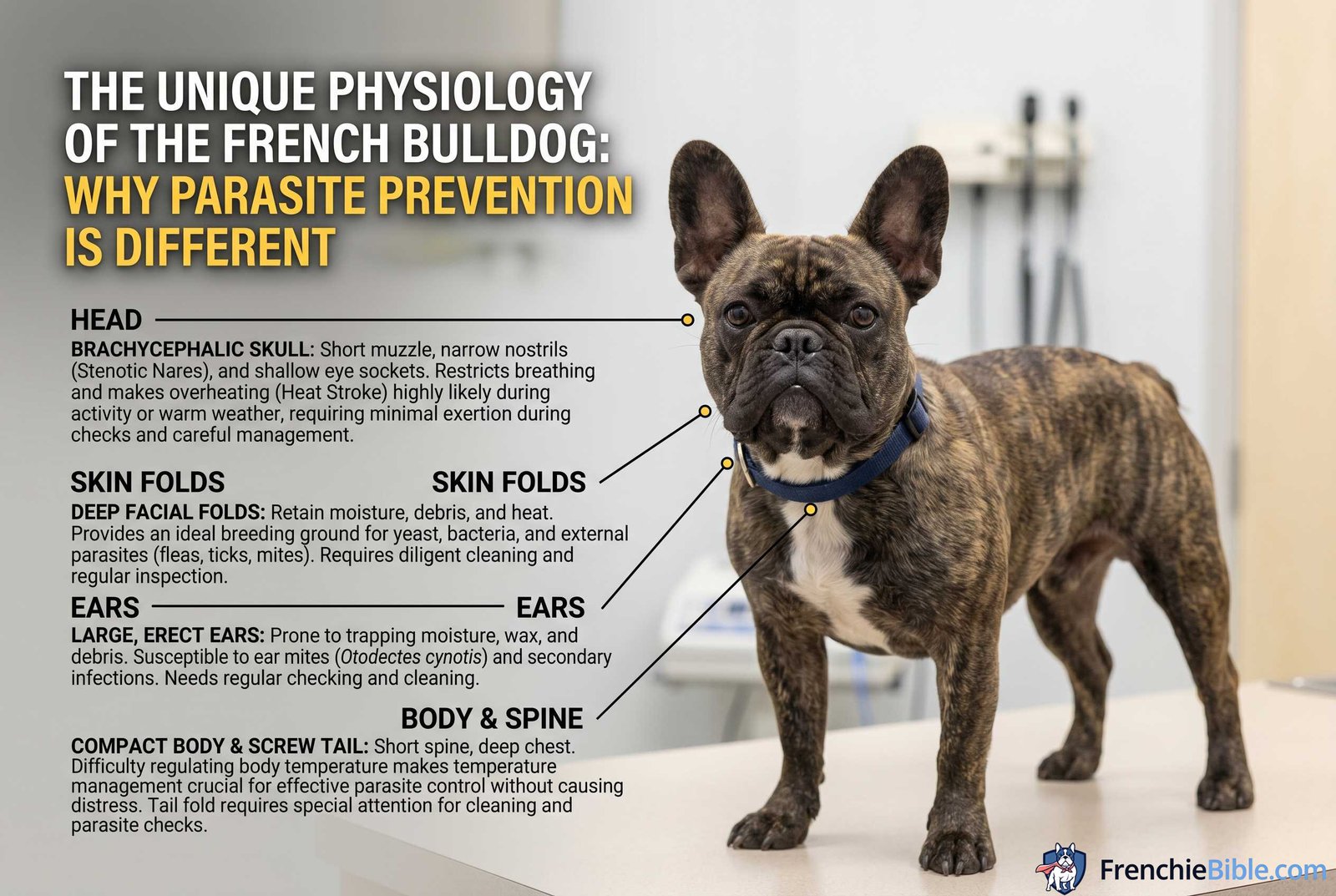
French Bulldogs are a brachycephalic (flat-faced) breed. This anatomical distinction doesn’t just affect their breathing; it impacts their entire systemic health. Their compromised airways mean that any illness that taxes their respiratory or cardiovascular system—such as Heartworm disease—is exponentially more dangerous for them than for a dog with a standard snout. A mild respiratory infection caused by migrating roundworm larvae can quickly escalate into a life-threatening pneumonia in a Frenchie.
Furthermore, French Bulldogs are notoriously prone to skin allergies, sensitivities, and dermatological issues. Their skin is often sensitive, and the deep folds around their face and tail pocket are perfect breeding grounds for yeast and bacteria. When a Frenchie gets bitten by a flea, they are highly susceptible to Flea Allergy Dermatitis (FAD). Just one single flea bite can send a French Bulldog into a frenzy of scratching, leading to severe hair loss, open sores, and secondary bacterial infections that take weeks and expensive antibiotics to resolve.
Finally, French Bulldogs can have sensitive gastrointestinal tracts. Some oral preventatives that are perfectly tolerated by a Labrador might cause severe vomiting, diarrhea, or inappetence in a Frenchie. Therefore, selecting the right preventative requires balancing maximum efficacy against parasites with maximum safety and tolerability for your specific dog.
Understanding the Enemy: Internal Parasites (Endoparasites)
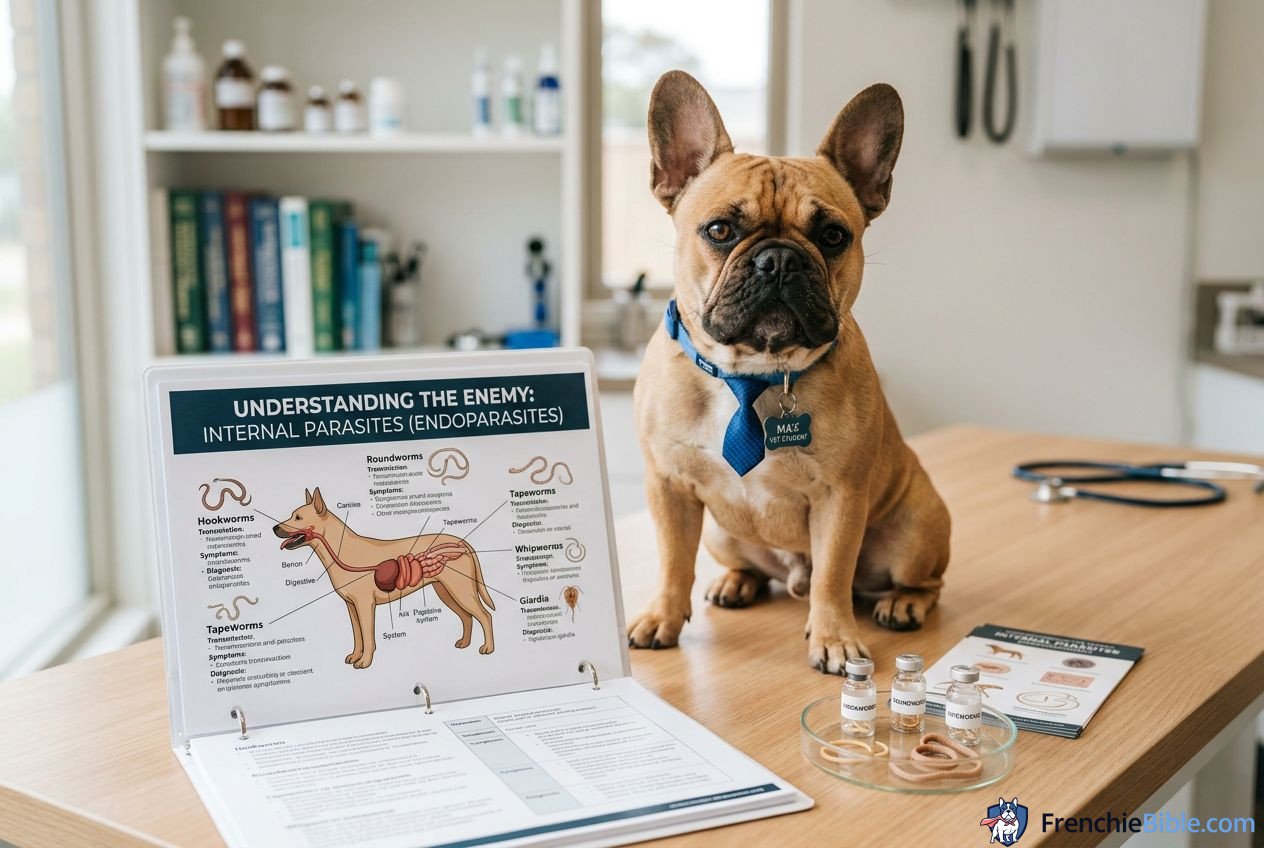
Internal parasites live inside your dog’s body, most commonly in the intestinal tract or, in the case of heartworms, in the heart and lungs. Because you rarely see them (until a severe infestation occurs), they are often out of sight and out of mind. However, they are silently stealing your dog’s nutrients, damaging internal organs, and potentially shedding eggs into your home environment, which can sometimes pose a risk to human family members (zoonosis).
Heartworms (Dirofilaria immitis)
Heartworms are, without a doubt, the most dangerous parasite your French Bulldog can encounter. They are transmitted by mosquitoes. When an infected mosquito bites your dog, it injects microscopic larvae into the bloodstream. Over several months, these larvae migrate to the heart and pulmonary arteries, growing into foot-long worms that physically block blood flow and cause severe, irreversible damage to the heart and lungs.
Why it’s worse for Frenchies: As mentioned, French Bulldogs already have compromised airways (Brachycephalic Obstructive Airway Syndrome, or BOAS). Heartworms cause pulmonary hypertension and right-sided heart failure. A Frenchie with heartworms will experience severe respiratory distress much faster than a breed with normal airways. Treatment for active heartworm infection is brutal, involving deep intramuscular injections of an arsenic-based compound, strict cage rest for months, and a high risk of fatal pulmonary embolisms. Prevention is absolutely non-negotiable.
Roundworms (Toxocara canis)
Roundworms are large, spaghetti-like worms that live in the intestines. They are incredibly common, especially in puppies. Puppies can contract them from their mother in utero or through her milk. Adult dogs can get them by ingesting infected soil, feces, or small prey.
Symptoms: Pot-bellied appearance in puppies, diarrhea, vomiting, dull coat, and poor weight gain. In severe cases, the migrating larvae can cause respiratory issues as they pass through the lungs.
Human Risk: Yes. Roundworm eggs in the environment can be ingested by humans (often children playing in dirt), leading to a condition called Visceral Larva Migrans, which can cause organ damage and even blindness.
Hookworms (Ancylostoma caninum)
Hookworms are tiny but vicious. They attach themselves to the lining of the intestinal wall using sharp, hook-like mouthparts and feed on your dog’s blood. They can be contracted through ingestion or by larvae in the soil burrowing directly through the dog’s skin (often the paws).
Symptoms: Severe anemia (pale gums, lethargy), dark, tarry stools (melena), weight loss, and weakness. Because French Bulldogs are small, a heavy hookworm burden can cause life-threatening blood loss very quickly.
Human Risk: Yes. Hookworm larvae can penetrate human skin, causing an itchy skin condition known as Cutaneous Larva Migrans.
Whipworms (Trichuris vulpis)
Whipworms live in the large intestine and cecum. They are contracted by ingesting eggs from contaminated soil. Whipworm eggs are incredibly resilient and can survive in the environment for years.
Symptoms: Chronic, watery diarrhea, often containing mucus or fresh blood; weight loss; and overall unthriftiness. They are harder to diagnose than other worms because they shed eggs sporadically.
Tapeworms (Dipylidium caninum)
Tapeworms are long, flat, segmented worms. The most common way dogs get tapeworms is by ingesting an infected flea (usually while chewing or licking themselves because they are itchy).
Symptoms: You will rarely see the whole worm. Instead, you will see small, rice-like segments (proglottids) around your dog’s anus, in their feces, or in their bedding. These segments contain the eggs. Tapeworms usually do not cause severe illness but can cause weight loss, poor nutrient absorption, and an itchy rear end (scooting).
Giardia and Coccidia
While technically protozoan parasites (single-celled organisms) rather than “worms,” they are common internal invaders, especially in puppies or dogs that frequent dog parks or drink from puddles. They cause severe, intractable diarrhea. Standard monthly dewormers do not cover these; they require specific, targeted prescription medications (like Fenbendazole or your veterinarian may recommend a antibiotic medication (never use without veterinary guidance) for Giardia, and Albon for Coccidia) upon diagnosis via a fecal test.
Understanding the Enemy: External Parasites (Ectoparasites)
External parasites live on the skin and coat of your Frenchie. They cause intense discomfort, transmit deadly diseases, and can quickly infest your home.
Fleas
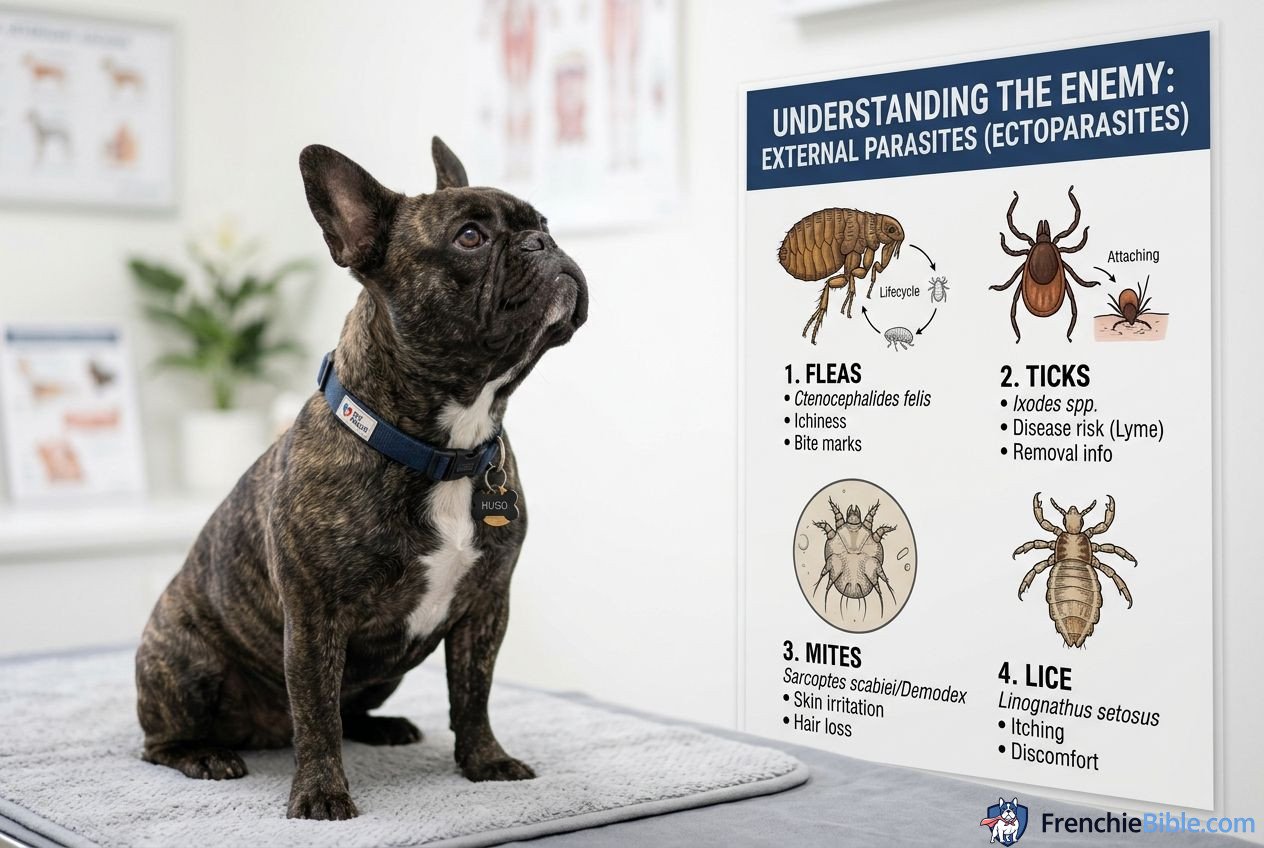
Fleas are agile, blood-sucking insects. They reproduce at an astonishing rate; a single female flea can lay up to 50 eggs a day. By the time you see one flea on your dog, there are likely hundreds of eggs, larvae, and pupae hiding in your carpets, furniture, and baseboards.
The Frenchie Factor: As highlighted earlier, French Bulldogs are prone to Flea Allergy Dermatitis (FAD). Their immune system hyper-reacts to the proteins in the flea’s saliva. This leads to intense, agonizing itching, frantic chewing at the base of the tail, groin, and armpits, resulting in raw, bleeding hot spots and staph infections. Furthermore, fleas transmit tapeworms and, in severe infestations (especially in puppies), can cause life-threatening anemia.
Ticks
Ticks are arachnids that latch onto your dog’s skin to gorge on their blood. They are typically picked up in wooded areas, tall grasses, or even your own backyard if you have wildlife passing through.
The Danger: Ticks are vectors for a multitude of serious, sometimes fatal, tick-borne diseases. The most notorious is Lyme disease, but they also carry Ehrlichiosis, Anaplasmosis, and Rocky Mountain Spotted Fever. These diseases can cause chronic joint pain, fever, kidney failure, and bleeding disorders. Finding a tick hidden in the dense fur or deep skin folds of a Frenchie can be challenging, making robust prevention crucial.
Mites (Demodex and Sarcoptes)
- Demodex (Demodectic Mange): These microscopic mites naturally live in the hair follicles of all dogs in small numbers. However, if a Frenchie’s immune system is compromised (common in puppies or stressed dogs), the mites rapidly multiply, causing localized or generalized hair loss, scaling, and redness. It is not typically contagious to other dogs or humans.
- Sarcoptes (Sarcoptic Mange / Scabies): This is highly contagious between dogs and can temporarily infect humans. It causes an intense, maddening itch, thick crusty skin, and hair loss.
Choosing the Right Preventatives for Your French Bulldog
Now that we know what we are fighting, how do we choose the right weapons? The market offers topicals (spot-ons), oral chews, and collars. The “best” choice depends on your geographic location, your dog’s lifestyle, and their individual health profile.

1. Oral Chews vs. Topical Spot-Ons
Oral Preventatives (Chews/Pills):
– Pros: Extremely effective, fast-acting, and completely waterproof. You don’t have to worry about bathing your dog or them swimming right after application. There is no messy residue on the coat, which is great if you have children who frequently hug and cuddle the dog. Many oral medications belong to the Isoxazoline class, which are highly effective against fleas and ticks, and some even treat mange mites off-label.
– Cons: Because they are ingested, they can cause gastrointestinal upset in sensitive Frenchies (vomiting or diarrhea). Furthermore, the Isoxazoline class of drugs (e.g., Bravecto, NexGard, Simparica, Credelio) has been associated with rare neurological side effects, including muscle tremors, ataxia, and seizures. While the incidence is very low, if your Frenchie has a history of seizures or epilepsy, these should generally be avoided.
Topical Preventatives (Spot-ons applied to the back of the neck):
– Pros: They do not pass through the gastrointestinal tract, making them a better choice for Frenchies with sensitive stomachs. Some topicals have a “repellent” effect (like those containing Permethrin), meaning the flea or tick doesn’t have to bite the dog to die. They are generally considered safe for dogs with a history of seizures.
– Cons: Can be messy and leave a greasy spot on the coat for a few days. You must adhere to strict bathing restrictions (usually no baths 48 hours before or after application). If the dog gets excessively wet, efficacy may be reduced. Some Frenchies have sensitive skin and may experience chemical burns, redness, or hair loss at the application site.
2. The Great Debate: All-in-One vs. Separate Products
Veterinary pharmaceutical companies have developed incredible combination products designed to target both internal and external parasites simultaneously. But is this the best approach for a Frenchie?
The “All-in-One” Approach
Products like Simparica Trio or NexGard PLUS combine an Isoxazoline (for fleas/ticks) with an anthelmintic (like Moxidectin or Milbemycin oxime for heartworms and intestinal worms).
– The Good: Unbeatable convenience. One chew, once a month, covers almost everything. It guarantees compliance, meaning you won’t forget one of the medications.
– The Bad: You are delivering a large payload of multiple chemicals into the dog’s system all at once. For a sensitive Frenchie, this can sometimes overload their system, leading to lethargy, GI upset, or allergic reactions. If your dog has an adverse reaction, it is harder to pinpoint exactly which chemical caused it.
The “Separate Products” Approach
This involves giving a dedicated heartworm/intestinal worm preventative (like Heartgard Plus or Interceptor Plus) and a separate flea/tick preventative (like NexGard, Bravecto, or a topical like Frontline or Advantage).
– The Good: This is often the preferred method for sensitive breeds like French Bulldogs. It allows you to stagger the medications. For example, give the heartworm chew on the 1st of the month, and the flea/tick preventative on the 15th. This reduces the chemical burden on the dog’s liver and immune system on any given day. It also allows you to customize: you can choose a very mild oral heartworm med and pair it with a topical flea/tick drop if your dog’s stomach is too sensitive for oral Isoxazolines.
– The Bad: Requires more organization. You have to remember two dates and buy two different products.
3. A Closer Look at Popular Heartworm & Internal Dewormers
- Heartgard Plus (Ivermectin/Pyrantel): A classic, highly trusted “beef chew.” Very gentle on the stomach and effectively prevents heartworms, roundworms, and hookworms. It does not cover whipworms or tapeworms. Generally very safe for Frenchies.
- Interceptor Plus (Milbemycin oxime/Praziquantel): Provides broader intestinal coverage than Heartgard. It prevents heartworms and treats roundworms, hookworms, whipworms, and tapeworms. An excellent choice if your dog frequents areas with high tapeworm or whipworm prevalence.
- ProHeart 6 or 12: An injectable heartworm preventative given by the vet that lasts 6 or 12 months. It is convenient but does not cover intestinal worms (except hookworms at the time of injection). If your dog has a severe adverse reaction, the drug cannot be removed from their system, which makes some owners of sensitive Frenchies hesitant.
4. A Closer Look at Popular Flea & Tick Preventatives
- NexGard / Simparica / Credelio (Oral Isoxazolines): Monthly chews. Highly effective, fast-acting. Great for managing FAD and Demodex mites. Caution: Use with extreme care or avoid in Frenchies with a history of seizures or severe neurological issues.
- Bravecto (Oral or Topical): Lasts for 12 weeks (3 months) per dose. Highly convenient, but again, belongs to the Isoxazoline class. Some owners prefer monthly doses so that if a reaction occurs, the drug clears the system faster than a 3-month dose.
- Advantage Multi / Revolution (Topical): These are interesting because they are topicals that absorb systemically to prevent heartworms and intestinal worms, plus fleas and some mites (like ear mites and sarcoptes). They do not generally cover ticks effectively. Good for dogs that absolutely refuse to eat oral chews.
- Seresto Collar: A long-lasting (8 months) collar that repels and kills fleas and ticks. It can be a good option for tick-heavy areas. However, because Frenchies have thick necks and skin folds, ensuring the collar makes proper skin contact without causing chafing or local irritation can sometimes be tricky.
Creating a Deworming Schedule for Your French Bulldog
The “perfect” schedule does not exist in a vacuum; it must be tailored by your veterinarian based on your location and dog’s lifestyle. However, here are the gold standard guidelines:
Puppies (0-6 Months)
Puppies are extremely vulnerable to heavy worm burdens.
– 2, 4, 6, and 8 weeks of age: Breeders should deworm puppies using a gentle liquid dewormer like Pyrantel Pamoate (Strongid) to clear out roundworms and hookworms.
– 8-10 weeks: Upon taking your puppy home, your vet will perform a fecal exam. They will likely prescribe a broad-spectrum dewormer if parasites are found. This is also when monthly heartworm prevention (like Heartgard Plus or Interceptor Plus) MUST begin.
– 10-12 weeks: Start monthly flea and tick prevention, choosing a product safe for puppies of their specific weight.
Adult Frenchies (6 Months and Older)
- Heartworm Prevention: YEAR-ROUND, regardless of where you live. Mosquitoes can survive in basements and microclimates even in winter.
- Intestinal Deworming: If using a product like Heartgard Plus or Interceptor Plus, they are being dewormed for common intestinal parasites every month.
- Flea/Tick Prevention: Year-round is strongly recommended, as ticks emerge on any day the temperature rises above freezing, and fleas thrive indoors year-round.
- Annual Testing: Your Frenchie must have a blood test for heartworms and tick-borne diseases, and a fecal flotation test for intestinal parasites at least once a year, even if they are on preventatives year-round. No preventative is 100% effective, and resistance can occur.
How to Administer Medications Safely to a Stubborn Frenchie
French Bulldogs are famously stubborn and can be incredibly suspicious of pills.
1. The “Meatball” Method: Wrap the pill completely in something high-value and sticky, like a small piece of pill putty, a cube of plain cheese, or a dab of dog-safe peanut butter (ensure it is strictly Xylitol-free!). Give them a “blank” meatball first, then the loaded one, then another blank one rapidly.
2. Don’t Make It a Big Deal: Dogs read our body language. If you approach them nervously holding a pill, they will refuse it. Be casual.
3. Topical Application: Part the hair on the back of the neck, between the shoulder blades (where they cannot reach to lick it). Squeeze the liquid directly onto the skin, not the hair. Do not rub it in.
Signs Your French Bulldog May Have Parasites
Despite your best efforts, breakthrough infections can happen. Monitor your Frenchie closely for these clinical signs:
– Persistent scratching, biting, or licking, especially at the base of the tail or paws.
– “Flea dirt” (looks like black pepper) on the skin, often visible on their belly.
– Visible worms or rice-like segments in the stool or around the anus.
– Unexplained weight loss despite a normal appetite.
– A dull, dry, or brittle coat.
– Chronic soft stools, diarrhea, or mucus/blood in the stool.
– Lethargy, weakness, or pale gums (signs of anemia).
– A chronic, soft cough or exercise intolerance (classic signs of heartworm disease).
– Scooting their rear end across the floor (though this can also indicate full anal glands).
The Dangers of “Natural” or Over-the-Counter Alternatives
Many well-meaning owners look for natural alternatives like garlic, diatomaceous earth, or essential oils to prevent parasites, fearing the chemicals in veterinary products.
As a professional, I must issue a strong warning:
– Garlic is toxic to dogs in large amounts and does not effectively repel fleas or heartworms.
– Diatomaceous Earth (DE) is an inhalation hazard. If your Frenchie breathes in DE powder, it can severely damage their sensitive lungs. Furthermore, it only kills fleas in the environment, not those actively feeding on the dog, and does nothing for internal parasites.
– Essential Oils (like tea tree or clove) can be highly toxic to dogs, causing liver damage or neurological issues, and their efficacy as repellents is incredibly weak compared to medical-grade preventatives.
– Over-the-Counter (OTC) grocery store brands (like cheap flea collars or drops) often use older, harsher chemicals (like pyrethrins) that are less effective due to parasite resistance and carry a higher risk of toxic reactions. Always buy preventatives directly from your veterinarian or An Experienced Breeder-approved pharmacy.
Conclusion
Protecting your French Bulldog from parasites is a lifelong commitment, but it doesn’t have to be overwhelming. Because of their unique physiological quirks—sensitive airways, delicate skin, and sometimes finicky digestive tracts—careful selection of preventatives is paramount.
For the average Frenchie, a strategy that staggers a monthly oral heartworm/intestinal preventative and a high-quality flea/tick preventative offers maximum protection with minimum systemic stress. Always maintain a close, communicative relationship with your veterinarian. Discuss your dog’s lifestyle, any history of allergies or neurological issues, and work together to build a customized fortress of protection around your beloved bat-pig. By staying vigilant and consistent, you ensure your Frenchie enjoys a long, comfortable, itch-free, and healthy life by your side.
Frequently Asked Questions (FAQs)
1. My French Bulldog strictly lives indoors and only goes out for potty breaks. Do I really need to give them preventatives?
Yes, absolutely. Mosquitoes (which carry heartworms) easily enter homes through open doors, windows, or tears in screens. You can track flea eggs or larvae into the house on your shoes. Wildlife in your yard can drop ticks in the grass where your dog potties. Indoor dogs are absolutely at risk and require year-round protection against parasites.
2. Is it safe to give my Frenchie an oral flea and tick chew if they have a history of seizures?
Generally, veterinarians recommend avoiding medications in the Isoxazoline class (such as NexGard, Bravecto, Simparica, and Credelio) if a dog has a known history of seizures or epilepsy, as these drugs have been associated with neurological adverse events in rare cases. In these situations, your vet will likely recommend a safe topical preventative or a collar instead. Always disclose your dog’s full medical history to your vet before starting a new medication.
3. I see small, white, moving rice-like things in my Frenchie’s poop. What are they?
These are very likely tapeworm segments (proglottids). Tapeworms are most commonly contracted when your dog ingests an infected flea while grooming or chewing an itchy spot. You will need to get a specific dewormer from your vet containing Praziquantel to kill the tapeworms, and you must also address the underlying flea issue to prevent reinfection.
4. Can I use my other dog’s leftover dewormer on my French Bulldog puppy?
Never. Deworming medications are strictly dosed by weight. Giving a puppy a dose intended for a larger dog can result in severe, potentially fatal toxicity. Furthermore, puppies require different deworming protocols than adult dogs. Always consult your vet for the correct product and dosage for your puppy’s current weight.
5. Why is my Frenchie throwing up after taking their monthly parasite chew?
Some French Bulldogs have sensitive stomachs that react to the flavoring, binders, or the active medication in oral chews. Try giving the chew with a full meal rather than on an empty stomach. If the vomiting persists, speak to your veterinarian. They may recommend switching to a different brand of chew, separating the medications (giving heartworm on the 1st and flea/tick on the 15th), or switching to a topical application that bypasses the gastrointestinal tract entirely.
Disclaimer: I am a French Bulldog breeding expert with over a decade of hands-on experience with this breed. I am not An Experienced Breedererinarian. The information in this article is for educational purposes only. Always consult your veterinarian regarding your dog’s specific health needs and care.
Disclaimer: I am a French Bulldog breeding expert with over a decade of hands-on experience with this breed. I am not a veterinarian. The information in this article is for educational purposes only. Always consult your veterinarian regarding your dog’s specific health needs and care.