

French Bulldogs are widely celebrated for their charming, affectionate, and comical personalities. As a breed, they are deeply devoted to their human families, often earning the nickname “Velcro dogs” due to their intense desire to be by your side at all times. However, this profound attachment, combined with their unique physical and psychological traits, can sometimes manifest in a highly frustrating behavioral issue: constant whining and crying.
If your French Bulldog is whining incessantly, it can be a distressing experience for both you and your pet. It disrupts your peace, causes anxiety for the owner, and clearly indicates that the dog is experiencing some form of physical or emotional discomfort. as a French Bulldog expert and breeder and breeding expert, I often hear from exasperated owners who are at their wits’ end, asking, “Why won’t my Frenchie stop crying?”
Related Reading: Health & Diet | Frenchie Puppy Guide
The crucial first step in addressing this vocalization is understanding that whining is a form of communication. Your dog is not trying to annoy you out of spite; they are attempting to express a need, a fear, or a physical ailment. Punishing a whining dog without addressing the root cause is not only ineffective but can severely damage the human-animal bond and exacerbate the underlying anxiety.
In this comprehensive guide, we will delve deep into the five primary reasons why your French Bulldog might be whining or crying constantly. We will explore the medical, psychological, and environmental factors from both An Experienced Breedererinary and behavioral standpoint. Furthermore, we will provide a detailed, step-by-step masterclass on how to teach the ‘Quiet’ command, alongside holistic strategies to bring peace and harmony back to your household.
The Unique Vocal Nature of French Bulldogs: Are They Naturally Noisy?
Before we dive into the pathological reasons for whining, it is essential to establish a baseline for normal French Bulldog vocalization. Frenchies are not typically “barky” dogs like terriers or hounds. However, they are far from silent.

Due to their brachycephalic (flat-faced) anatomy, French Bulldogs produce a wide array of sounds that are entirely normal for the breed. These include snorts, grunts, snoots, gargles, and the famous “Frenchie yodel” or “death wail” (a dramatic, high-pitched yawning sound often made when they are excited or stretching). These sounds are primarily a result of their elongated soft palates, narrow tracheas, and stenotic nares (pinched nostrils), which create turbulence as air passes through their airways.
Therefore, as an owner, you must learn to differentiate between normal breed-specific vocalizations and problem whining. Normal grumbles usually happen during play, when settling down to sleep, or when seeking gentle attention. In contrast, constant whining, high-pitched crying, pacing while vocalizing, or whining accompanied by destructive behavior points to an underlying issue that requires immediate attention.
When vocalization shifts from occasional, situational communication to a relentless, repetitive behavior, it is time to investigate the five core reasons outlined below.
5 Main Reasons Your French Bulldog is Whining or Crying Constantly
Understanding the “why” is the foundation of any successful behavioral modification plan. Here are the top five reasons your Frenchie is crying, ranked from psychological to physiological triggers.
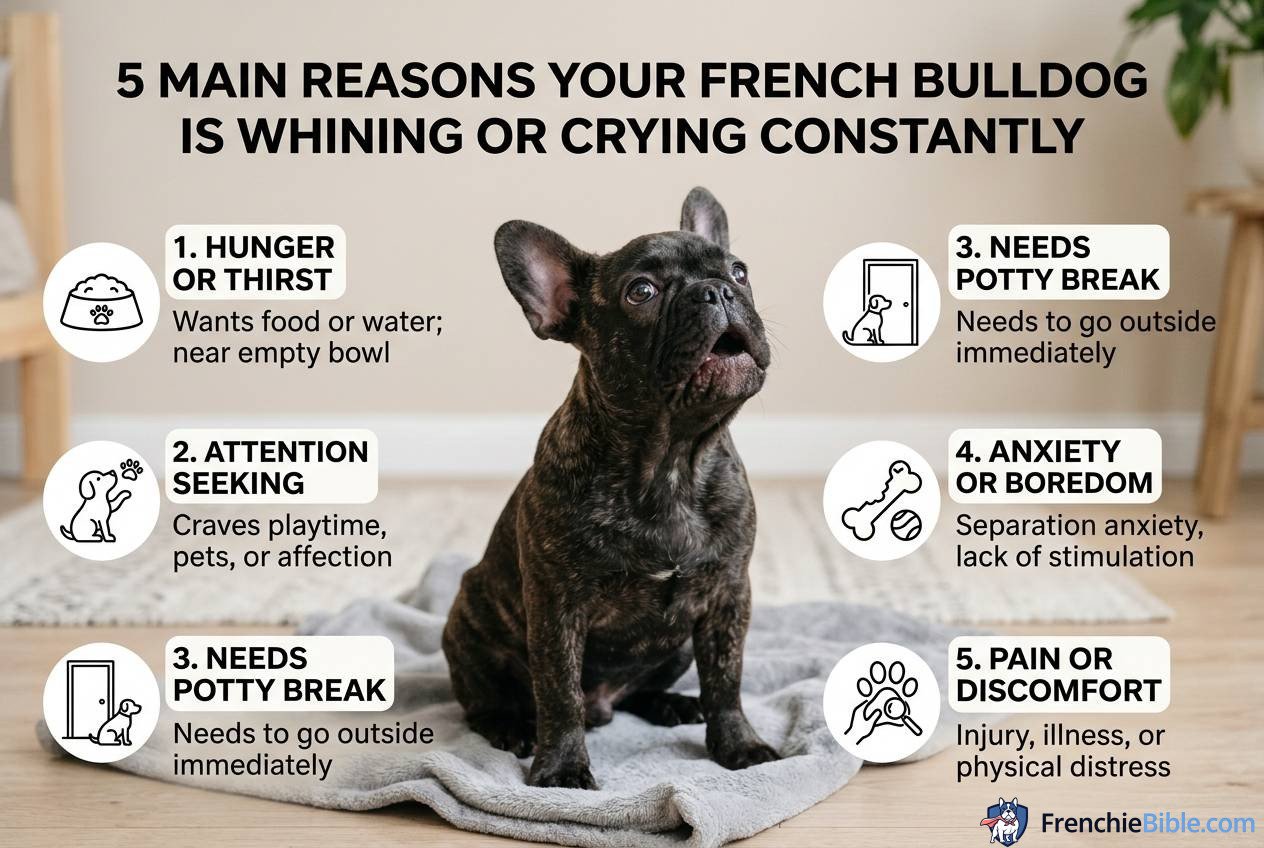
1. Attention-Seeking Behavior and True Separation Anxiety
The most common psychological reason for whining in French Bulldogs is related to their intense bond with their owners. Frenchies were bred specifically to be companion animals. They thrive on human interaction and can suffer deeply when isolated.
Demand Whining (Attention-Seeking):
French Bulldogs are highly intelligent and remarkably stubborn. They quickly learn cause-and-effect relationships. If your Frenchie whines and you respond by looking at them, talking to them (even to say “no”), petting them, or giving them a toy to quiet them down, you have inadvertently rewarded the behavior. This creates a cycle of “demand whining.” The dog learns, “When I make this high-pitched noise, the human drops everything and pays attention to me.” Demand whining is usually characterized by the dog staring directly at you, pausing to see if you react, and then escalating the noise if you ignore them.
Separation Anxiety:
While demand whining is manipulative, true separation anxiety is a state of sheer panic. Because they are “Velcro dogs,” Frenchies can develop severe hyper-attachment. When left alone, or even when physically separated by a door within the same house, they may experience profound distress. Whining associated with separation anxiety is rarely isolated. It is typically accompanied by other severe signs such as:
- Pacing and panting heavily.
- Excessive drooling and hypersalivation.
- Destructive behavior, specifically around exit points (scratching at doors or windows).
- Inappropriate elimination (urinating or defecating indoors despite being potty trained).
- Non-stop, high-pitched vocalization that continues the entire time you are gone.
2. Underlying Pain, Illness, or Physical Discomfort
as a French Bulldog expert and breeder, I cannot stress this point enough: Any sudden onset of behavioral change, including excessive whining, must first be evaluated for underlying medical causes.
French Bulldogs are notorious for being remarkably stoic. They often mask pain exceptionally well, a trait inherited from their bulldog ancestors. Therefore, whining might be the only subtle clue they give you that something is medically wrong.
Common medical issues in Frenchies that manifest as whining include:
- Intervertebral Disc Disease (IVDD): Frenchies are chondrodystrophic dogs, making them highly susceptible to spinal disc issues. A dog with early-stage IVDD may whine when picked up, when trying to jump onto the sofa, or may just stand frozen and cry due to sharp nerve pain.
- Brachycephalic Obstructive Airway Syndrome (BOAS): If your dog is struggling to breathe, especially during sleep or mild exercise, they may whine out of panic and distress. Oxygen deprivation is terrifying, and a dog waking up gasping for air will often cry out.
- Gastrointestinal Distress: Frenchies have sensitive stomachs and are prone to food allergies and inflammatory bowel disease. Abdominal cramping, gas pain, or nausea can lead to pacing, lip smacking, and persistent whining.
- Ear Infections (Otitis) and Allergies: Chronic itching from skin allergies or the deep, throbbing pain of an ear infection can drive a dog to whine incessantly as they try to find relief.
- Corneal Ulcers: Their prominent, bulging eyes are prone to scratches. Eye pain is excruciating, and a Frenchie with a scratched cornea will often squint, tear up, and whine.
3. Boredom and Lack of Mental/Physical Stimulation
There is a common misconception that French Bulldogs are purely “couch potatoes.” While they do not require the marathon running of a Border Collie, they are active, sturdy, and intelligent dogs that require daily physical exercise and, crucially, mental enrichment.
If a Frenchie is left alone in an apartment for 10 hours a day with nothing but a food bowl and a plush toy, they will lose their minds to boredom. Pent-up energy has to go somewhere. In the absence of an outlet, that energy morphs into frustration, pacing, destructive chewing, and—you guessed it—incessant whining.
Boredom whining is essentially the dog sighing heavily and saying, “I have nothing to do, I am frustrated, and I want you to entertain me.” If your dog has only had a quick five-minute walk to the end of the block and back, their whining is a direct result of being under-stimulated.
4. Environmental Stressors, Fear, or Anxiety
French Bulldogs can be surprisingly sensitive to changes in their environment. A dog that feels insecure or frightened will use whining as a coping mechanism and a plea for comfort.
Common environmental triggers include:
- Noise Phobias: Thunderstorms, fireworks, construction noises, or even a new loud appliance can trigger extreme anxiety.
- Changes in the Household: Bringing home a new baby, adopting another pet, having houseguests, or moving to a new home disrupts their routine and causes stress.
- Tension in the Home: Dogs are incredibly empathetic. If there is yelling, stress, or tension among the human family members, your Frenchie will absorb that energy and may pace and whine in response.
- Resource Guarding Fear: Sometimes, whining occurs when a dog is anxious about someone taking their high-value chew or toy, expressing a state of fearful conflict.
When whining is fear-based, you will also notice specific canine stress signals: tightly pinned ears, a tucked tail, “whale eye” (showing the whites of their eyes), lip licking, yawning when not tired, and trembling.
5. Need to Potty or Basic Unmet Needs (Hunger/Thirst)
Sometimes, the answer is the simplest one. Your dog may be whining because a fundamental biological need is not being met.
- The Potty Dance: If your normally quiet Frenchie starts pacing toward the front door, spinning in circles, and letting out short, sharp whines, they urgently need to relieve themselves. This is particularly common in puppies whose bladder control is still developing, or in older dogs experiencing urinary tract infections (UTIs) or age-related incontinence.
- Hunger and Thirst: Did you forget to fill the water bowl? Is it an hour past their usual dinner time? A dog will certainly vocalize to remind you that their basic survival needs are pending.
- Temperature Discomfort: French Bulldogs cannot regulate their body temperature efficiently. If they are confined to a room that is too hot (risking heatstroke) or too cold, they will whine in distress.
Diagnostic Approach: How to Identify the Root Cause
To stop the whining, you must become an active observer of your dog’s behavior. I recommend my clients keep a “Behavior Log” for one week. Record the following:

- Time of Day: When does the whining happen? (e.g., right after you leave for work, right before dinner, at 3 AM).
- Context and Triggers: What was happening exactly before the whining started? Did a loud truck drive by? Did you sit down on the couch to watch TV?
- Body Language: What does your dog look like while whining? Are they stiff and trembling, or loose and staring at a toy under the sofa?
- Duration: Does it last 2 minutes or 2 hours?
- Resolution: What finally makes it stop? (e.g., you gave them a treat, they fell asleep, you opened the door).
The Veterinary Checkpoint:
If your log reveals sudden, unexplainable whining, or if the dog exhibits signs of pain (hunched back, reluctance to move, altered appetite), your first stop MUST be the veterinarian. Bring your behavior log and a video of the whining episode. A thorough physical exam, orthopedic evaluation, and possibly bloodwork or x-rays are necessary to rule out medical emergencies like IVDD.
Only once your vet gives your Frenchie a clean bill of health should you proceed to behavioral training.
Step-by-Step Guide: How to Train the ‘Quiet’ Command
If you have ruled out pain, anxiety, and basic needs, and you are dealing with demand whining or vocalization due to over-excitement, teaching the ‘Quiet’ command is highly effective.

Many owners mistakenly believe that yelling “NO!” or “QUIET!” at a barking or whining dog will solve the problem. In dog psychology, yelling is just you “barking” along with them, which validates their excitement or anxiety. The ‘Quiet’ command must be taught through positive reinforcement, requiring patience and precise timing.
Phase 1: Understanding the Mechanics of the ‘Quiet’ Command
To teach a dog what ‘Quiet’ means, they first have to be making noise, and you must reward the exact second the noise stops. Because French Bulldogs are food-motivated, you will need high-value treats (like small pieces of boiled chicken, hot dogs, or cheese) that are infinitely more appealing than the reason they are whining.
Phase 2: Teaching the ‘Speak’ Command First (The Counter-Intuitive Approach)
This sounds backwards, but the easiest way to teach a dog to stop vocalizing on command is to first teach them to start vocalizing on command. By putting the behavior on a cue, you gain control over it.
- Find the Trigger: Figure out what reliably makes your Frenchie bark or whine. Is it someone knocking on the door? Holding a high-value toy just out of reach?
- Capture the Behavior: Trigger the noise. The moment your dog barks or gives a sharp whine, excitedly say “Speak!” and immediately give them a high-value treat.
- Repeat and Condition: Do this multiple times. Trigger the noise, say “Speak!”, and treat.
- Remove the Trigger: Eventually, just look at your dog and say “Speak!” If they vocalize, jackpot reward them. Your dog has now learned that the word “Speak” means making noise pays off.
Phase 3: Introducing the ‘Quiet’ Cue
Once your dog reliably knows “Speak,” you can teach “Quiet.”
- Command to Speak: Tell your dog to “Speak!” When they bark or whine, acknowledge it.
- The Intervention: While they are vocalizing, hold a high-value treat directly in front of their nose. A dog cannot deeply sniff a delicious piece of chicken and bark/whine at the same time. The moment they stop making noise to sniff the treat, clearly and calmly say “Quiet.”
- Reward the Silence: Wait for exactly 1 to 2 seconds of total silence. Do not reward if they are still grumbling. If they are quiet for 2 seconds, give them the treat and praise them calmly.
- Extend the Duration: Repeat this process, but gradually increase the time they must remain silent before getting the treat. Go from 2 seconds to 5 seconds, then 10 seconds, then 30 seconds. If they break the silence before the time is up, they get no treat, and you start over.
- Add a Hand Signal: Dogs read body language better than verbal cues. Pair the word “Quiet” with a hand signal, such as holding your index finger to your lips or holding up a flat palm.
Phase 4: Proofing the Command in Real-Life Scenarios
Training in your living room is easy; training when the Amazon delivery driver rings the doorbell is hard.
- Set Up Scenarios: Have a friend ring the doorbell. Your dog will likely start whining or barking.
- Apply the Command: Step in front of your dog, calmly use your hand signal, and say “Quiet.”
- Reward and Redirect: The moment they stop vocalizing and look at you, reward them heavily. Then, redirect them to an appropriate behavior, like going to their bed or picking up a toy.
- Consistency: Everyone in the household must use the exact same word, the exact same hand signal, and the exact same criteria for the reward.
Comprehensive Strategies to Stop french bulldog whining
Teaching the ‘Quiet’ command is an excellent tool, but it is just one part of a holistic behavioral modification plan. Depending on the root cause of the whining, you must employ additional strategies.
Strategy 1: The ‘Ignore’ Technique for Demand Whining
If your Frenchie is whining solely for attention (and all medical/basic needs are met), the most powerful tool you have is absolute withdrawal of your attention.
- Turn Your Back: The moment the demand whining starts, do not look at them, do not speak to them, and do not touch them. Fold your arms and turn your back. Or, quietly stand up and leave the room.
- The Extinction Burst: Be prepared for the behavior to get worse before it gets better. When a dog’s usual tactic (whining) suddenly stops working, they will try harder and louder. This is called an extinction burst. You MUST push through this. If you give in during the extinction burst, you have just taught your dog that they need to scream at level 10 to get what they want, rather than level 2.
- Reward the Calm: The exact moment the dog gives up, sighs, and lies down quietly, calmly walk over and drop a treat between their paws, or offer gentle petting. You are rewarding the calm state, not the noisy one.
Strategy 2: Desensitization and Counter-Conditioning for Anxiety
For whining caused by fear (e.g., thunderstorms, vacuums), you must change the dog’s emotional response to the trigger.
- Desensitization: Expose the dog to the scary stimulus at a very low level. For example, play thunderstorm sounds on your phone at a barely audible volume.
- Counter-Conditioning: While the low-level sound is playing, feed your dog their absolute favorite treats (like peanut butter or liver paste).
- Gradual Increase: Over weeks, very slowly increase the volume of the trigger, always pairing it with high-value rewards. The goal is to change the dog’s emotional state from “Loud noise = Fear/Whining” to “Loud noise = Delicious treats/Happy times.”
- Calming Aids: Consult your vet about using Adaptil (dog appeasing pheromone) diffusers, Thundershirts, or supplements like L-theanine or Zylkene to help lower their baseline anxiety during this training.
Strategy 3: Providing Adequate Physical and Mental Enrichment
A tired dog is a quiet dog. You must address the boredom factor.
- Physical Exercise: Frenchies need two solid, brisk walks a day (weather permitting—avoid the heat of the day).
- Mental Stimulation: This is often more exhausting than physical exercise. Ditch the standard food bowl. Feed your Frenchie their meals out of puzzle toys, Kongs stuffed with frozen wet food, or snuffle mats.
- Training Games: Dedicate 15 minutes a day to teaching new tricks or practicing obedience. This engages their brain, builds your bond, and burns mental energy that would otherwise turn into whining.
Strategy 4: Addressing Separation Anxiety Professionally
If the whining is rooted in severe separation anxiety, basic training is not enough.
- Crate Training done Right: The crate should be a sanctuary, not a prison. Never use the crate as punishment. Feed them in the crate, give them special chews only in the crate, and leave the door open while you are home so they choose to rest there.
- Micro-Departures: Practice picking up your keys and walking to the door, then sitting back down. Desensitize them to your departure cues. Then, leave for 1 second and return before they whine. Gradually increase to 5 seconds, 10 seconds, 1 minute. This requires immense patience.
- Do Not Make a Fuss: When you leave or come home, be utterly boring. Do not throw a highly emotional “goodbye” party or an excited “hello” greeting. This only heightens their anxiety about your presence/absence.
Common Mistakes Owners Make When Dealing with Whining
As a professional, I often see owners inadvertently sabotaging their own efforts. Avoid these critical mistakes:
- Using Aversives on a Brachycephalic Breed: NEVER use a shock collar, prong collar, or citronella anti-bark collar on a French Bulldog. These dogs are physically delicate (prone to tracheal collapse) and emotionally sensitive. Aversives will drastically spike their anxiety, often leading to aggression, deeper fear, and severe medical emergencies.
- Inconsistency: If you ignore demand whining on Monday, but give them a treat to shut them up on Tuesday because you have a headache, the dog learns that whining is a gamble that sometimes pays off. They will continue to play the odds.
- Comforting at the Wrong Time: If a dog is whining out of fear, comforting them with “It’s okay, mommy’s here, don’t cry” while holding them tight can sometimes inadvertently validate the fear. Instead, be a pillar of calm, confident leadership. Let them see that you are not reacting to the scary stimulus, which helps them realize there is no danger.
- Assuming They Will “Grow Out of It”: Without intervention, behavioral issues rarely resolve themselves; they usually escalate.
When to Seek Professional Help
If you have tried the strategies above consistently for several weeks with no improvement, or if the whining is accompanied by self-harm (chewing their own paws), severe destruction, aggression, or clear panic, it is time to call in the experts.
You should consult a Veterinary Behaviorist (DACVB) or a Certified Applied Animal Behaviorist (CAAB). These professionals have advanced degrees in animal psychology and neurochemistry. In cases of severe clinical separation anxiety or phobias, An Experienced Breedererinarian may need to prescribe anxiolytic medications (like your veterinarian may recommend a anti-anxiety medication (never use without veterinary guidance) or Clomipramine) to lower the dog’s panic threshold enough so that behavioral training can actually penetrate their brain. Medication is not a crutch; it is a tool to facilitate learning.
Frequently Asked Questions (FAQ)
Q: Why does my Frenchie puppy cry in their crate at night?
A: This is entirely normal for puppies newly separated from their mother and littermates. They are lonely and scared. Keep the crate next to your bed so they can smell and hear you. You can drop your fingers through the grate to soothe them. Ensure they have gone potty before bed, and provide a warm heartbeat toy (like a Snuggle Puppy). Only let them out when there is a lull in the crying, so you don’t teach them that crying opens the door.
Q: Do French Bulldogs grow out of whining?
A: They may grow out of the needy puppy whining as they gain confidence and independence around 1-2 years of age. However, if the whining has been reinforced by the owner (demand whining) or is rooted in untreated separation anxiety, they will not grow out of it. It requires active training to resolve.
Q: Is my French Bulldog whining because of breathing problems (BOAS)?
A: It is very possible. If the whining happens mostly when they are trying to sleep, after exercise, or in warm weather, and is accompanied by heavy panting, snoring, or a blue tinge to their gums, it is a medical emergency. They are crying out of the sheer panic of not getting enough oxygen. See An Experienced Breeder immediately for a BOAS evaluation.
Q: Can I use a bark collar on my French Bulldog to stop the crying?
A: Absolutely not. French Bulldogs have thick, short necks and compromised airways. Bark collars (shock, vibration, or spray) cause physical pain and psychological trauma. Furthermore, they punish the symptom (the noise) without addressing the root cause (anxiety, boredom, pain), which will only lead to more severe neuroses.
Q: How long does it take to teach the quiet command?
A: This depends heavily on the dog’s intelligence, the consistency of the owner, and the value of the rewards used. Many Frenchies can learn the basic mechanics of the ‘Quiet’ command in a quiet living room within 3 to 5 days of short, 10-minute training sessions. However, proofing the command against high-distraction environments (like a doorbell ringing) can take several weeks or even months of consistent practice.
Conclusion
A French Bulldog that whines constantly is a dog that is trying to tell you something. Whether they are in physical pain from a genetic breed predisposition, suffering from the deep panic of separation anxiety, bored out of their minds, or simply trying to manipulate you into handing over a piece of cheese, it is your responsibility as their guardian to decode the message.
By adopting a diagnostic approach—ruling out medical issues first, identifying the triggers, and applying consistent, positive-reinforcement-based training like the ‘Quiet’ command—you can dramatically reduce unwanted vocalizations. Remember that your Frenchie’s desire to communicate is rooted in their deep love and reliance on you. Approach the whining with patience, empathy, and professional guidance when necessary, and you will restore the peaceful, comical harmony that makes sharing your life with a French Bulldog so incredibly rewarding.
Disclaimer: We are not veterinarians and do not hold veterinary medical licenses. The information provided in this article is based on years of breeding and daily care experience and is for educational purposes only. It should not replace professional veterinary advice. Always consult with a licensed veterinarian if you have concerns about your French Bulldog’s health or before starting any new treatment.
Disclaimer: I am a French Bulldog breeding expert with over a decade of hands-on experience with this breed. I am not a veterinarian. The information in this article is for educational purposes only. Always consult your veterinarian regarding your dog’s specific health needs and care.