If you are reading this, chances are you are standing over a fresh puddle of pee on your favorite rug, staring down at a bat-eared, wide-eyed French Bulldog who looks incredibly guilty but also ready to do it again in an hour. Take a deep breath. Over my past ten years as a French Bulldog breeder and daily care specialist I have seen it all. I have wiped up enough messes to last a lifetime, and I have worked with hundreds of frustrated owners who are at their wits’ end.
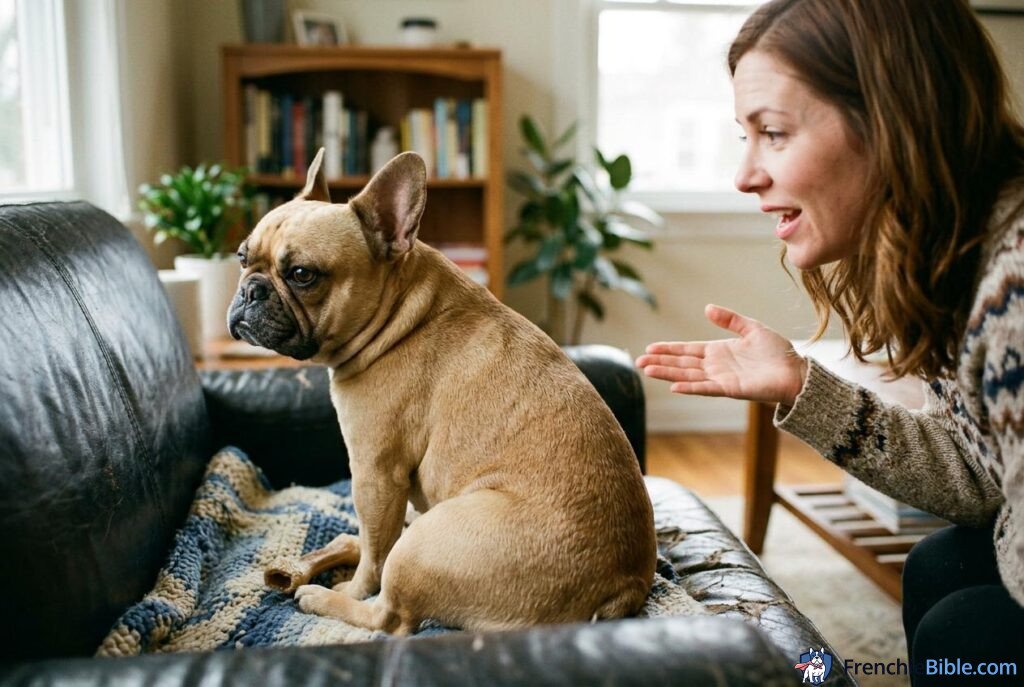
Let me tell you the biggest mistake I see new—and even experienced—Frenchie owners make: punishment. When a French Bulldog pees in the house, the natural human instinct is often to scold, yell, or, in outdated training circles, rub their nose in it. I am here to tell you, definitively, that punishing your French Bulldog for potty accidents does not work. In fact, it is likely the exact reason your potty training is stalling.
Related Reading: Health & Diet | Grooming & Care
Instead, the true “soft spot” of a Frenchie—the absolute key to unlocking a well-trained, reliable companion—is positive reinforcement. In this comprehensive guide I will walk you through exactly why punishment fails, how the unique Frenchie mind works, and how to harness the power of positive reinforcement to finally get your French Bulldog potty trained.
The Unique Psychology of the French Bulldog
To understand why punishment fails, we first have to understand the mind of the French Bulldog. Over the last decade of raising litters and watching puppies grow into seniors I have come to realize that Frenchies are a walking paradox. They are not like Golden Retrievers, who live solely to please you. Nor are they like independent working dogs who just want a job to do.
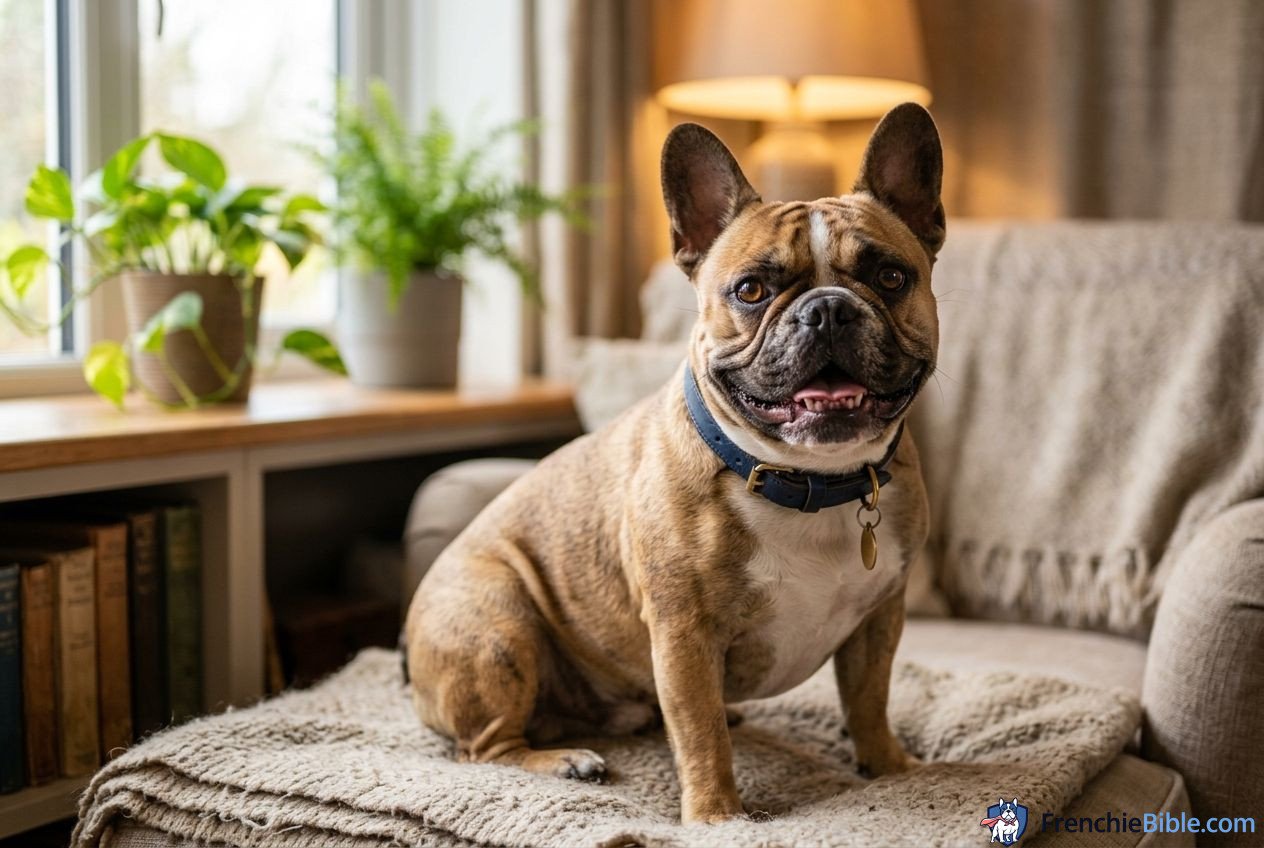
French Bulldogs were bred for one primary purpose: companionship. This means their entire existence revolves around their connection with their humans. They are deeply emotional, incredibly sensitive, and highly attuned to your body language, tone of voice, and facial expressions. When you are happy, they are ecstatic. When you are angry, their world crumbles.
However, paired with this deep sensitivity is a legendary stubborn streak. Frenchies are thinkers. If you ask a Frenchie to do something, their first internal thought is often, “What is in it for me?” They require motivation. If the motivation is fear (punishment), their stubbornness kicks in as a defense mechanism. If the motivation is positive (treats, praise, play), they become eager, willing partners.
Trying to force a French Bulldog to do something through intimidation is like trying to push a boulder up a hill. It is exhausting, frustrating, and ultimately futile. But if you lead them with positive reinforcement, they will happily run up that hill with you.
Why Punishment Completely Backfires in Potty Training
Let’s look at what actually happens from the dog’s perspective when you punish them for peeing inside.
The Myth of the “Guilty Look”
Many owners tell me, “But they know what they did! They look so guilty!” Let me clarify this: dogs do not feel complex moral guilt about bodily functions. That “guilty” look—the flattened ears, the whale eye (showing the whites of their eyes), the tucked tail, the avoidance of eye contact—is actually an “appeasement behavior.”
Your Frenchie is reading your angry body language and trying to say, “Please don’t hurt me I am no threat to you.” They are reacting to your anger in the present moment, not reflecting on the puddle they made five minutes ago.
The Creation of the “Ninja Pee-er”
When you punish a French Bulldog for peeing in the house—whether by yelling, swatting with a newspaper, or dragging them to the spot—you are not teaching them that peeing inside is wrong. Because their canine brains associate consequence with immediate action, you are teaching them that peeing in front of you is incredibly dangerous.
I once worked with a family whose six-month-old Frenchie, let’s call him Buster, was still having daily accidents. The owner insisted Buster knew right from wrong because he would run and hide under the bed immediately after peeing. But Buster didn’t know the rug was off-limits; Buster just knew that whenever he emptied his bladder and his owner was visible, a scary explosion of anger happened. So Buster adapted. He started sneaking off into unused guest rooms, behind the sofa, or under the dining table to relieve himself. Punishment hadn’t stopped the behavior; it had just made him a stealthy, secret pee-er.
The Cortisol Cycle: Stress and Bladder Control
Fear and stress physically impact a dog’s ability to hold their bladder. When you yell or act aggressively, your Frenchie’s cortisol (stress hormone) levels spike. Stress and anxiety can actually induce urination, especially in puppies. By creating an environment of anxiety around potty time, you are physiologically making it harder for them to succeed.
Furthermore, a terrified dog cannot learn. If their brain is flooded with stress hormones, the learning centers shut down. They are in survival mode. A relaxed, confident Frenchie is much more capable of understanding what you want and controlling their bodily functions than a fearful one.
The Trauma of “Rubbing Their Nose In It”
This old-school tactic needs to be retired permanently. Forcing a dog’s nose into their own urine or feces is degrading, confusing, and terrifying for the animal. It completely shatters the trust between you and your dog. From the dog’s perspective, their trusted leader has suddenly become unpredictable and physically abusive. It does absolutely zero to teach them where the correct bathroom is.
Anatomy and Physical Realities of the Frenchie Bladder
Before we implement a positive reinforcement strategy, we have to respect the physical realities of the breed. French Bulldogs are small dogs, which means they have small internal organs.
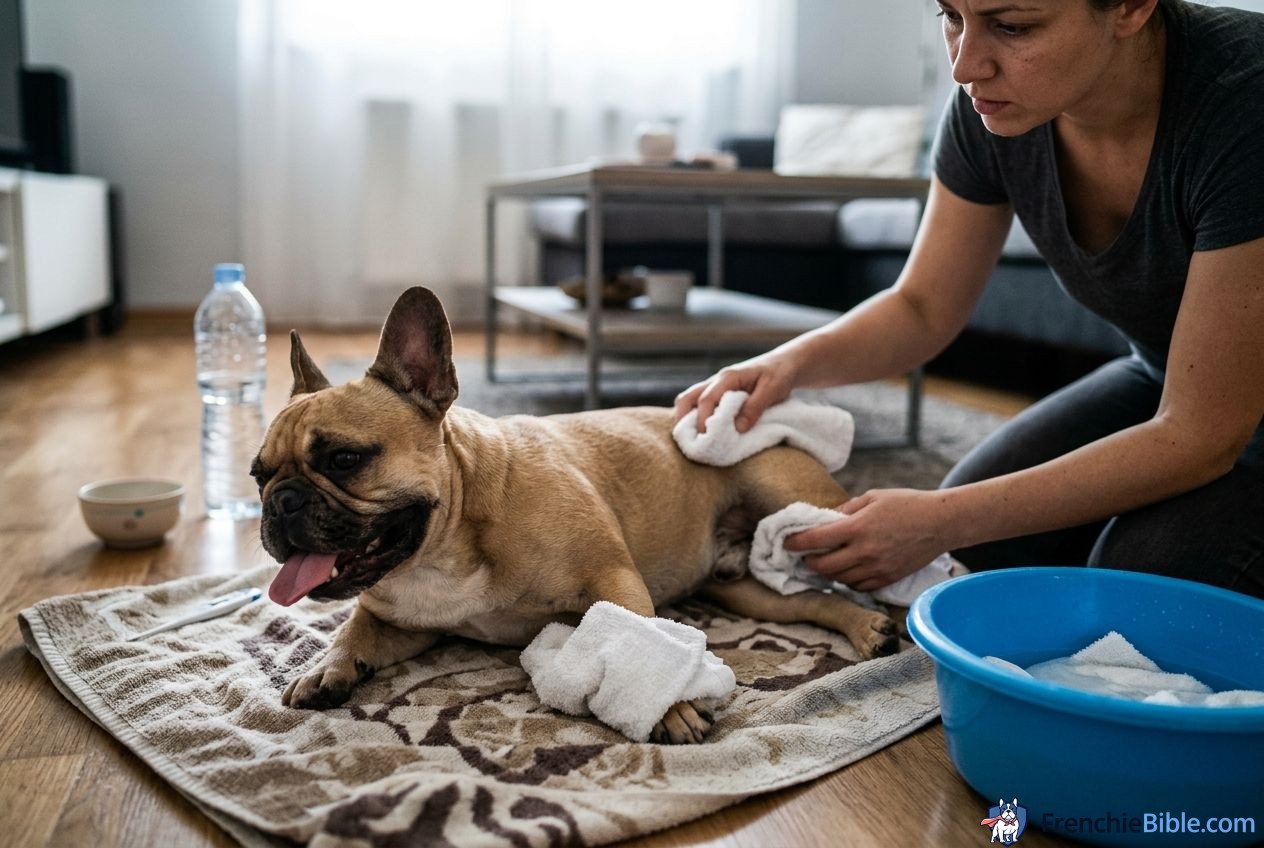
The Formula for Puppy Bladder Control
A general rule of thumb in the dog world is that a puppy can hold their bladder for one hour per month of age, plus one. So, a two-month-old (8-week) puppy can hold it for roughly three hours maximum while sleeping, and significantly less when awake and active.
Expecting a young Frenchie puppy to hold it for an entire eight-hour workday is biologically impossible. It is setting them up for inevitable failure. When they fail because their tiny bladder simply overflowed, and you punish them for it, you are punishing them for their anatomy.
Milestones of Bladder Development
- 8 to 12 weeks: At this stage, they barely know they need to pee until it is already happening. You must be proactive, taking them out constantly.
- 3 to 6 months: They are developing better sphincter control. They can hold it longer, but excitement or play can still cause sudden leaks.
- 6 to 12 months: They should have adult bladder control, but adolescent regression can happen (more on that later).
Recognizing the difference between a physical need (they just couldn’t hold it anymore) and a training gap is crucial for maintaining your patience.
Unpacking the Types of Potty Accidents
Not all puddles are created equal. In my years of breeding and advising families I categorize accidents into four main types. Understanding which type your dog is experiencing will dictate your training approach.
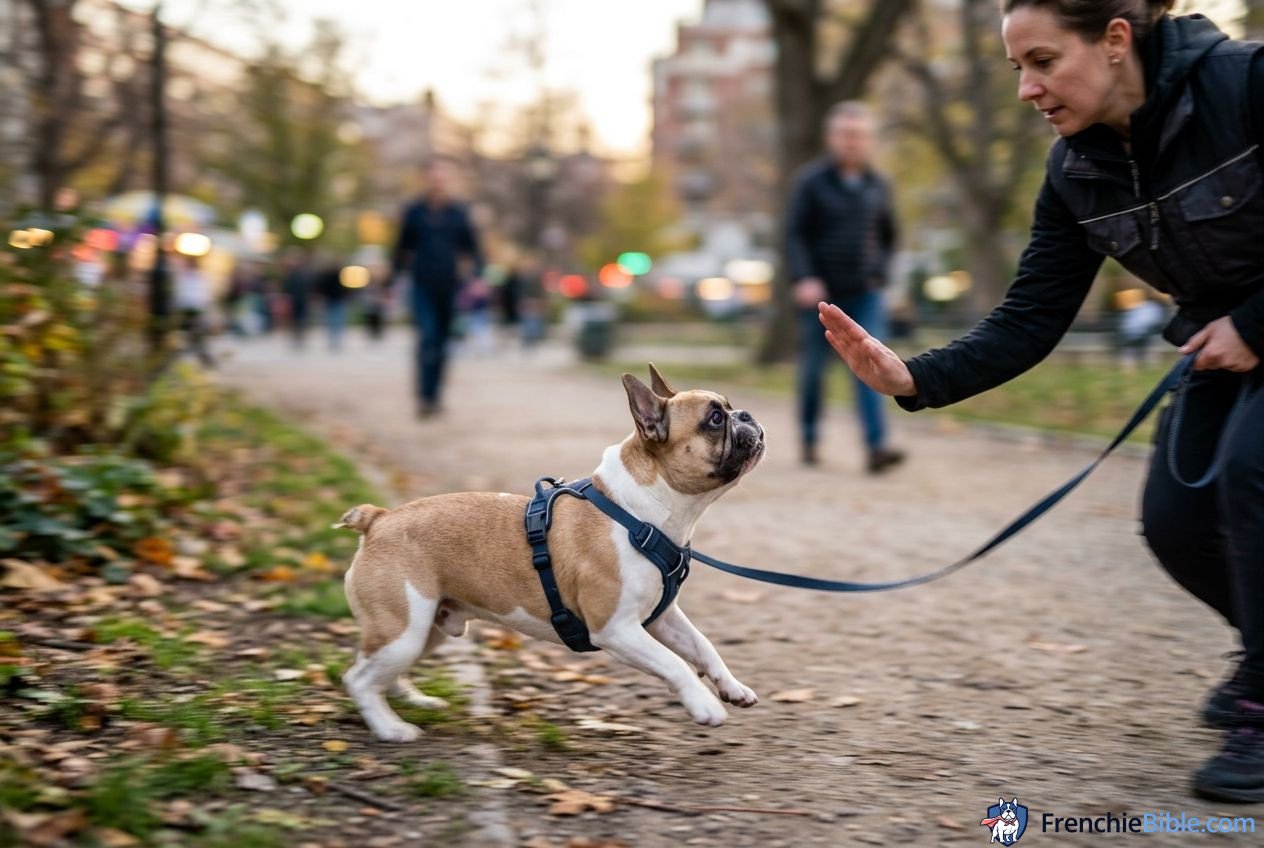
1. The Genuine “I Couldn’t Hold It” Accident
This happens when the dog’s physical limit is reached. Usually, this is the owner’s fault for not taking the dog out frequently enough, ignoring the dog’s subtle signals (pacing, sniffing, whining), or leaving them in a crate too long. Positive reinforcement works here by rewarding outdoor success, but the real fix is better time management by the owner.
2. Submissive Urination
This happens when a dog feels intimidated, frightened, or is trying to show extreme deference to a person or another dog. It often happens when you lean over them, use a loud voice, or reach for them quickly. It is an involuntary physical response. Punishing this will 100% make it worse, as punishment increases fear, which increases submission. The solution is building confidence and practicing low-key, sideways greetings.
3. Excitement Urination
Very common in young Frenchies, this happens when they are simply overwhelmed with joy—like when you come home from work or a new guest arrives. Their brain is so overstimulated that they lose control of their bladder muscles. Again, this is involuntary. Do not punish. Wait for them to calm down, ignore the jumping, and take them outside immediately.
4. Territorial Marking
This is different from emptying a full bladder. Marking involves leaving small amounts of urine on vertical surfaces (chair legs, sofa skirts, walls) to claim territory or communicate with other dogs. Unneutered males and some unspayed females are most prone to this. While neutering/spaying can help reduce this drive, positive reinforcement and strict supervision are required to break the habit if it has already formed.
The Magic and Mechanics of Positive Reinforcement
If punishment is off the table, how do we communicate to our Frenchies that the rug is not a bathroom? We use their kryptonite: positive reinforcement.
Positive reinforcement simply means adding something highly desirable immediately following a behavior, making that behavior more likely to happen again in the future. By making the act of peeing outside the most rewarding, exciting, and delicious part of your dog’s day, you create a powerful, self-driven motivation for them to hold it until their paws touch the grass.
The Science of Motivation: Finding the Ultimate Jackpot
Remember the stubborn streak? A piece of dry, boring kibble is not going to convince a Frenchie to leave the warm, soft living room to go pee in the chilly grass. You are competing with the comfort of the indoors. You must bring out the big guns.
You need to find your dog’s “jackpot.” In my experience, this needs to be incredibly high-value, highly fragrant, and something they only ever receive for pottying outside. Do not give this treat for sitting, rolling over, or just being cute. It is the exclusive “Potty Treat.”
– Boiled chicken breast (shredded into tiny, pea-sized pieces)
– Freeze-dried beef liver, salmon, or lamb lung
– Tiny cubes of low-fat cheese
– Plain, unseasoned cooked ground beef or turkey
If your Frenchie is one of the rare ones who isn’t food-motivated, find their life reward. Maybe it’s 30 seconds of intense, enthusiastic tug-of-war with a special toy that is only brought out after a successful potty trip.
The Critical Nature of Timing: The 1-to-3 Second Window
This is where 90% of owners fail. The timing of the reward is the absolute lynchpin of positive reinforcement.
Dogs are associative learners. They associate consequences with the action they completed in the last one to three seconds. Let me paint a picture of a common mistake: Your Frenchie pees outside. You say, “Good boy!” You both walk back to the door, go inside, walk to the kitchen, you open the treat jar, and hand him a biscuit.
What did you just reward? You rewarded him for walking into the kitchen and sitting by the jar. The act of peeing happened 45 seconds ago; in dog time, that is ancient history.
To effectively potty train, the treat must be delivered immediately as they finish the act of peeing, while their feet are still on the grass. This means you cannot just open the back door and let them out. You must go outside with them, every single time, leash in hand, jackpot treat in your pocket, ready to deliver the moment the bladder is empty.
The Ultimate Positive Reinforcement Potty Training Masterplan
Now let’s put theory into practice. Here is the exact, step-by-step masterplan I use to train litters and advise new owners. This method requires dedication, but it works rapidly because it is clear, fair, and highly motivating.
Step 1: Impeccable Environmental Management
You cannot positively reinforce good behavior if you aren’t managing the environment to prevent bad behavior. Every time your dog successfully pees on the rug, that behavior is intrinsically rewarding to them (bladder relief feels good). You must prevent the rehearsals of bad behavior.
When you cannot watch your Frenchie with 100%, laser-focused attention, they must be confined.
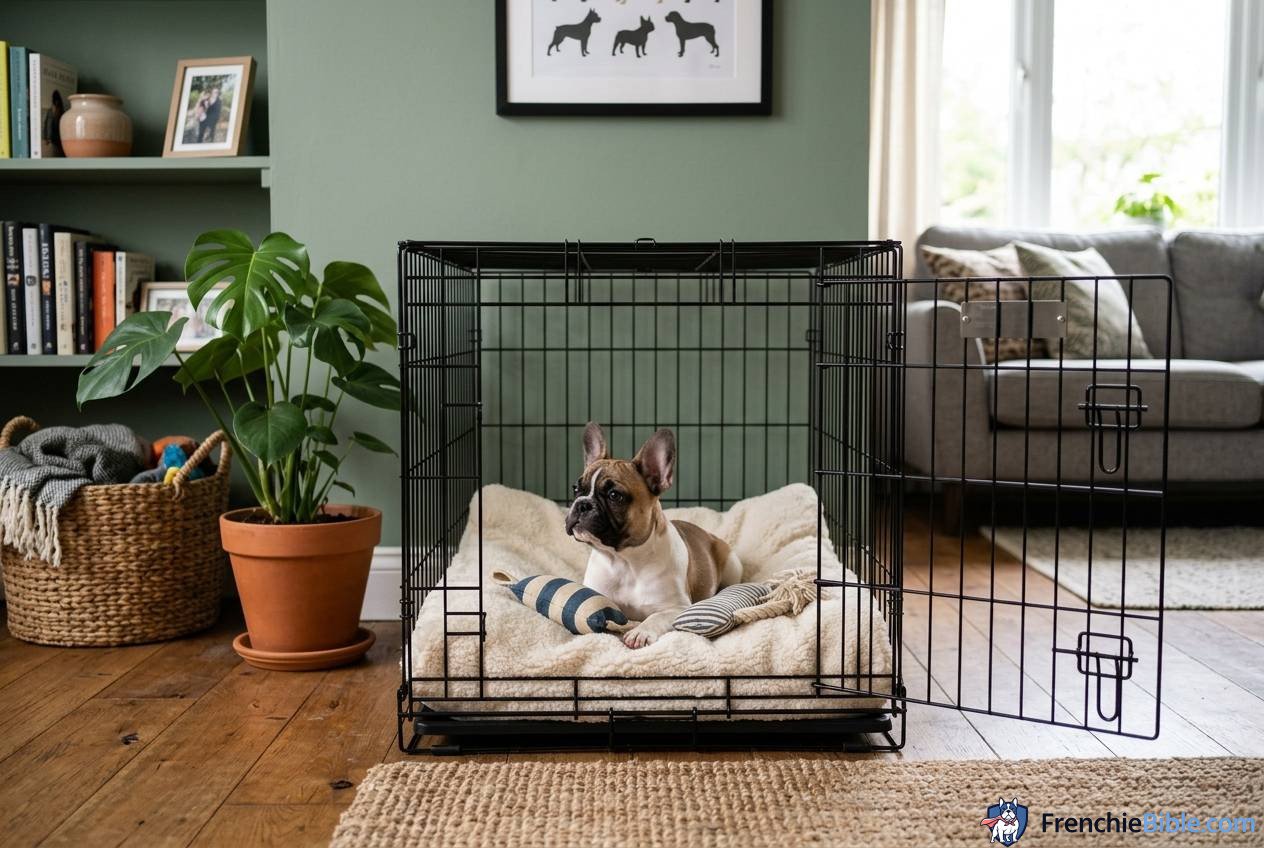
– Crate Training: This is my preferred tool. Dogs have a natural denning instinct and will go to great lengths to avoid soiling where they sleep. A properly sized crate (just big enough to stand, turn, and lie down) is a fantastic tool to encourage them to hold their bladder.
– Playpens: If you use a playpen, ensure it is on an easy-to-clean surface. However, be aware that a pen gives them enough room to sleep in one corner and pee in the other, which can drastically slow down the training process.
– Tethering: If you are cooking or working at a desk, put your Frenchie on a leash and tie the leash to your belt loop. They cannot sneak off to pee if they are physically attached to you.
Step 2: Establishing a Non-Negotiable Routine
Frenchies thrive on predictability. Their digestive tracts are like clockwork once you establish a rigid schedule. You should be escorting your Frenchie outside:
– The absolute second they wake up in the morning (do not make coffee first; take the dog out).
– Right after every single meal.
– After 10-15 minutes of vigorous play.
– Immediately upon waking up from any daytime nap.
– Right before bedtime.
– For young puppies, every 1 to 2 hours in between.
Step 3: Naming the Action
As you take your dog outside, preferably on a leash so they don’t get distracted by leaves or bugs, guide them to a specific spot in the yard. Dogs are creatures of habit; the residual scent of their previous bathroom trips will act as a trigger to go again.
Stand in the designated spot and become the most boring person on earth. Do not talk to them, do not play, do not make eye contact. Just stand still.
As soon as your Frenchie begins to squat or lift a leg, softly and calmly say your chosen cue word. I use “Go potty” or “Do your business.” Say it exactly as it is happening, so they associate the physical sensation with the word.
Step 4: The Celebration (Delivering the Jackpot)
The exact millisecond they finish emptying their bladder—as they are lifting out of the squat or putting their leg down—throw a party.
Praise them enthusiastically (“YES! Good potty! What a good dog!”), and immediately pop that high-value piece of chicken or cheese directly into their mouth.
Make them feel like they just won the Olympic gold medal. This dramatic contrast—boring owner before the pee, ecstatic owner with delicious food immediately after the pee—is what solidifies the training in their mind. They will quickly learn that going to the bathroom outside is the most lucrative thing they can do all day.
Step 5: The “Earned Freedom” Protocol
Only after your Frenchie has gone to the bathroom outside do they earn “freedom” in the house. After a successful outdoor trip and their jackpot reward, bring them inside and allow them to roam the living room (still supervised!) for 30 to 45 minutes.
Once that safe window is up, it is back to the crate, the playpen, or tethered to you until the next scheduled potty break. Slowly increase this freedom time (to an hour, then two hours) over weeks of consecutive, accident-free days. If they have an accident, you gave them too much freedom too soon. Scale it back.
Diet Hydration, and Digestion’s Role in Potty Training
Potty training isn’t just about what comes out; it’s heavily dependent on what goes in. Over my years of daily care I’ve found that diet management is the unsung hero of housebreaking.
High-Quality Diet Equals Predictable Output
Feeding your French Bulldog a high-quality, highly digestible diet means their body processes the food efficiently, resulting in smaller, firmer, and highly predictable bowel movements. Cheap kibble packed with fillers leads to massive, frequent, and urgent stools that are much harder for a dog to hold.
The Importance of Feeding Schedules
Never free-feed (leaving a bowl of food out all day) a puppy you are trying to potty train. If food goes in at random times, food and water will come out at random times. Feed your Frenchie two to three measured meals a day at the exact same times. What goes in on a schedule comes out on a schedule.
Hydration Management
Water is essential, but you can control access to help with overnight training. A common practice is to pick up the water bowl about two hours before the dog’s bedtime. This gives them time to process the liquid and empty their bladder one last time before settling into their crate for the night, drastically reducing the chance of overnight accidents.
Navigating Apartment Living and Unique Environments
Not everyone has a sprawling backyard. If you live in an apartment or condo, positive reinforcement is even more critical because the effort required to get outside is higher.
The Elevator Challenge
If you live on the 10th floor, getting a puppy down the elevator before they pee is a monumental task. My advice: carry them. Puppies rarely pee while being held securely. Carry them all the way down the hall, into the elevator, and out the front doors. Only put them down when their feet hit the designated potty area.
Balcony Grass Patches vs. Pee Pads
I generally advise against using traditional white, square puppy pads. Pee pads teach a dog that it is acceptable to eliminate inside the house, on a soft, square, absorbent surface. It should not be a surprise when they later confuse a bath mat, a door rug, or a dropped towel for a pee pad.
If you must use an indoor or balcony solution, opt for a real-grass patch subscription service, or a synthetic grass tray. This at least reinforces the texture of grass under their paws, making the eventual transition to the great outdoors much smoother. You apply the exact same positive reinforcement protocol to the grass patch as you would a yard.
What to Do When Mistakes Inevitably Happen
Even with an iron-clad schedule and the best treats in the world, accidents will happen. You are dealing with a living, breathing creature, not a robot. How you handle these mistakes is the ultimate test of your commitment to the positive reinforcement philosophy.
Catching Them in the Act: The Gentle Interruption
If you walk into the living room and see your Frenchie mid-squat on the Persian rug, suppress every urge to scream. Do not hit them. Do not clap aggressively.
Instead, make a sharp, surprising noise to startle them slightly and interrupt the flow—a sudden “Ah-ah!” or a quick, loud clap works well. The goal is to stop them, not terrify them.
Immediately scoop them up (yes, even if they are still dripping; this is the glamorous side of dog ownership) and rush them outside to their designated potty spot. Put them down. If they finish peeing outside, reward them massively with the jackpot treat. You want to clearly communicate the contrast: “Peeing inside gets interrupted and rushed, but peeing outside is where the party happens.”
Finding the Mess Later: Why Silence is Golden
If you walk into a room and find a puddle of pee that has been there for five minutes or five hours, do absolutely nothing to the dog. Do not yell. Do not drag them over to it. Do not point at it and ask, “What did you do?”
They have already forgotten the physical act of peeing. Any punishment or anger now will just make them afraid of you, and they won’t have the slightest clue why you are mad.
Instead, roll up a newspaper, gently tap yourself on the head with it, and repeat: “I should have been watching my dog. I should have been watching my dog.” Quietly put the dog in another room so they don’t think cleaning is a game, and clean the mess. Recommit to your schedule and supervision. The failure was yours, not the dog’s.
The Critical Importance of Enzymatic Cleaners
Proper cleanup is not just about aesthetics; it is a vital part of training. Frenchies possess incredibly sensitive olfactory systems. If you clean a pee spot with regular household cleaners (like bleach, ammonia, or standard carpet foam), you might eliminate the stain and the smell to your human nose. However, you are leaving behind uric acid crystals.
To a Frenchie, that spot still reeks of a bathroom, practically screaming at them, “This is where we pee!” To truly break the cycle, you must use an enzymatic cleaner specifically designed for pet urine. These cleaners contain active biological enzymes that physically eat and break down the uric acid proteins, eliminating the odor at a microscopic level. Saturate the area heavily, let it sit for the manufacturer’s recommended time, and blot it dry.
Dealing with Regressions Weather, and Setbacks
The path to a fully potty-trained Frenchie is rarely a straight line. Expect bumps in the road, and be prepared to address them with patience rather than punishment.
The Adolescent Regression Phase
It is incredibly common for puppies to experience a behavioral regression around 6 to 10 months of age. A dog who was perfectly potty trained for months might suddenly look you right in the eye and pee on the sofa. This is canine adolescence. Their hormones are surging, their brains are rewiring, and they are testing boundaries.
Do not panic, and do not resort to punishment out of frustration. When a regression happens, go back to basics. Revert to the strict, 2-hour schedule. Limit their free-roaming privileges in the house, bring back the crate, and reinstate the ultra-high-value jackpot treats for outdoor successes. Treat them exactly as you would an 8-week-old puppy learning for the very first time. Usually, a week or two of strict management and positive reinforcement is enough to reset their brain and get them back on track.
The “Weather Strike”
If there is one universal truth I have learned about French Bulldogs, it is that they despise inclement weather. They hate rain. They hate snow. They hate wet grass, cold wind, and puddles. Many Frenchies will walk to the open door, look at the rain, and flat-out refuse to step outside, preferring to hold it until they burst—or until they sneak off to the bedroom.
You cannot force them, and punishing them for hating the rain is useless. Instead, use management and high-value bribery. If it is raining and your Frenchie refuses to pee, bring them inside and immediately place them in their crate. Wait 15 minutes. Put on your own raincoat, grab an umbrella, take them back outside on a leash, and try again. Repeat this cycle (outside, refuse to pee, back in crate) until they finally go.
When they do finally pee in the rain, the reward must be astronomical. Give them a handful of chicken. Throw a massive party in the rain. You have to make the miserable experience of wet grass worth their while. For extreme cases, setting up a small covered pop-up tent in the yard or investing in a well-fitting doggie raincoat can make a world of difference.
Re-training an Adult Rescue Frenchie
Bringing home an adult rescue Frenchie who was never properly house-trained presents unique challenges. They may have deeply ingrained bad habits, or they may have a history of being punished by previous owners, making them fearful and secretive.
The process is exactly the same as training a puppy: strict management, a rigid schedule, and massive positive reinforcement. However, you will need double the patience. You are not just teaching a new habit; you are actively overwriting years of bad habits and potential trauma. Build trust first. Never raise your voice, manage their environment meticulously, and let the jackpot treats do the heavy lifting.
Conclusion
Potty training a French Bulldog is a marathon, not a sprint. It is a profound test of your patience, your consistency, and your empathy. By abandoning the outdated, damaging methods of punishment and fully embracing the science of positive reinforcement, you are doing so much more than just keeping your carpets clean.
You are building a foundational language of trust with your dog. You are teaching them that you are a safe, predictable, and rewarding leader. Remember, beneath that stubborn exterior, your Frenchie desperately wants to please you and be by your side. Make it crystal clear what you want, make it easy for them to succeed, and reward them generously when they do. Before you know it, the days of scrubbing rugs will be a distant memory, replaced by the joy of a reliable, fully house-trained companion.
FAQs about French Bulldog Potty Training
1. How long does it usually take to fully potty train a French Bulldog?
Every dog is an individual, but generally, with consistent positive reinforcement, a Frenchie puppy will begin to understand the concept by 4 to 5 months of age. However, true, reliable bladder control and deep habituation often take until they are 8 to 12 months old. Consistency on the owner’s part is the single biggest factor in speeding up this timeline.
2. My Frenchie pees when they get excited. How do I stop this?
Excitement urination is an involuntary physical response to overwhelming stimulation, very common in puppies. Do not punish them, as this adds fear and worsens the problem. Practice low-key greetings. When you come home, ignore your dog until they have completely calmed down. Avoid direct eye contact, keep your voice low, and don’t bend over them. Once they are calm, calmly leash them and take them outside. They usually outgrow this as they mature and gain confidence.
3. Should I use pee pads for my French Bulldog?
As a breeder I strongly advise against traditional pee pads unless absolutely necessary. They teach the dog that eliminating on soft, square items inside the house is acceptable, which frequently leads to confusion with area rugs, bath mats, and dropped clothing. If an indoor solution is mandatory due to your living situation, opt for a real-grass patch system instead, which at least reinforces the correct texture under their paws.
4. How often should I take my Frenchie puppy outside to potty?
A young puppy (8-12 weeks) should be taken out extremely frequently to prevent accidents. Aim for every 1 to 2 hours while they are awake, plus immediately after waking up from any sleep, within 15 minutes after eating a meal, and after any vigorous play session. It is always better to take them out too often than not enough. Set them up for success.
5. Why is my fully house-trained older French Bulldog suddenly peeing in the house?
If a previously reliable adult Frenchie suddenly starts having accidents indoors, the very first step should always be a visit to the vet. This is frequently the primary symptom of a medical issue, such as a urinary tract infection (UTI), bladder stones, or kidney dysfunction. Once your vet has thoroughly ruled out any medical causes, evaluate if there have been any stressful changes in the household routine (a move, a new baby, a change in work schedule) and revert to basic positive reinforcement training.
Disclaimer: We are not veterinarians and do not hold veterinary medical licenses. The information provided in this article is based on years of breeding and daily care experience and is for educational purposes only. It should not replace professional veterinary advice. Always consult with a licensed veterinarian if you have concerns about your French Bulldog’s health or before starting any new treatment.