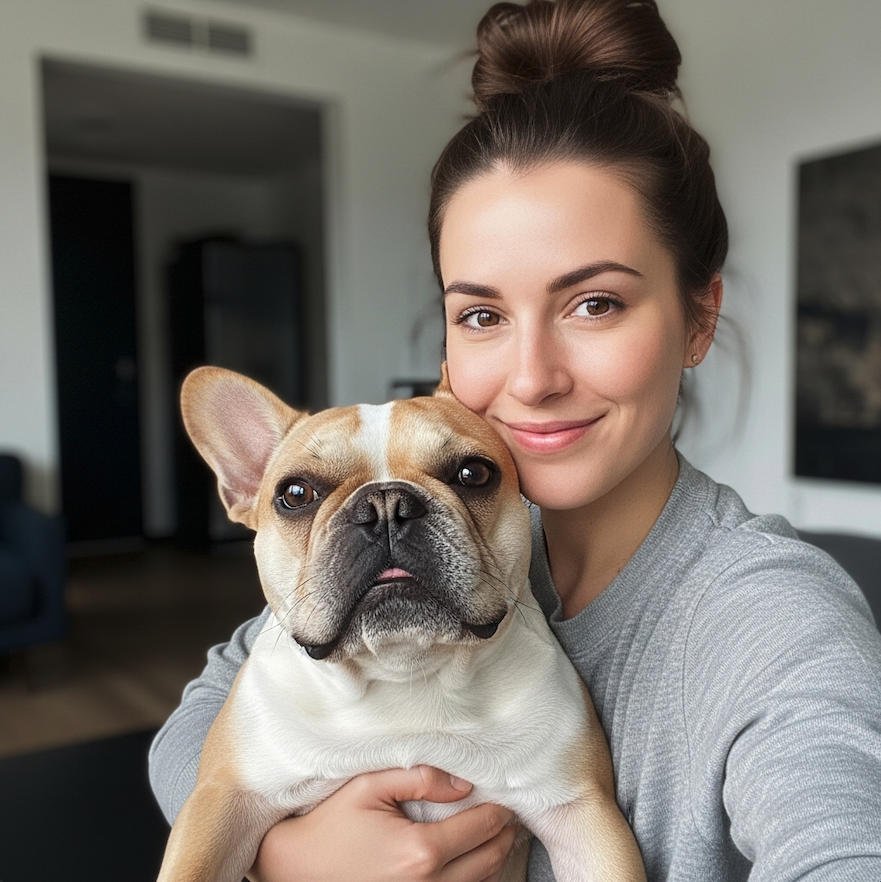
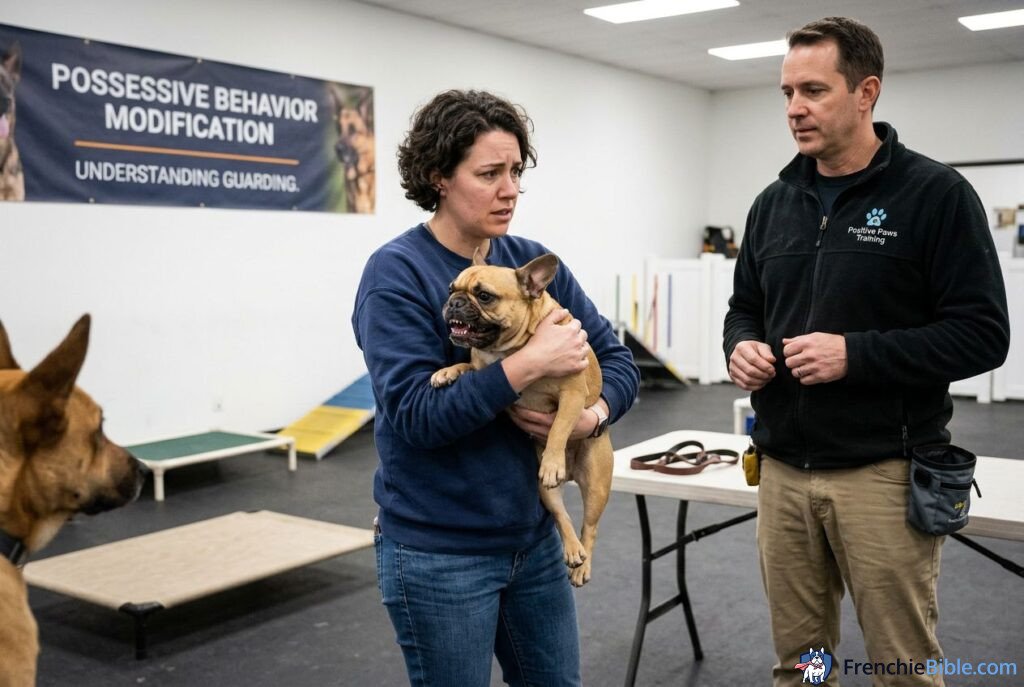
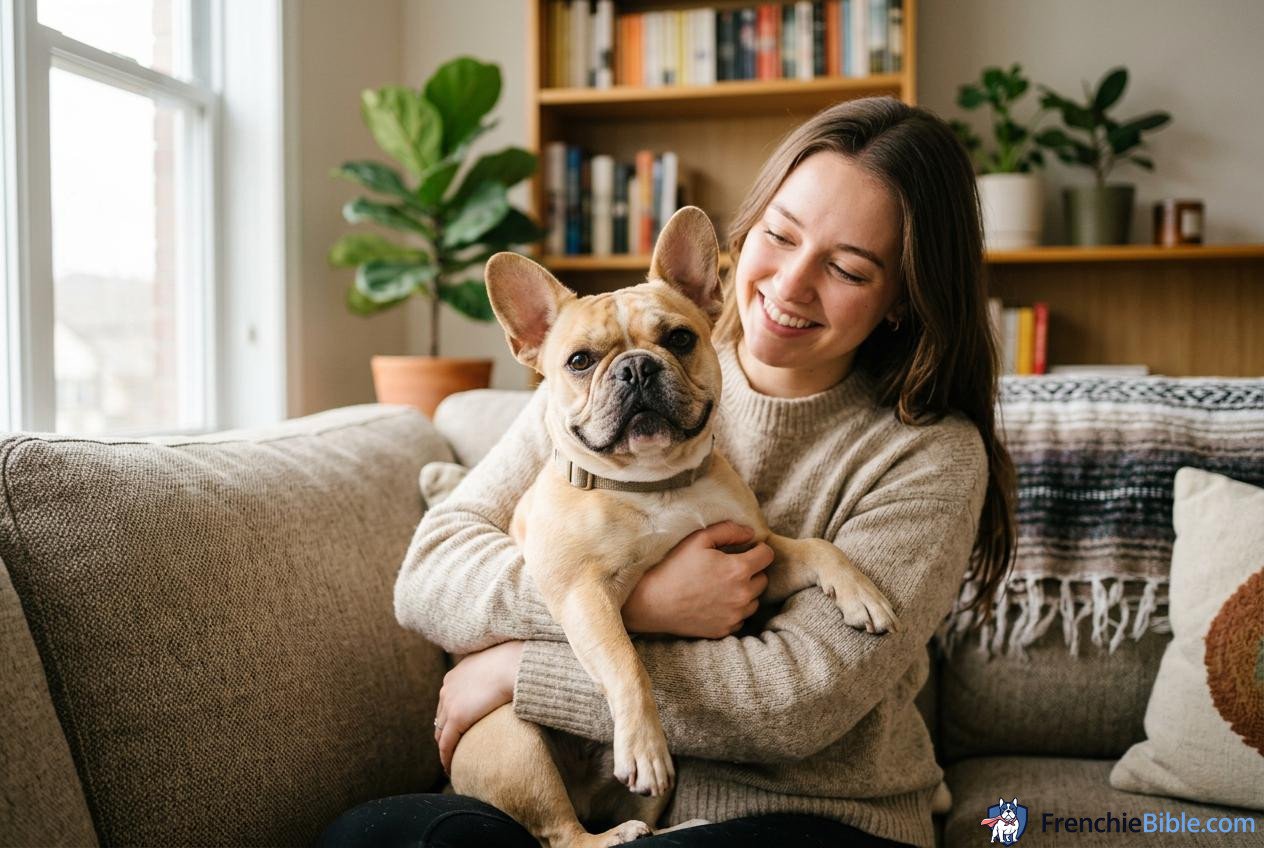
If you are a French Bulldog owner, you might have experienced this jarring scenario: you are holding your sweet, affectionate, and usually comical little companion in your arms. Someone approaches you—a friend, a stranger, or perhaps another dog—and suddenly, your angelic Frenchie transforms into a growling, snapping, and lunging gremlin. The sheer contrast between the loving dog in your lap and the ferocious defender they become can be deeply confusing and embarrassing. In Chinese, there is a saying for this: “Gou zhang ren shi,” which loosely translates to “a dog relying on its human’s power to act tough.” It is a perfectly accurate description of what is happening.
As a senior French Bulldog breeding expert and behavioral specialist with over a decade of hands-on experience in raising, training, and observing these incredible dogs I can assure you that you are not alone in facing this issue. I have worked with hundreds of French Bulldogs and their owners, and this specific behavioral quirk—acting aggressively or defensively only when being held or sitting on a lap—is incredibly common. It is a complex issue rooted in canine psychology, pack dynamics, and the unique, often stubborn personality of the French Bulldog breed.
Related Reading: Health & Diet | Grooming & Care
In this comprehensive guide, we will dive deep into the mind of your Frenchie to understand exactly why they become aggressive when you hold them. We will explore the concepts of resource guarding, barrier frustration, and fear-based reactivity. More importantly I will share the exact strategies, behavioral modifications, and training protocols I have used for over ten years to help owners effectively manage and eliminate this behavior, turning your reactive Frenchie back into the calm and confident companion they are meant to be.
Understanding the “Holding” Phenomenon: Why Your French Bulldog Changes Personalities
To fix the problem, we must first understand the root cause. When your French Bulldog is on the ground, they are usually friendly, curious, or perhaps just indifferent to approaching strangers or dogs. But the moment you pick them up, the dynamic shifts entirely. Why does being in your arms flip a switch in their brain? There are several psychological and instinctual mechanisms at play.
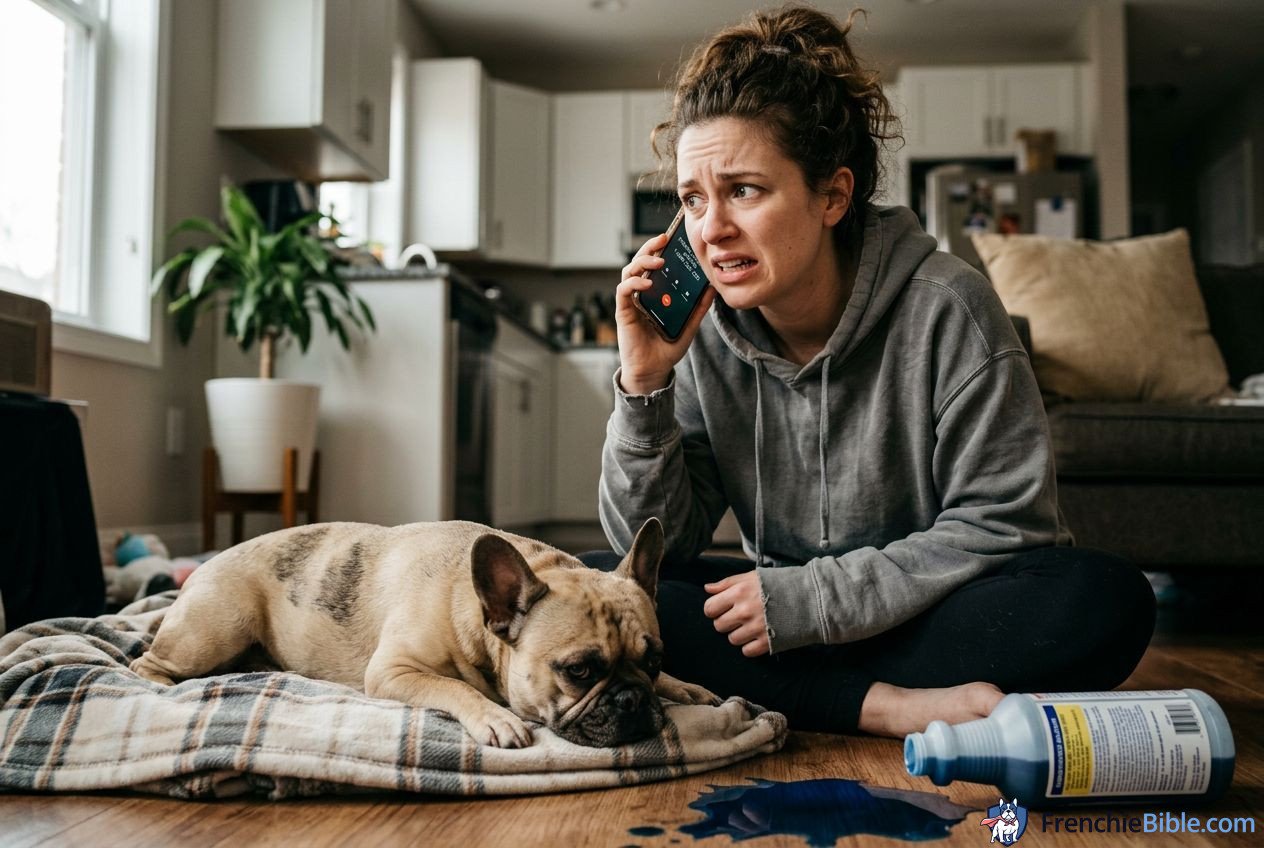
The Concept of Resource Guarding: You Are the Prize
In the canine world, resource guarding is a natural behavior where a dog becomes defensive over something they consider highly valuable. This could be a bone, a favorite toy, a food bowl, or a comfortable sleeping spot. However, one of the most common and often overlooked “resources” that dogs guard is their human.
For your French Bulldog, you are the ultimate resource. You provide food, warmth, comfort, affection, and security. When you pick your Frenchie up and hold them close to your chest, you are essentially establishing physical ownership of them, and in their mind, they are establishing ownership of you. When a stranger or another dog approaches, your Frenchie perceives them as a potential threat to their most prized possession: you. The growling, snapping, and barking are their way of saying, “Back off, this human is mine, and I will protect my access to them.”
French Bulldogs are incredibly loyal and form intense bonds with their owners. They are known as “velcro dogs” because they always want to be by your side. While this loyalty is endearing, it can easily cross the line into possessiveness if not properly managed with boundaries.
Barrier Frustration and the Restriction of Movement
Another critical psychological factor is something known as barrier frustration. When a dog is on the ground, they have the freedom to choose their reaction to a stimulus. They can engage, or they can choose “flight” and walk away if they feel uncomfortable.
However, when you are holding your French Bulldog tightly in your arms, you are removing their option for flight. They are physically trapped in your embrace. In the canine psychological framework, when the “flight” option is removed, a dog who feels insecure or threatened will almost automatically default to the “fight” response.
Being held acts as a physical barrier. They can see the approaching person or dog, but they cannot move naturally to investigate or retreat. This restriction builds immense frustration and anxiety, which quickly boils over into aggressive displays. It is very similar to leash reactivity, where a dog barks and lunges on a leash because they feel restricted, but acts perfectly fine when off-leash. Your arms are acting as the ultimate, restrictive leash.
Elevation Insecurity, and the “Napoleon Complex”
French Bulldogs are small dogs with big personalities. When they are on the ground, they are well aware of their physical size relative to the world around them. But when you pick them up, you suddenly elevate them to human eye level.
This sudden elevation can have two contrasting psychological effects, both of which can lead to aggression:
1. False Confidence (The Napoleon Complex): Being up high can give some Frenchies an artificial sense of dominance and authority. They feel larger and more powerful because they are physically looking down on other dogs or people. This false confidence can trigger them to act out and try to “boss around” the approaching individual.
2. Deep-Rooted Insecurity: Conversely, being elevated removes their feet from the solid ground, making some dogs feel incredibly vulnerable and off-balance. If a dog is already slightly fearful or anxious, being held in the air exacerbates that fear. Their aggressive display is a preemptive strike—a bluff to scare away a potential threat because they feel they are in a defenseless position.
Pack Dynamics and “Owner Guarding”
Dogs are social creatures with deeply ingrained instincts regarding pack structure and spatial dynamics. When your French Bulldog is in your arms, they are in your immediate personal space. If you are a dog owner who tends to baby your Frenchie, pamper them excessively, and lack strict household rules, your dog might view themselves as the protector of the household rather than a subordinate member of the family.
When someone approaches you while you are holding them, the dog feels it is their duty to patrol the perimeter and warn off intruders. Because you have inadvertently given them the “manager” position in the household, they are simply doing what they believe is their job: guarding you.
Signs Your French Bulldog Is About to React: Reading the Body Language
One of the most important skills you can develop as a French Bulldog owner is the ability to read your dog’s subtle body language. Aggression rarely happens without warning. The growl or snap is just the final stage of a sequence of escalating stress signals. If you can identify these early warning signs while you are holding your dog, you can intervene before the behavior escalates into aggression.
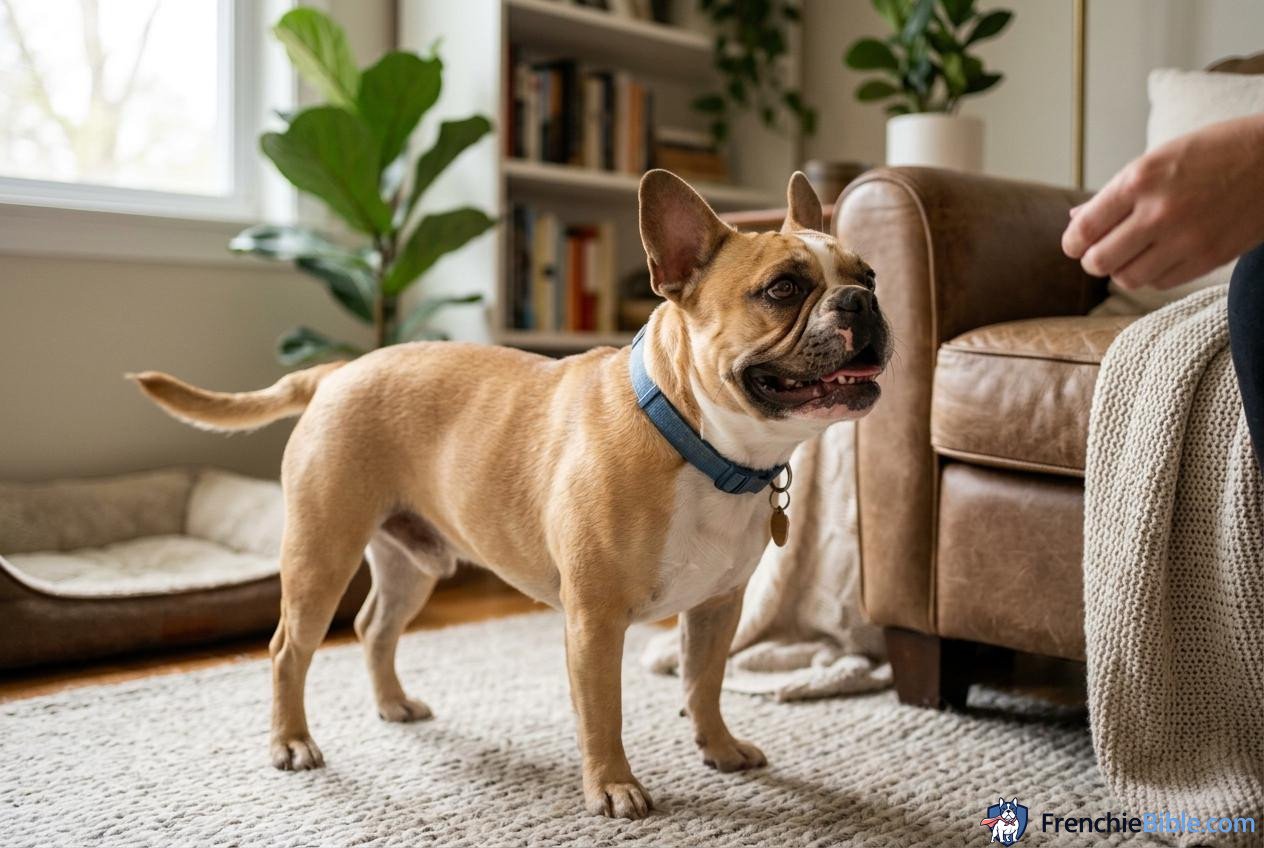
Here are the key body language cues to watch for when you are holding your Frenchie and someone approaches:
The Physical Stiffening
This is often the very first sign. You will feel your Frenchie’s body go completely rigid in your arms. The relaxed, floppy dog suddenly turns into a tense, hard block of muscle. This tension is their body preparing for action (the “fight” response). If you feel your dog stiffen, an aggressive reaction is likely seconds away.
The “Hard Stare” and Whale Eye
Look at your dog’s eyes. When a Frenchie is relaxed, their gaze is soft and wandering. If they are about to react aggressively, they will lock onto the approaching person or dog with a “hard stare”—an intense, unblinking fixation.
You may also see what behaviorists call “whale eye,” where the dog turns their head slightly away but keeps their eyes fixed on the target, exposing the white parts (sclera) of their eyes in a half-moon shape. This is a classic sign of anxiety and resource guarding.
Subtle Warning Signals
Before a growl, a dog will often give displacement signals or subtle warnings. Because French Bulldogs are brachycephalic (flat-faced), their breathing is already noisy, making it sometimes hard to distinguish a low growl from heavy breathing. However, watch for:
– Lip Licking: Rapidly licking their lips when no food is present is a sign of stress.
– Yawning: A wide yawn out of context is a way dogs try to release tension.
– Ears Pinned Back: While Frenchies are famous for their upright “bat ears,” if those ears suddenly flatten tightly against the back of their head, they are feeling extremely defensive or fearful.
– A Closed Tight Mouth: A relaxed dog often has a slightly open mouth with the tongue lolling. A tense dog will close their mouth tightly, pulling the commissures (corners of the mouth) forward.
If you observe any of these signs, the environment has already become too stimulating or threatening for your dog.
How Your Reactions Fuel Your Frenchie’s Aggression
As a breeder and behavior expert I often have to have difficult conversations with owners. The hardest truth to accept is this: you are likely reinforcing and worsening your dog’s aggressive behavior without even realizing it. Dogs are masters of reading human energy and body language. How you react when your dog acts aggressively in your arms dictates whether the behavior will stop or escalate.
The Trap of Unintentional Reinforcement
Imagine this: You are holding your Frenchie, someone approaches, and your dog starts to low-growl. What is your immediate instinct? Most owners will hug the dog a little tighter, stroke their head, and speak in a soft, soothing voice, saying, “It’s okay, buddy. Shhh, it’s okay, be nice.”
From a human perspective, you are trying to calm the dog down. From the dog’s psychological perspective, you are doing the exact opposite. You are petting them and speaking in a sweet, approving tone while they are engaging in aggressive behavior. You are literally rewarding the growling. You are telling your dog, “Yes, good boy! I like it when you protect me and growl at that person.” By trying to soothe them, you are validating their resource guarding.
The Transfer of Tension
French Bulldogs are incredibly sensitive to the emotional state of their owners. Let’s say your dog has snapped at someone while being held in the past. Now, every time you are holding your dog and a stranger approaches, you start to feel anxious. You anticipate a bad reaction.
As the stranger gets closer, you subconsciously tighten your grip on your dog, your breathing becomes shallower, and your heart rate increases. Your French Bulldog feels this physical tension right through your arms. They smell the subtle changes in your pheromones caused by anxiety.
To the dog, the logic is simple: “My human is suddenly tense and scared. That approaching person must be very dangerous! I need to defend us!” Your anxiety acts as the catalyst that triggers their aggression. You are essentially telling them that there is something to be worried about.
Picking Them Up as a Reward
Many owners inadvertently create this problem by using picking up as a default management tool. If your dog is barking at another dog on a walk, and your solution is to pick them up to “save” them from the situation, you are teaching them that throwing a tantrum results in being elevated to their favorite, most secure spot—your arms. You are rewarding the reactivity with physical affection and elevation.
Effective Strategies to Stop Your French Bulldog from Snapping When Held
Over the past ten years of my breeding and behavioral consultation career I have developed a highly effective protocol for eliminating this specific type of aggression. It requires consistency, patience, and a willingness to change your own behavior as much as your dog’s. We are not going to use punishment; we are going to use boundary setting, desensitization, and counter-conditioning.
Here are the exact strategies you need to implement immediately.
Strategy 1: The “Put Down” Rule (Removing the Resource)
This is the most crucial step and the foundation of fixing this behavior. Right now, your dog believes that acting aggressively while in your arms is an acceptable way to control the environment. We need to teach them that aggressive behavior results in the immediate loss of the resource they are guarding: being held by you.
How to execute this:
The very second your French Bulldog shows the first sign of aggression while in your arms—whether it is a stiff body, a hard stare, a low growl, or a lip curl—you must immediately, but calmly, put them down on the ground.
Do not yell. Do not scold them. Do not say “No!” Do not look at them. Simply open your arms, place their feet on the floor, and turn your body slightly away from them.
By doing this silently and swiftly, you communicate a very clear, undeniable message: “If you act aggressively, you lose the privilege of being in my arms. You lose the high ground.”
If they continue to bark or act aggressively on the ground, calmly step on their leash (if attached) so they cannot lunge, but ignore them completely until they settle down. Once they are quiet and relaxed for a full minute, you can invite them back onto your lap or pick them up again. If they growl again, they immediately go right back on the floor.
Consistency is absolute here. You must execute the “Put Down” rule every single time, without exception.
Strategy 2: Counter-Conditioning and Desensitization
The “Put Down” rule stops the behavior in the moment, but we also want to change the dog’s underlying emotional response to people approaching while they are held. We want to change their mindset from “Approaching person = threat to my owner” to “Approaching person = amazing things happen to me.” This is called counter-conditioning.
How to execute this:
You will need a friend or family member who your dog does not see every day to help you with this exercise. You will also need high-value treats (like boiled chicken, freeze-dried liver, or tiny pieces of cheese—something they rarely get).
- Find the Threshold: Have your friend stand far enough away that your dog notices them but does not react while you are holding them. This might be 15 or 20 feet away.
- The Approach: Have your friend take one single step forward. The moment your friend moves forward, cheerfully say “Yes!” or use a clicker, and immediately pop a high-value treat into your Frenchie’s mouth.
- The Retreat: Have the friend step back to their starting position. The treats stop immediately.
- Repeat and Close the Distance: Keep repeating this. Friend steps forward -> feed treat. Friend steps back -> treats stop. Your dog will quickly learn that the approach of a person is the trigger for delicious food raining from the sky.
- Gradual Progression: Slowly, over several training sessions (not all in one day), have the friend get closer and closer. If your dog stiffens or growls, your friend has gotten too close too fast. You must immediately apply the “Put Down” rule (Strategy 1), put the dog on the ground, and end the session. Next time, start from further away.
Eventually, your dog will see someone approaching while in your arms and instead of growling, they will eagerly look up at your face expecting a treat. You have successfully rewired their emotional response.
Strategy 3: Teaching the “Look at Me” Command
An engaged dog cannot be a reactive dog. When your dog is hyper-focused on an approaching “threat,” we need a mechanism to break that fixation. Teaching a strong “Look at Me” or “Watch” command gives you a way to redirect their attention back to you.
How to execute this:
Start this training at home in a quiet environment, with your dog on the floor (not in your arms yet).
1. Hold a treat near their nose, then draw the treat up to your eyes.
2. The moment your dog makes eye contact with you, say “Yes!” and give them the treat.
3. Add the verbal cue: Say “Look” or “Watch,” wait for the eye contact, say “Yes!” and treat.
4. Practice this until they reliably snap their head up to look at your eyes whenever you say the command.
Once they have mastered it on the floor, practice it while holding them in a quiet room. Finally, start using it in real-world scenarios. When you are holding your dog and you see someone approaching in the distance, before your dog even has a chance to react, say “Look!” When they make eye contact, reward them heavily. You are teaching them to check in with you for guidance rather than taking matters into their own paws.
Strategy 4: Managing Your Own Body Language and Energy
Remember how we discussed that your tension fuels their aggression? You must actively work on your own physical reactions.
When you are holding your Frenchie and someone approaches:
– Breathe: Take a deep, slow breath from your diaphragm.
– Loosen Your Grip: Do not clutch the dog to your chest. Hold them securely but loosely. Let your arms relax.
– Stay Neutral: Do not anticipate a bad reaction. Project calm, confident energy. If you act like the approaching person is no big deal, your dog is much more likely to follow your lead.
– Do NOT Soothe: If the dog growls, do not say “It’s okay” and do not pet them. Execute the “Put Down” rule immediately in total silence.
Strategy 5: Revoking Unearned Privileges
Sometimes, this specific behavior is a symptom of a broader lack of structure in the household. If your French Bulldog is allowed on all the furniture whenever they want, sleeps in your bed, demands food and gets it, and generally runs the house, their resource guarding is a natural extension of their perceived status as the “alpha.”
Implement what behaviorists call “Nothing In Life Is Free” (NILIF). Your dog must earn their privileges. They should sit before their food bowl is put down. They should sit before you open the door for a walk. And most importantly, they must sit calmly before you invite them onto the couch or pick them up. By establishing yourself clearly as the benevolent leader who controls all resources, the dog feels less pressure to “guard” you, because they respect that you are capable of handling situations yourself.
When to Seek Professional Behavioral Help
As an expert with ten years of experience I always advise owners to try these structured, positive reinforcement-based strategies first. In most cases, consistency with the “Put Down” rule and counter-conditioning will resolve the issue within a few weeks.
However, you must know when an issue is beyond basic management. If your French Bulldog is not just snapping the air but has actually made contact and bitten someone while being held, you are dealing with a severe liability and a deep-rooted psychological issue. If the aggression is escalating, spreading to other resources (like their food bowl or toys), or if you feel fearful of your own dog, it is time to call in a professional.
Look for a certified canine behaviorist (such as a CBCC-KA) or a certified professional dog trainer (CPDT-KA) who specializes in positive reinforcement and behavioral modification. They can observe your specific dynamics in person and tailor a protocol to your dog. (Please remember, as stated below, my advice is based on extensive breeding and training experience, but a hands-on evaluation by a professional is invaluable for severe cases).
Frequently Asked Questions (FAQ) About french bulldog aggression When Held
1. Is my French Bulldog aggressive because of its genetics?
While genetics play a role in a dog’s base temperament French Bulldogs are not inherently bred to be aggressive or guard dogs; they are bred to be companion animals. However, they are known to be stubborn and form very intense, possessive attachments to their owners. The aggression you see when holding them is almost always a learned behavior, rooted in resource guarding and barrier frustration, rather than a genetic predisposition to violence. It is behavioral, which means it can be un-learned.
2. Should I just stop picking up my Frenchie in public altogether?
In the short term, yes. While you are actively working on training and counter-conditioning, it is wise to manage the environment and prevent rehearsals of the bad behavior. If picking them up triggers aggression, leave them on the ground and let them walk on a leash when in public. You should only practice holding them in controlled, low-stress environments with a helper until they are desensitized.
3. Why does my French Bulldog only do this with me and not my partner?
This is a classic hallmark of resource guarding. Your dog values you differently than your partner. You might be the primary caregiver, the one who feeds them, or the one who provides the most affection. In the dog’s mind, you are the highest-value resource in the household, and therefore, you are the one worth guarding. It also means your partner might project a calmer, more authoritative energy that does not trigger the dog’s protective instincts.
4. Can neutering or spaying help with this protective aggression?
Spaying or neutering can sometimes reduce certain types of hormonally driven aggression, such as male-to-male conflict or roaming behaviors. However, the aggression displayed when being held is rooted in resource guarding, anxiety, and learned behavioral patterns. Altering the dog rarely fixes resource guarding on its own. It requires active training and behavior modification.
5. How long does it take to train this behavior out of a Frenchie?
This depends entirely on how long the dog has been practicing the behavior and how consistent you are with the new rules. If you strictly implement the “Put Down” rule every single time and practice daily counter-conditioning, you can see significant improvement in as little as 2 to 4 weeks. However, if you are inconsistent or if the behavior is deeply ingrained, it could take several months of dedicated work to completely rewire their response.
Disclaimer: The information provided in this article is solely based on my over 10 years of professional experience as a senior French Bulldog breeder, handler, and canine behavior specialist. I am not a licensed veterinarian, and I do not possess any medical qualifications. The content within this article is for educational and informational purposes only regarding dog training, daily care, and behavioral management. It is absolutely not intended to diagnose, treat, or cure any medical conditions, nor should it be used as a substitute for professional veterinary advice. If your dog is exhibiting sudden, uncharacteristic aggression, it could be a sign of underlying pain or neurological issues. Always consult with a licensed veterinarian to rule out medical causes before beginning any behavioral modification program.
Disclaimer: I am a French Bulldog breeding expert with over a decade of hands-on experience with this breed. I am not a veterinarian. The information in this article is for educational purposes only. Always consult your veterinarian regarding your dog’s specific health needs and care.