as a French Bulldog expert and breeder and breeder with over a decade of clinical experience I’ve seen it all. You walk through the front door after a long day at work, and your Frenchie wiggles toward you, ears pinned back, nubby tail wagging a million miles an hour. You reach down to give them a well-deserved scratch behind the ears, and suddenly—puddle.
You love your little bat-eared companion, but cleaning up urine from your hardwood floors or carpets every time someone visits or whenever you say a cheerful “Hello!” gets old incredibly fast. If you are constantly searching for ways to stop your French Bulldog leaking urine, you are not alone.
Related Reading: Health & Diet | Grooming & Care
This phenomenon is incredibly common in the breed. Often, owners misinterpret this as a house-training failure, stubbornness, or even spite. Let me assure you, it is none of those things. In my breeding program I frequently counsel frustrated owners who are at their wits’ end, ready to blame themselves or their dog.
Today, we are going to dive deep into the world of French Bulldog submissive urination and excitement urination. We will explore the subtle but crucial differences between the two, the psychological and anatomical reasons behind why your Frenchie leaks, how to rule out serious medical conditions, and most importantly, a step-by-step, actionable protocol to build your dog’s confidence and stop the puddles for good.
Understanding the Difference: Submissive Urination vs. Excitement Urination in French Bulldogs
Before we can fix the problem, we have to diagnose it correctly. While they look similar—both result in an inappropriate release of urine—the underlying emotional triggers are completely different. Treating excitement urination like submissive urination (or vice versa) can actually make the problem worse.
What is Excitement Urination? (The “Happy Piddle”)
Excitement urination typically happens when your Frenchie is simply overwhelmed with joy. Their emotional cup overflows, and they lose control of their bladder sphincter.
Common Triggers:
– You arriving home from work.
– Guests coming through the front door.
– Meeting a new dog friend.
– Anticipating a walk, a car ride, or mealtime.
– High-pitched, enthusiastic baby talk from you.
Body Language to Watch For:
A Frenchie experiencing excitement urination will look happy but frantic. They might be jumping up, doing the classic “Frenchie zoomies,” panting, and seeking active engagement. They aren’t scared; they literally just can’t contain themselves. This is especially prevalent in puppies under one year of age whose bladder muscles haven’t fully matured to match their massive enthusiasm for life.
What is Submissive Urination? (The “I Yield” Puddle)
Submissive urination is deeply rooted in canine social structure and communication. It is an appeasement gesture. When a dog feels intimidated, anxious, or perceives you (or another dog) as a higher-ranking threat, they urinate to say, “I am no threat to you, please don’t hurt me. I submit.”
Common Triggers:
– People reaching over the dog’s head to pet them.
– Direct, prolonged eye contact from a human or dog.
– Loud noises, yelling, or scolding (even if you are scolding them for something else).
– Approaching the dog too quickly.
– Leaning over the dog to put on a harness or leash.
Body Language to Watch For:
The body language here is vastly different from excitement. A submissive Frenchie will cower, flatten their ears against their head, tuck their little tail nub tight, avoid eye contact, and often roll onto their back to expose their belly while urinating. They are showing you deference out of fear or lack of confidence.
Why Frenchies are Prone to These Behaviors
French Bulldogs are famously affectionate, deeply attached to their owners, and sometimes, a little sensitive underneath that tough, muscular exterior. They are companion dogs through and through, bred to be constantly connected to their humans. This hyper-attachment means their emotional highs and lows are closely tied to your presence and reactions. Furthermore, many Frenchies have a sensitive disposition that can easily tip into anxiety if they aren’t socialized properly during their critical puppyhood fear periods.
The Anatomy and Psychology Behind the Leak
as a French Bulldog expert and breeder I always look at the intersection of mind and body. You can’t train away a biological reflex without understanding the machinery behind it.
The Frenchie Bladder: Small Package Big Emotions
French Bulldogs have relatively small bladders compared to larger breeds, but they produce just as much emotional energy. In puppies, the sphincter muscles that hold the urine inside the bladder are physically immature. When the sympathetic nervous system kicks into overdrive (either from extreme joy or fear), those weak sphincter muscles simply relax involuntarily.
Imagine trying to hold a bursting water balloon closed with weak fingers while someone is tickling you. That’s what happens to your Frenchie’s bladder when you hype them up at the front door. Usually, puppies outgrow excitement urination as they gain muscle tone, but if we handle it poorly, it becomes an ingrained behavioral habit that lasts into adulthood.
The Role of Confidence in Your Frenchie’s Development
Confidence is the antidote to submissive urination. A confident dog feels secure in their environment and their relationship with you. A dog that lacks confidence is constantly trying to “appease” the perceived threats around them.
Often, well-meaning owners inadvertently strip their Frenchie of confidence. Because Frenchies are small and cute, we tend to loom over them, pick them up constantly without warning, and use intimidating body language without realizing it. Building up a “bulletproof” Frenchie requires us to change how we interact with them.
Clinical Perspective: Ruling Out Medical Issues First
Before we start any behavioral modification protocol I tell every single client: We must rule out medical causes. If your dog has a physical ailment causing the leakage, no amount of training will fix it. In my breeding program I run specific diagnostics before diagnosing a behavioral urination issue.
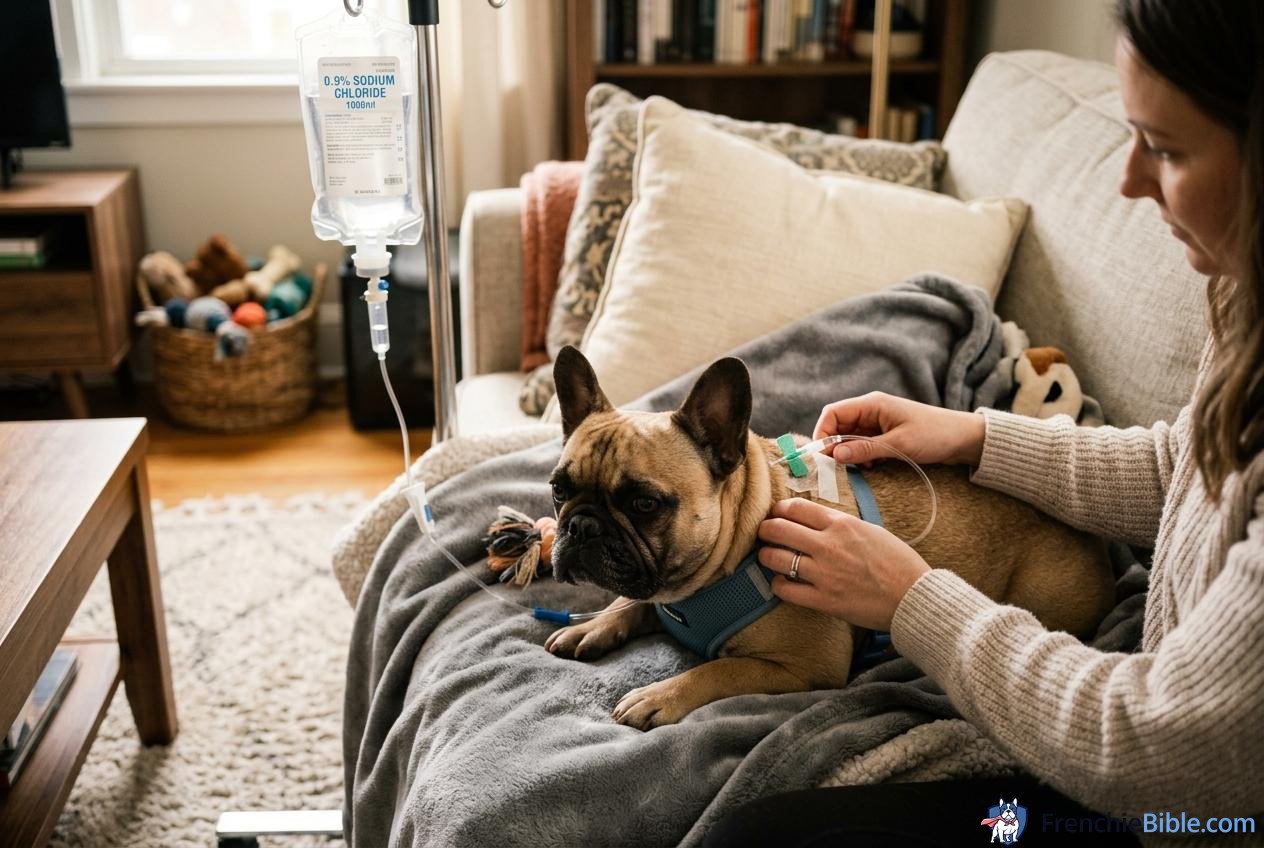
Urinary Tract Infections (UTIs)
A UTI is the most common medical culprit. Bacteria in the bladder cause inflammation and a constant, urgent need to urinate. If your Frenchie suddenly starts leaking urine when they didn’t before, or if their urine smells unusually foul or has a pinkish hue, a simple urinalysis is the first step. UTIs make it physically painful to hold urine.
Ectopic Ureters and Structural Abnormalities
Sometimes, puppies are born with plumbing issues. An ectopic ureter means the tube that carries urine from the kidney to the bladder bypasses the bladder sphincter entirely, leading to constant dribbling. While this usually presents as a constant leak rather than situational (like excitement), it’s vital to check for it in young pups who never seem to get potty trained.
Spinal Issues (IVDD) and Incontinence
This is a massive red flag for French Bulldogs. Our beloved breed is a chondrodystrophic breed (dwarf breed), making them highly susceptible to Intervertebral Disc Disease (IVDD). If a disc in their spine bulges or ruptures, it can compress the nerves that control the bladder and bowel.
If your Frenchie is leaking urine and also showing signs of a wobbly gait, dragging their back paws, reluctance to jump, or crying in pain, this is an immediate veterinary emergency. Neurological incontinence is very different from behavioral urination.
Once your vet gives your Frenchie a clean bill of health, we can move on to the behavioral protocols.
7 Proven Steps to Stop Excitement Urination in Your Frenchie
If your vet has ruled out medical issues and your Frenchie is purely an “excited piddler,” it is time to change the narrative. The goal is to lower their arousal levels during high-stress/high-joy moments.
Step 1: Master the “Low-Key” Greeting
This is the hardest step for owners, but it is the most crucial. When you come home, your instinct is to match your dog’s excitement. “HIIIII BUDDY! WHO’S A GOOD BOY?! DID YOU MISS ME?!”
Stop doing this immediately.
When you walk through the door, you must be the most boring person on the planet.
1. Do not look at your dog.
2. Do not speak to your dog.
3. Do not touch your dog.
Walk past them, take off your coat, put down your keys, and go about your business for the first 5 to 10 minutes. Wait until your Frenchie has settled down, stopped panting, and has all four paws on the floor. Only then should you call them over for a calm, gentle greeting. Speak in a low, soothing tone. If they start to get frantic again, immediately turn your back and ignore them.
Step 2: Keep Goodbyes Boring
The anticipation of you leaving can also build up anxious energy. Do not make a big production out of leaving the house. No long hugs or “Mommy will be right back!” Just grab your things and walk out the door. The less of a deal you make out of your comings and goings, the less anxiety and extreme emotion your dog will attach to the front door.
Step 3: Redirect the Energy (The Toy Trick)
A dog cannot physically be jumping up and peeing if they are focused on a task. Keep a basket of their favorite high-value toys right outside your front door or in the entryway. When you walk in, immediately toss a toy onto the ground for them to pick up.
Having a toy in their mouth serves two purposes: it redirects their mental energy away from overwhelming joy towards “holding the prize,” and it physically changes their body posture, which often prevents the sphincter from relaxing.
Step 4: Manage Their Environment
Set your Frenchie up for success while you are working on the training. If you know they always pee when Aunt Sarah comes over, don’t let them greet Aunt Sarah on your expensive Persian rug.
When guests arrive, either have your dog in a crate, behind a baby gate on a hard, easily cleanable surface (like tile), or keep them on a leash. Inform your guests of the rules: “Please ignore the dog completely until he calms down. Do not pet him or look at him.” It takes a village to train a dog.
Step 5: The Power of Outdoor Greetings
If the excitement urination is severe, take the greeting outside. When you come home, immediately leash your dog and step out the front door or into the backyard before you engage with them. If they pee out of excitement on the grass, no harm done. You can praise them for peeing outside, effectively turning an accident into a positive potty training moment.
Step 6: Ignore the Mess Reward the Calm
If an accident happens, your reaction is critical. Do not gasp, yell, or say “Oh no!” Simply ignore the puddle, calmly walk away, and take the dog outside. Come back and clean it up quietly with an enzymatic cleaner (like Nature’s Miracle) when the dog is not looking.
If you make a big deal out of the mess, you increase the emotional intensity of the situation, which is exactly what we are trying to avoid.
Step 7: Build Confidence Through Positive Reinforcement
Even for excitement pee-ers, confidence building is key. Engage in daily, short training sessions teaching basic obedience (Sit Stay Down Place). Use high-value treats and keep the sessions under 5 minutes. Every time your Frenchie successfully learns a command and gets rewarded, their confidence in themselves and in their bond with you grows. A dog that is thinking and working is a dog that is in control of their body.
How to Correct Submissive Urination: Building a Brave Frenchie
If your Frenchie is leaking because they are scared, anxious, or showing appeasement, the protocol requires a massive shift in your body language. You must become non-threatening.
Rethink Your Posture (Get on Their Level)
To a 25-pound Frenchie, a human standing over them is a terrifying giant. When you approach a submissive dog, never loom over them or bend at the waist to pet them from above.
Instead, crouch down to their level off to the side, not directly in front of them. Let them come to you. Present the side of your body, which is much less threatening than squaring your shoulders and facing them head-on.
Avoid Direct Eye Contact and Looming
In dog language, prolonged, direct eye contact is a challenge. When interacting with a submissive Frenchie, look at their paws or their ears, but avoid staring directly into their eyes.
When you go to pet them, never reach over their head. A hand coming down over the head is deeply intimidating. Always reach under their chin or tickle their chest. Keep your movements slow, predictable, and smooth. No sudden jerky motions.
Ditch the Punishments (Why Scolding Makes it Worse)
This is the golden rule of submissive urination: If you punish a dog for submissive urination, you will guarantee they do it again.
If you yell at them for peeing, you are confirming their fear that you are an aggressive, dominant threat. The next time they see you, they will be even more frightened, and they will pee even more to try and appease your anger. You enter a vicious cycle. If they pee submissively, you must swallow your frustration, walk away calmly, and clean it up later without a word.
Confidence-Building Games for Anxious Frenchies
To cure submissive urination, we have to make the dog feel like a superhero.
Nosework and Snuffle Mats:
Dogs see the world through their noses. Giving your Frenchie a snuffle mat loaded with treats, or hiding kibble around the living room for them to “hunt,” taps into their primal instincts. When they find the food, they feel a massive sense of accomplishment, which builds deep confidence.
Target Training (Touch):
Teach your dog to touch their nose to your palm on command. It’s a very simple trick to teach using positive reinforcement. Once they master it, you can use the “Touch” command when guests arrive. It gives the submissive dog a safe, known task to execute instead of worrying about the intimidating stranger.
Agility for Fun:
Set up tiny, safe obstacles in your backyard (like a broom handle laid flat on the ground to step over, or a sturdy box to put their front paws on). Cheering them on as they conquer these “scary” obstacles does wonders for their self-esteem.
What NOT to Do When Your French Bulldog Pees from Excitement or Submission
As a professional I see owners make the same well-meaning mistakes that set their training back by months. Please avoid these pitfalls:
Never Rub Their Nose in It
This is an antiquated, cruel, and completely ineffective training method. A dog’s brain does not connect the puddle on the floor to the act of peeing that happened 5 minutes ago. Rubbing their nose in it only teaches them to be terrified of you and of their own bodily functions, drastically worsening submissive urination and potentially leading to aggressive fear-biting.
Avoid “Alpha Dog” Training Methods
Concepts like “alpha rolling” (forcing the dog onto their back to show dominance) or harsh leash corrections will destroy a French Bulldog’s spirit. These methods are rooted in debunked wolf psychology. Frenchies respond best to mutual respect, clear boundaries, and scientifically backed positive reinforcement. Dominance-based training will create an anxious, fearful dog that leaks urine everywhere.
Real-Life Success Story from My Frenchie Clinic
A few years ago, a wonderful couple brought in a 6-month-old female Frenchie named Bella. Bella was a classic submissive urinator. If anyone looked at her too long, she would roll over and pee. The owners were exhausted and considering rehoming her.
During our consultation I noticed the husband had a booming voice and a habit of bending straight down to pick Bella up. We immediately instituted the “No Stare No Touch No Talk” rule for the first 10 minutes of arriving home. We taught the owners to only pet Bella under the chin while sitting on the floor.
I also prescribed a regimen of confidence-building trick training. They taught Bella “high five” and “spin.” Within three weeks of changing their behavior Bella’s submissive urination reduced by 80%. By the time she was a year old and her bladder fully matured, the puddles completely stopped. Bella didn’t need medication; she just needed her humans to speak her language and build her up.
Patience, environmental management, and adjusting your own body language are the keys to success. Your Frenchie wants to please you; they just need you to show them how to feel safe and calm.
Frequently Asked Questions (FAQ)
Q: At what age do French Bulldogs usually outgrow excitement urination?
A: Most puppies will naturally outgrow excitement urination between 8 to 12 months of age as their sphincter muscles strengthen and they gain better emotional regulation. However, if handled incorrectly with scolding or excessive coddling, the behavior can persist into adulthood.
Q: Can spaying or neutering my Frenchie stop submissive urination?
A: Spaying or neutering generally does not cure submissive or excitement urination, as these are behavioral and emotional issues, not hormonal ones. In some rare cases, early spaying in females can lead to spay incontinence, which is a medical issue that requires medication, but it is entirely different from submissive peeing.
Q: Are French Bulldogs harder to potty train than other breeds?
A: Frenchies can be famously stubborn, and they are a brachycephalic (flat-faced) breed, meaning they don’t always like going outside in extreme heat, cold, or rain. While they may take a bit longer to fully housebreak than a Border Collie, consistency, positive reinforcement, and a strict schedule are usually successful.
Q: Should I use puppy pads if my Frenchie leaks when excited?
A: I generally recommend against using puppy pads near the front door if you are trying to stop excitement urination. Puppy pads can blur the lines of house training, teaching the dog that it is acceptable to pee indoors. It is better to manage the greetings outdoors or on easily washable hard floors until the behavior is resolved.
Q: How do I clean the urine so my dog doesn’t keep peeing in the same spot?
A: You must use an enzymatic cleaner specifically designed for pet urine (like Nature’s Miracle or Rocco & Roxie). Regular household cleaners or bleach will not break down the uric acid crystals. If the dog can still smell the urine, even if you can’t, they will view that spot as an acceptable indoor toilet.
Disclaimer: We are not veterinarians and do not hold veterinary medical licenses. The information provided in this article is based on years of breeding and daily care experience and is for educational purposes only. It should not replace professional veterinary advice. Always consult with a licensed veterinarian if you have concerns about your French Bulldog’s health or before starting any new treatment.