
Disclaimer: I am a veterinary professional and breeder with over 10 years of experience, but the information provided in this article is for educational purposes only. IVDD is a severe, life-threatening medical emergency. If your dog is dragging their back legs or showing signs of spinal pain, you must seek immediate emergency veterinary care. Time equals spinal cord preservation.
As a veterinarian specializing in French Bulldogs, there is one specific phone call that makes my stomach drop every single time. It usually comes in late at night or early on a Sunday morning. The owner is frantic, often crying: “Doc, he was just jumping off the couch, he yelped, and now he can’t use his back legs. He’s just dragging them behind him. What do I do?”
Related Reading: Training & Behavior | Frenchie Puppy Guide | Best Food for Frenchies
This is the terrifying reality of Intervertebral Disc Disease (IVDD). It is the single most catastrophic, fast-acting health crisis a French Bulldog faces, next to BOAS (airway obstruction). Frenchies are genetically built like little tanks on short legs, putting immense, unnatural stress on their spines. When a disc ruptures in their back, you do not have days to “wait and see.” You have hours.
In this comprehensive emergency guide, I am going to explain exactly what IVDD is, the critical warning signs you cannot ignore, and the strict emergency protocol you must follow the moment you suspect a spinal injury to give your Frenchie the best chance of walking again.
What is IVDD? (Intervertebral Disc Disease)
To understand the emergency, you must understand the anatomy. Your French Bulldog’s spine is made up of individual bones called vertebrae. Between each vertebra is a small, jelly-like cushion called an intervertebral disc. These discs act as shock absorbers when your dog runs, jumps, or plays.
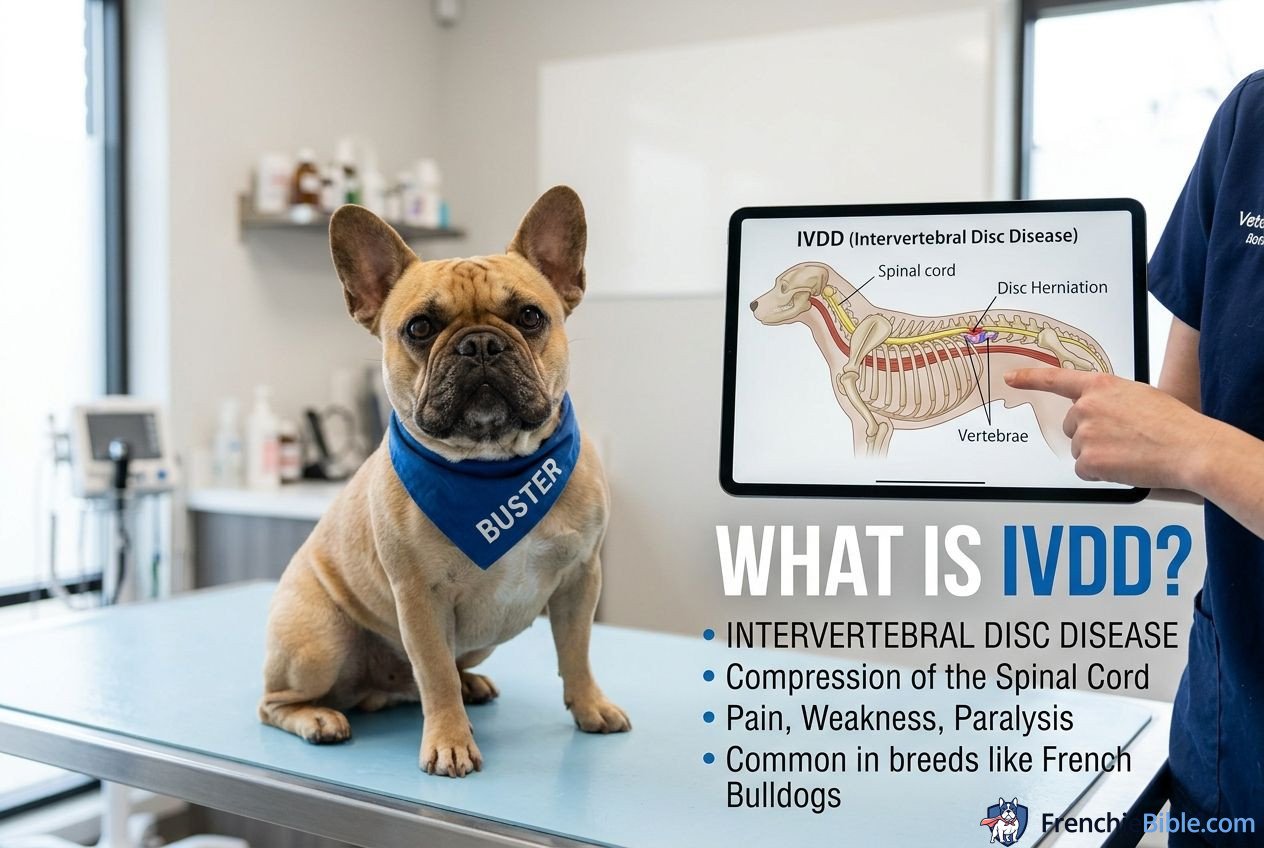
French Bulldogs have a genetic condition called chondrodysplasia (which causes their short, bowed legs). This same genetic mutation causes the discs in their spine to prematurely age, calcify, and turn brittle.
When a brittle disc is subjected to force—like jumping off a bed, twisting to catch a ball, or even just turning a corner too quickly—the outer shell of the disc tears. The jelly-like center violently explodes upward into the spinal canal.
The spinal canal is a closed, bony tunnel housing the delicate spinal cord. When the disc material shoots into this tunnel, it smashes into the spinal cord, crushing the nerves that send signals to the back legs, the bladder, and the bowels. The severity of the paralysis depends entirely on how hard the cord was hit and how quickly the pressure is removed.
The 5 Warning Signs of an IVDD Emergency
IVDD doesn’t always happen in one explosive moment. Sometimes, it is a slow leak. Recognizing the early warning signs before total paralysis sets in is the key to saving your dog’s mobility. If you see ANY of these signs, consider it a medical emergency.
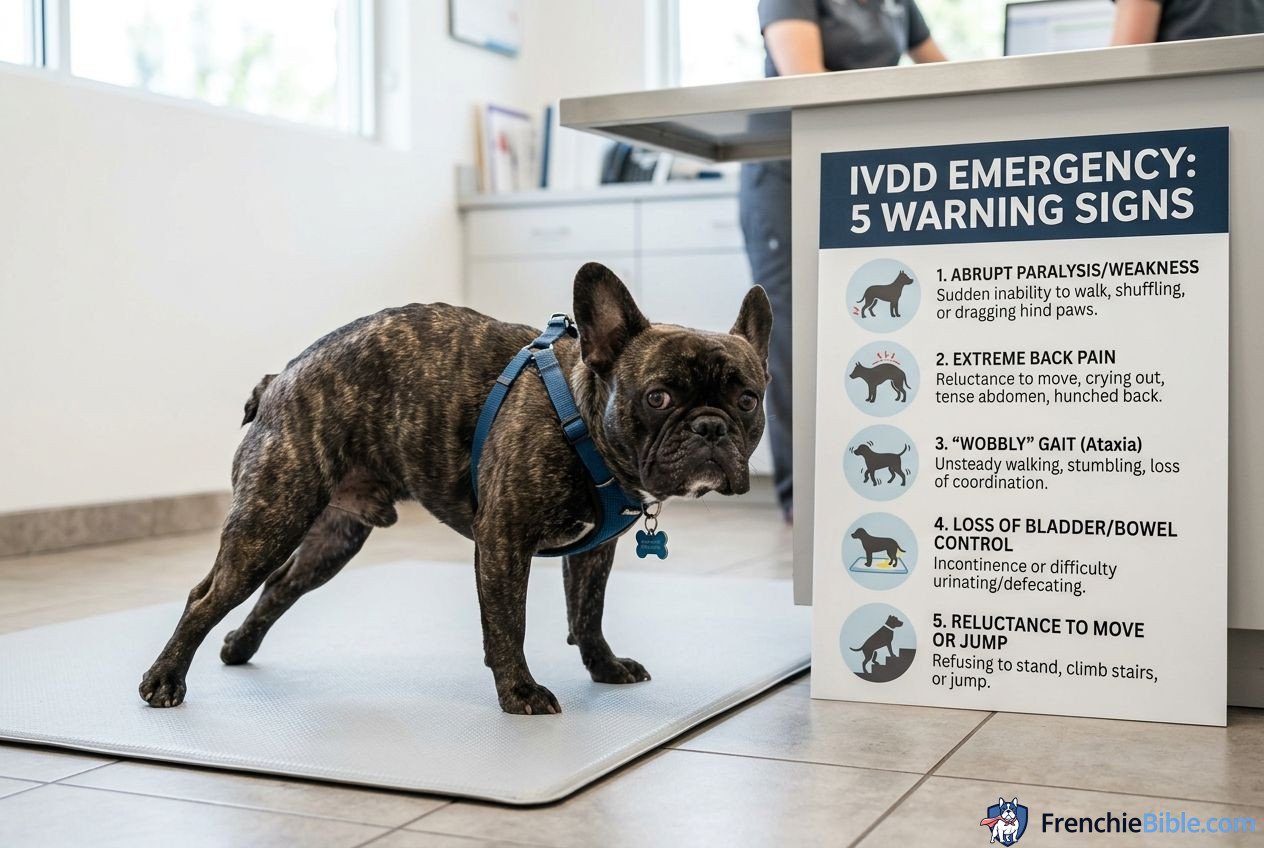
- The “Drunken Sailor” Walk (Ataxia): Your Frenchie is walking, but their back legs look uncoordinated. They might sway, cross their back paws over one another, or occasionally knuckle over (walking on the top of their toes instead of the pads).
- The “Hunched” Posture: They stand with their back arched up like a Halloween cat, their head held very low to the ground, and their neck stiff. They look incredibly tense.
- Shivering and Panting: Dogs hide pain. If your Frenchie is sitting quietly but shivering violently, panting heavily when the room is cool, or refusing to eat, they are likely experiencing severe spinal pain.
- Reluctance to Move: A normally playful dog suddenly refuses to jump on the couch, won’t climb the stairs, or cries out when you pick them up under the chest.
- Sudden Paralysis (Dragging Legs): The absolute red alert. Their front legs work fine, but their back legs are completely limp, dragging behind them like a seal.
The Immediate Action Plan: What to Do RIGHT NOW
If you witness any of the signs above, particularly dragging legs or severe back pain, follow these steps with militaristic precision.

Step 1: STRICT Crate Rest Immediately
Do not let them take another step. Do not let them try to walk it off. Do not massage their back. Pick them up immediately, keeping their spine as straight and level as possible, and place them into a small crate.
The crate must be small enough that they can only stand up and turn around, nothing more. Any further movement, twisting, or walking can force more disc material into the spinal canal, turning a treatable injury into permanent, irreversible paralysis. If you do not have a crate, put them in a small laundry basket or a highly confined space.
Step 2: Call the Nearest Emergency Vet or Neurologist
Do not wait for your primary vet to open on Monday morning. You must find an emergency hospital. Ideally, you want a hospital that has a Board-Certified Veterinary Neurologist on staff and an MRI machine on-site. Time is spine. If your dog loses “deep pain sensation” (the ability to feel a hard pinch on their toes), your window for successful surgery shrinks to less than 12 to 24 hours.
Step 3: Transport with Extreme Care
When transporting your Frenchie to the hospital, you must act like a paramedic moving a patient with a broken neck.
– Do not let them walk to the car.
– Slide a firm piece of cardboard, a wooden board, or a completely flat, rigid dog bed under them to act as a backboard.
– Carry them horizontally, supporting both their chest and their hindquarters simultaneously. Never pick them up by the armpits, letting their back legs dangle; this arches the spine and causes catastrophic damage.
– Place them flat on the floorboard or secure them tightly in the back seat so they cannot roll or fall during the drive.
What NEVER to Do During an IVDD Crisis
In the panic of the moment, owners often make fatal mistakes trying to comfort their dog.
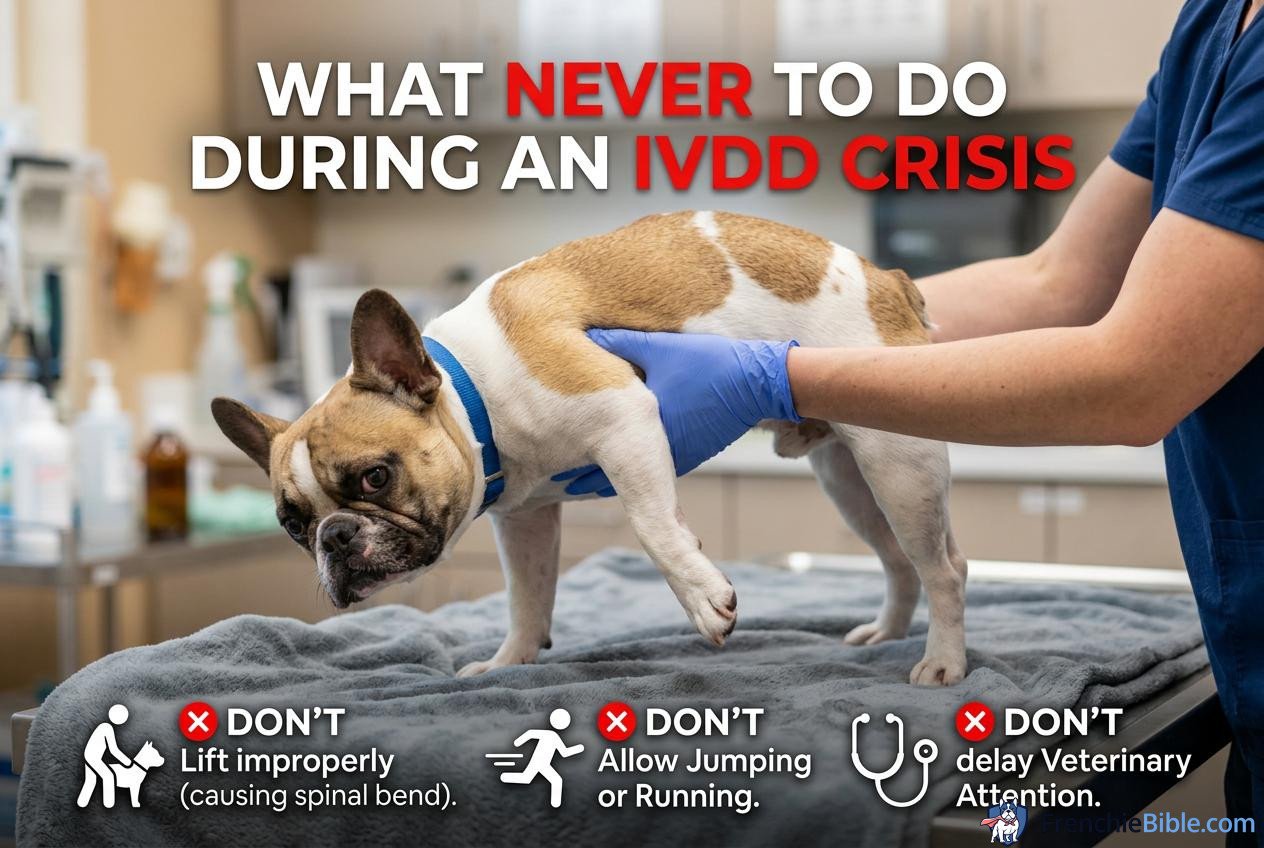
- NEVER give human pain medication. Ibuprofen, Tylenol, and Aspirin are highly toxic to dogs and will cause fatal stomach ulcers or kidney failure. Furthermore, if you mask the pain with medication at home, the dog will feel better, try to walk, and permanently severe their spinal cord.
- NEVER use a wheelchair immediately. Wheelchairs are for dogs who have permanently lost mobility after all surgical or medical options have been exhausted. Putting an acutely injured dog in a wheelchair forces their spine to move, worsening the herniation.
- NEVER try to “pop” or adjust their back. Do not attempt canine chiropractic maneuvers. The disc is ruptured; manipulating the spine will drive the fragments deeper into the nervous tissue.
What to Expect at the Veterinary Hospital
When you arrive at the emergency hospital, the veterinary team will immediately perform a neurological exam. They will test your Frenchie’s reflexes, check for ataxia, and crucially, they will test for “deep pain.” They will take a pair of hemostats (medical pliers) and pinch the dog’s toes. If the dog turns around and tries to bite them or yelps, that is fantastic news—the spinal cord is still transmitting signals. If the dog feels nothing, the prognosis drops significantly.
Medical vs. Surgical Management
Depending on the severity of the neurological exam, the vet will recommend one of two paths.
- Conservative/Medical Management: If your dog is in pain but can still walk, or if surgery is absolutely financially impossible, the vet may prescribe strict crate rest (6 to 8 weeks minimum) along with heavy anti-inflammatories, muscle relaxers, and nerve pain medications (like Gabapentin). The goal is to let the inflammation subside and allow scar tissue to form over the torn disc.
- Surgical Intervention (Hemilaminectomy): If your dog is paralyzed, surgery is the gold standard. The neurologist will perform an MRI to locate the exact ruptured disc. They will then take the dog to surgery, drill a hole through the vertebrae, and physically scrape the ruptured disc jelly off the spinal cord, relieving the pressure.
Prevention: The IVDD Lifestyle
While genetics load the gun, environment pulls the trigger. If you own a French Bulldog, you must live an “IVDD Prevention Lifestyle” from the day you bring them home as a puppy.
- Ban the Jumping: They must never jump on or off furniture. Train them to use ramps or doggy stairs.
- Use a Harness Only: Never walk a Frenchie on a collar. A collar puts pressure on the cervical (neck) discs. Use a well-fitted Y-harness.
- Keep Them Lean: Every extra pound of fat on a Frenchie’s belly pulls their spine downward, exacerbating the pressure on the discs. Keep them at an ideal, lean body weight.
Conclusion
Intervertebral Disc Disease is the nightmare scenario for any French Bulldog owner. It is violent, sudden, and heartbreaking. However, knowledge is power. By knowing the warning signs of ataxia, back pain, and dragging legs, and by understanding that immediate, strict crate rest and emergency veterinary transport are non-negotiable, you hold the power to save your dog from permanent paralysis. Treat your Frenchie’s spine like glass every single day, and be prepared to act instantly if the worst occurs.
Frequently Asked Questions (FAQs)
1. How much does IVDD surgery for a French Bulldog usually cost?
The financial reality of IVDD is harsh. Depending on your location and the specific hospital, the cost of the neurological consult, the MRI, the surgery itself, and a few days of ICU hospitalization typically ranges between $6,000 and $10,000 USD. This is the primary reason I demand all French Bulldog owners carry high-quality pet insurance.
2. What is the success rate of IVDD surgery?
If a dog is paralyzed but still has “deep pain sensation” in their toes, the success rate of a hemilaminectomy surgery is incredibly high—often over 90%. If the dog has lost deep pain sensation, the success rate drops to around 50%, and surgery must be performed within 12 to 24 hours of the deep pain loss for the best chance of recovery.
3. If I choose conservative management (no surgery), will my dog ever walk again?
It is possible, but highly dependent on the severity. Dogs with mild ataxia or just pain have a high recovery rate with 8 weeks of strict crate rest. However, for a dog that is completely paralyzed with no motor function, conservative management rarely restores the ability to walk. The pressure on the spinal cord must be physically removed via surgery.
4. Is laser therapy or acupuncture effective for IVDD?
Yes, but only as post-operative rehabilitation or as part of a conservative management plan after the acute emergency phase has passed. Laser therapy helps reduce inflammation and speed cellular healing, while acupuncture can help stimulate nerve regeneration. They do not replace the need for crate rest or surgery in an acute rupture.
5. Once my dog recovers from IVDD, can it happen again?
Unfortunately, yes. The genetic mutation (chondrodysplasia) affects every single disc in your dog’s spine. While the surgeon fixed the ruptured disc, the disc next to it, or the one in their neck, is still calcified and brittle. A dog who has suffered one IVDD episode is at a very high risk of having another one, making strict lifestyle management permanently mandatory.