Disclaimer: I am a French Bulldog specialist and breeder with over 10 years of experience, but this article is strictly for educational purposes and does not replace professional veterinary advice or certified behavioral training. If you suspect your French Bulldog has ingested a toxic substance, a foreign object, or poison, do not wait—contact your emergency veterinarian or Animal Poison Control immediately. Time is critical in poisoning cases.
As An Experienced Breedererinary professional specializing in French Bulldogs, one of the most common and terrifying emergencies I see in the clinic is gastrointestinal obstruction or toxicity. Frenchies are notorious scavengers. Their low-to-the-ground stature and insatiable curiosity mean their noses are constantly scanning the sidewalk like vacuum cleaners. Whether it is a discarded chicken bone, a piece of chocolate, rodent poison, or a moldy piece of trash, if it fits in their mouth, a Frenchie will likely try to swallow it.
Related Reading: Health & Diet | Frenchie Puppy Guide
When you see your dog pick up something dangerous, the natural human instinct is to panic, scream, and lunge at them to pry their jaws open. Unfortunately, this instinct triggers a reaction in your Frenchie that makes the situation much worse. In this comprehensive guide, we will explore the psychology of the “keep-away” game, why prying a Frenchie’s mouth open is dangerous, and how to reliably teach the life-saving “Drop It” and “Leave It” commands to protect your dog from street toxins and foreign body surgeries.
The Psychology of Scavenging and Resource Guarding
To stop your Frenchie from eating garbage, you must understand why they do it. Dogs explore the world with their mouths. For a French Bulldog, finding a piece of street trash is the equivalent of finding a hundred-dollar bill on the sidewalk. It is a high-value prize.

The Danger of the “Lunge and Pry”
When your Frenchie picks up a mystery object and you scream “NO!” and sprint toward them, you inadvertently trigger two instinctual responses:
1. The Game of Keep-Away: They think you are initiating a chase game. They will clamp their jaws shut and run away from you, chewing as fast as they can.
2. Resource Guarding / Panic Swallowing: If you manage to catch them and try to pry their jaws open, their bulldog tenacity kicks in. Because you are trying to steal their prize, they will instinctively swallow the object whole to prevent you from getting it. This panic swallowing is exactly how chicken bones get lodged in the esophagus or stomach, requiring emergency surgery.
To prevent this, we must reprogram both your reaction and your dog’s response. We need to teach the dog that spitting out their prize willingly results in an even better reward from you.
“Leave It” vs. “Drop It”: Understanding the Difference
These are two distinct commands that serve different purposes in your safety toolkit.
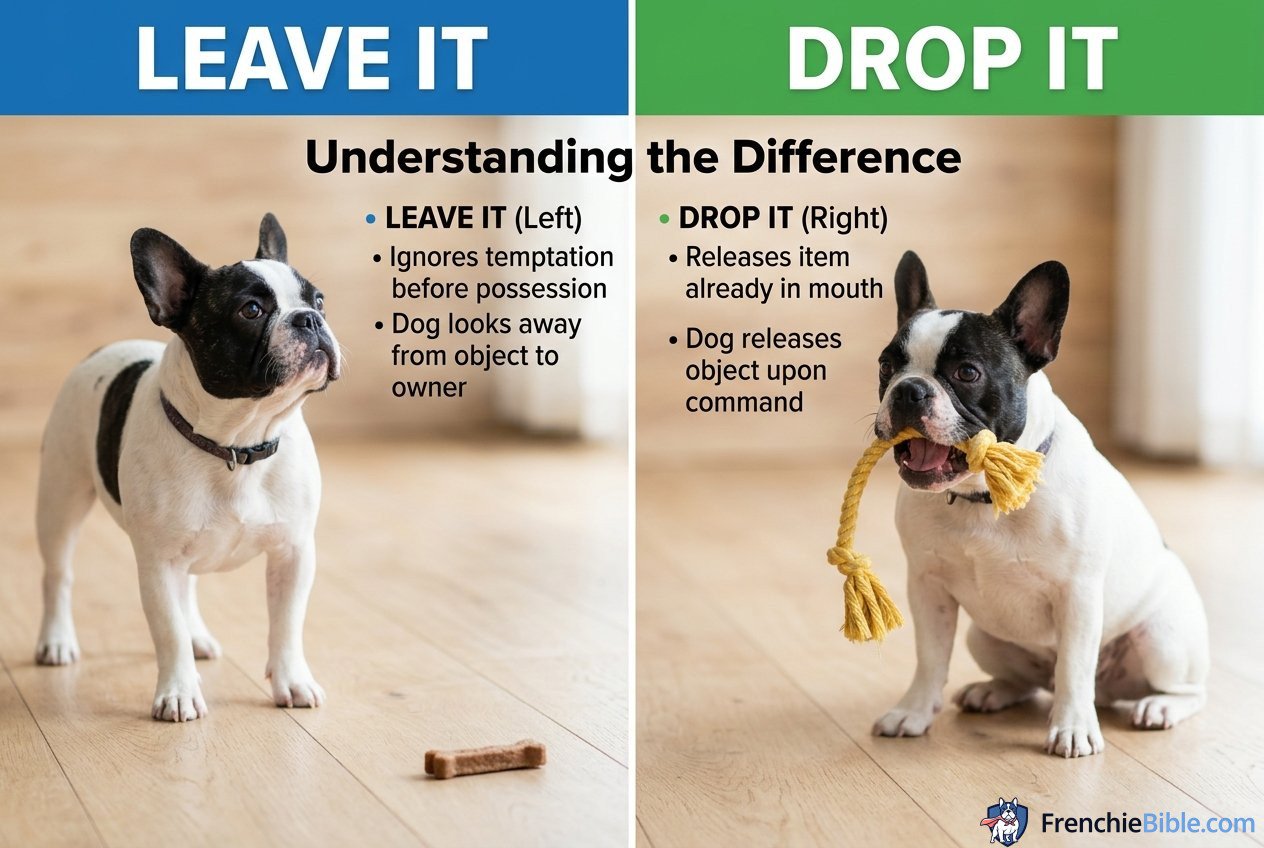
- “Leave It”: This is a preventative command. It means, “I see you looking at that dead bird on the sidewalk; do not put it in your mouth. Look at me instead.”
- “Drop It”: This is the emergency release command. It means, “You already have the dead bird in your mouth; open your jaws and spit it out immediately.”
Step-by-Step Training: The “Leave It” Command
Teaching “Leave It” is all about impulse control. We want the dog to learn that ignoring something they want actually earns them something better.
Phase 1: The Closed Fist Exercise
- The Setup: Sit on the floor with your Frenchie. Have a low-value treat (like a piece of their regular kibble) in your left hand, and a high-value treat (like a piece of hot dog or cheese) hidden in your right hand behind your back.
- The Action: Present your left hand to the dog with the kibble inside, keeping your fist closed. Your dog will sniff, lick, and perhaps paw at your closed fist trying to get the kibble. Do not say anything. Just wait patiently.
- The Breakthrough: Eventually, your dog will get frustrated and pull their nose away from your fist, even if just for a second, to look at your face.
- The Reward: The exact millisecond they pull away and look at you, say “Yes!” enthusiastically. Open your right hand (from behind your back) and give them the high-value cheese. (Do not give them the kibble from the left hand).
- Add the Cue: Repeat this 10 times. Once the dog is consistently ignoring the closed fist immediately, say “Leave It” right before you present the fist.
Phase 2: The Floor Exercise
Once they master the closed fist, place the low-value kibble on the floor and cover it with your shoe. Say “Leave It.” When they stop investigating your shoe and look up at you, mark with “Yes!” and reward with the high-value cheese from your hand. Progress to doing this with the treat uncovered, always keeping your foot ready to cover it if they try to snatch it.
Step-by-Step Training: The “Drop It” Command
“Drop It” requires teaching the dog the concept of trading up. They must believe that whatever you have is vastly superior to what is currently in their mouth.
Phase 1: The Toy Trade
Never start teaching “Drop It” with high-value items like bones or food. Start with low-value toys.
1. The Setup: Engage your Frenchie in a mild game of tug-of-war with a standard rope or plush toy. Have several extremely high-value treats (like liver paste or chicken) ready in your pocket.
2. The Action: While the dog has the toy in their mouth, stop pulling. Go completely dead and still. A dead toy is boring to a dog.
3. The Trade: Bring the high-value treat right up to their nose. The moment they open their mouth to eat the treat, the toy will drop.
4. The Cue: As the toy falls from their mouth, clearly say “Drop It.” Feed them the treat.
5. The Reward Return: Here is the crucial secret: give the toy back to them immediately. This teaches the dog that dropping an item doesn’t mean they lose it forever; it just means they get a snack, and then the game continues.
Phase 2: The High-Value Trade
Once they reliably drop toys, practice trading with slightly higher value items, like a dental chew. Always trade for something vastly superior. If they have a dental chew, trade for a piece of steak.
Note: In a real-life street scenario, if they pick up something toxic, you obviously will not give the toxic item back to them. But because you have practiced the “Drop It/Return” game hundreds of times at home, their muscle memory will cause them to drop the street trash automatically upon hearing the command, expecting a treat.
Emergency Tactics: When Training Fails
Even the best-trained Frenchie might find a piece of street pizza too tempting to drop. If you are on a walk, they grab something dangerous, and they refuse to “Drop It,” you must act safely to prevent panic swallowing.
- Do Not Pry the Jaws: If you try to pull their jaws apart, they will clamp down harder.
- The Treat Scatter: If you carry treats on your walk (which you always should!), take a handful of high-value treats and throw them directly onto the ground in front of the dog’s nose. Often, the instinct to eat 10 pieces of cheese off the ground will override the desire to hold onto the single chicken bone. They will drop the bone to eat the cheese, allowing you to kick the bone away safely.
- The Gentle Squeeze (Last Resort): If the item is highly toxic and they are actively trying to swallow, gently press the dog’s lips inward against their own teeth. The slight discomfort of biting their own lip will often cause them to open their mouth, allowing you to hook the item out with your finger. Be extremely careful not to get bitten.
Conclusion
Teaching your French Bulldog the “Leave It” and “Drop It” commands is an investment in their longevity and your peace of mind. As a breed prone to severe gastrointestinal complications and breathing difficulties under anesthesia (which is required for foreign body removal surgeries), prevention is absolutely paramount. By understanding their scavenging psychology, avoiding the panic-inducing “lunge and pry” reflex, and consistently practicing positive reinforcement “trade-up” games, you can confidently navigate city streets and dog parks knowing you have the verbal tools to save your dog’s life.
Frequently Asked Questions (FAQs)
1. What are the most common toxic items French Bulldogs pick up on walks?
Common urban and suburban hazards include chicken bones (which splinter and puncture the intestines), discarded chewing gum (often containing Xylitol, which is deadly to dogs), chocolate wrappers, rodenticide (rat poison), and moldy food which contains neurotoxic tremorgenic mycotoxins.
2. My Frenchie guards their toys and growls when I try to teach “Drop It.” What should I do?
If your dog is actively growling and resource guarding, stop training immediately. Pushing a guarding dog can lead to a bite. You need to consult a certified veterinary behaviorist to work through the resource guarding safely before continuing standard obedience training.
3. Is it too late to teach an older Frenchie the “Drop It” command?
Never! While puppies learn faster because they are blank slates, older dogs are highly capable of learning new tricks, especially when high-value food is involved. It just requires more patience and consistency to overwrite their old habits.
4. What is the absolute best treat to use for trading during “Drop It” training?
You need something smelly, soft, and irresistible. Boiled chicken breast, plain hot dogs (in tiny pieces), freeze-dried liver, or a squeeze tube of dog-safe peanut butter or liver paste are excellent choices. Hard kibble will not work for this training.
5. If my dog swallows something dangerous, should I induce vomiting at home?
Never induce vomiting in a French Bulldog without direct veterinary supervision. Because they are a brachycephalic (flat-faced) breed, they are at an exceptionally high risk of aspiration pneumonia—inhaling the vomit into their lungs—which can be fatal. Rush them to an emergency vet clinic immediately.
Disclaimer: I am a French Bulldog breeding expert with over a decade of hands-on experience with this breed. I am not An Experienced Breedererinarian. The information in this article is for educational purposes only. Always consult your veterinarian regarding your dog’s specific health needs and care.
Disclaimer: I am a French Bulldog breeding expert with over a decade of hands-on experience with this breed. I am not a veterinarian. The information in this article is for educational purposes only. Always consult your veterinarian regarding your dog’s specific health needs and care.