as a French Bulldog expert and breeder and breeder with over a decade of clinical experience, I look forward to summer with a mix of dread and anxiety. Every year, as the mercury rises, my breeding program’s phone starts ringing with panicked owners. The sad reality is that summer is the most dangerous season for our flat-faced companions. Brachycephalic Obstructive Airway Syndrome (BOAS) isn’t just a clinical term; it’s a structural reality that turns a hot summer day into a life-threatening gauntlet for your Frenchie.
If you’re wondering, “Can my French Bulldog go out in the summer?” the answer is yes, but with extreme caveats, precise timing, and a deep understanding of ambient temperature versus humidity. This comprehensive guide will walk you through exactly when it is safe to take your Frenchie outside, how to read the weather like a professional, and what to do if the worst happens. Let’s keep your bat-eared best friend safe this summer.
Related Reading: Training & Behavior | Grooming & Care | French Bulldog Colors
Why Summer is the Deadliest Season for French Bulldogs
To understand why heat is so dangerous for French Bulldogs, we must look under the hood. As an owner, you already know they have flat faces, but the implications go far beyond their adorable appearance.
The Anatomy of a Brachycephalic Breed
French Bulldogs have been selectively bred to have a shortened skull, but the soft tissues inside their mouth and throat did not shrink proportionally. This results in an elongated soft palate, stenotic nares (pinched nostrils), everted laryngeal saccules, and often a hypoplastic (narrow) trachea. Imagine trying to breathe through a cocktail straw while wearing a heavy winter coat—that is what a Frenchie experiences when exerting themselves. Their compromised airway means they simply cannot move enough air to effectively oxygenate their bodies or cool down.
How Dogs Cool Down vs. How Frenchies Fail to Cool Down
Dogs do not sweat through their skin like humans do; their primary mechanism for thermoregulation is panting. Panting works by evaporating moisture from the tongue, nasal passages, and the lining of the lungs, drawing heat away from the body.
For a normal dog with a long snout (like a Labrador), the elongated nasal cavity provides a large surface area for this evaporative cooling. A Frenchie, however, lacks this real estate. Their short snouts provide minimal cooling surface. Furthermore, because their airways are already partially obstructed, the rapid breathing required for panting causes the soft tissues in their throat to swell from friction and inflammation. This creates a terrifying feedback loop: they get hot, they pant harder, their airway swells, they can move even less air, and their body temperature skyrockets.
The Hidden Danger: Humidity Multiplier
Temperature is only half the story. As a clinician, I constantly remind owners to look at the humidity index. Because panting relies on evaporative cooling, high humidity in the air prevents the moisture in your dog’s mouth from evaporating. If the humidity is over 70%, even a seemingly mild temperature of 72°F (22°C) can be fatal for a Frenchie with severe BOAS. Always look at the “Feels Like” temperature and the humidity percentage before grabbing the leash.
The Official French Bulldog Safe Temperature Walking Chart
Over my years of practice, I have developed a rigid temperature traffic-light system. Print this out, stick it on your fridge, and live by it. Note: These temperatures assume a moderate humidity level (under 50%). If humidity is high, drop every threshold down by 5 degrees Fahrenheit.
Green Zone: Under 68°F (20°C) – Safe and Fun
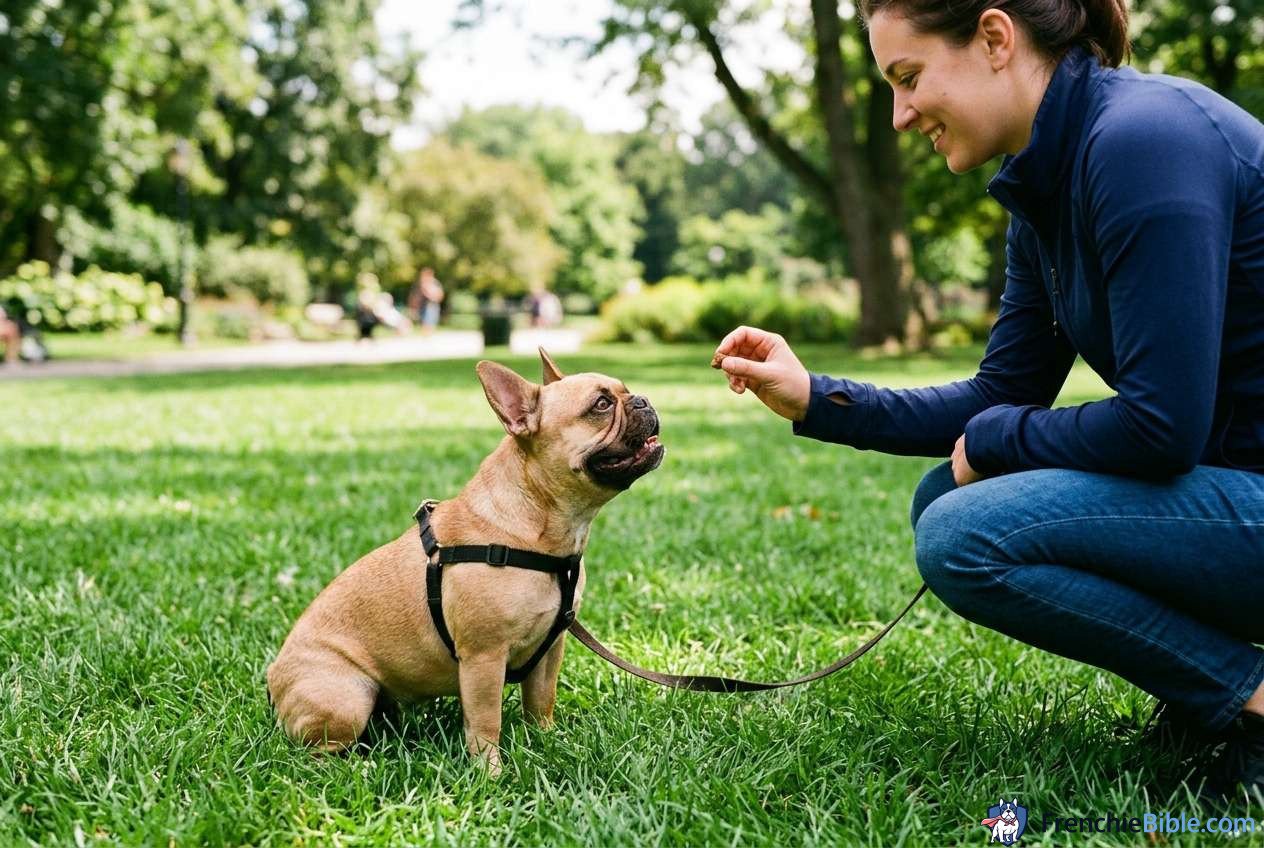
When the temperature is below 68°F, the vast majority of French Bulldogs can enjoy their standard walks. This is the optimal temperature for your dog to explore, sniff, and get their daily exercise.
- Action: Normal walking, up to 30-45 minutes.
- Precaution: Still carry water, and monitor for any abnormal breathing, especially if your dog has severe BOAS.
Yellow Zone: 69°F to 75°F (21°C to 24°C) – Proceed with Caution
This is where inexperienced owners make mistakes. 75 degrees feels lovely to a human in a t-shirt, but to a Frenchie, it’s getting uncomfortably warm. The pavement is starting to hold heat, and evaporative cooling is becoming less efficient.
- Action: Limit walks to 15-20 minutes. Walk early in the morning (before 8 AM) or late in the evening (after 8 PM).
- Precaution: Walk in shaded areas exclusively. Bring cold water. Do not encourage running or intense play. Keep a close eye on the color of their tongue—if it turns dark red or purple, stop immediately.
Orange Zone: 76°F to 82°F (25°C to 28°C) – Danger Approaching
At this temperature range, taking a Frenchie for a traditional walk is playing Russian Roulette. Their core temperature can elevate to dangerous levels within 10 minutes.
- Action: Potty breaks only. A quick 3-5 minute trip to the grass to do their business, and immediately back into the air conditioning.
- Precaution: No sustained walking. Do not walk on asphalt (it can burn their paw pads and radiates heat upward directly into their chest). Use a cooling vest just for the potty break if your dog is particularly heat-intolerant.
Red Zone: Over 82°F (28°C) – Strictly Indoors Only
I cannot emphasize this enough: at 82°F and above, do not walk your French Bulldog. Period. Every summer, I see dogs lose their lives because owners thought “just a quick walk around the block” would be fine.
- Action: Indoor activities only. Potty breaks should be restricted to shaded grass, lasting no more than 2 minutes.
- Precaution: Keep the home air-conditioned. If you do not have AC, use cooling mats and fans, and keep the dog in the coolest room of the house.
Recognizing the Early Warning Signs of Heatstroke in Frenchies
Time is tissue. When a Frenchie begins to overheat, you have mere minutes to reverse the trend before permanent organ damage or death occurs. Knowing the subtle early signs is your best defense.
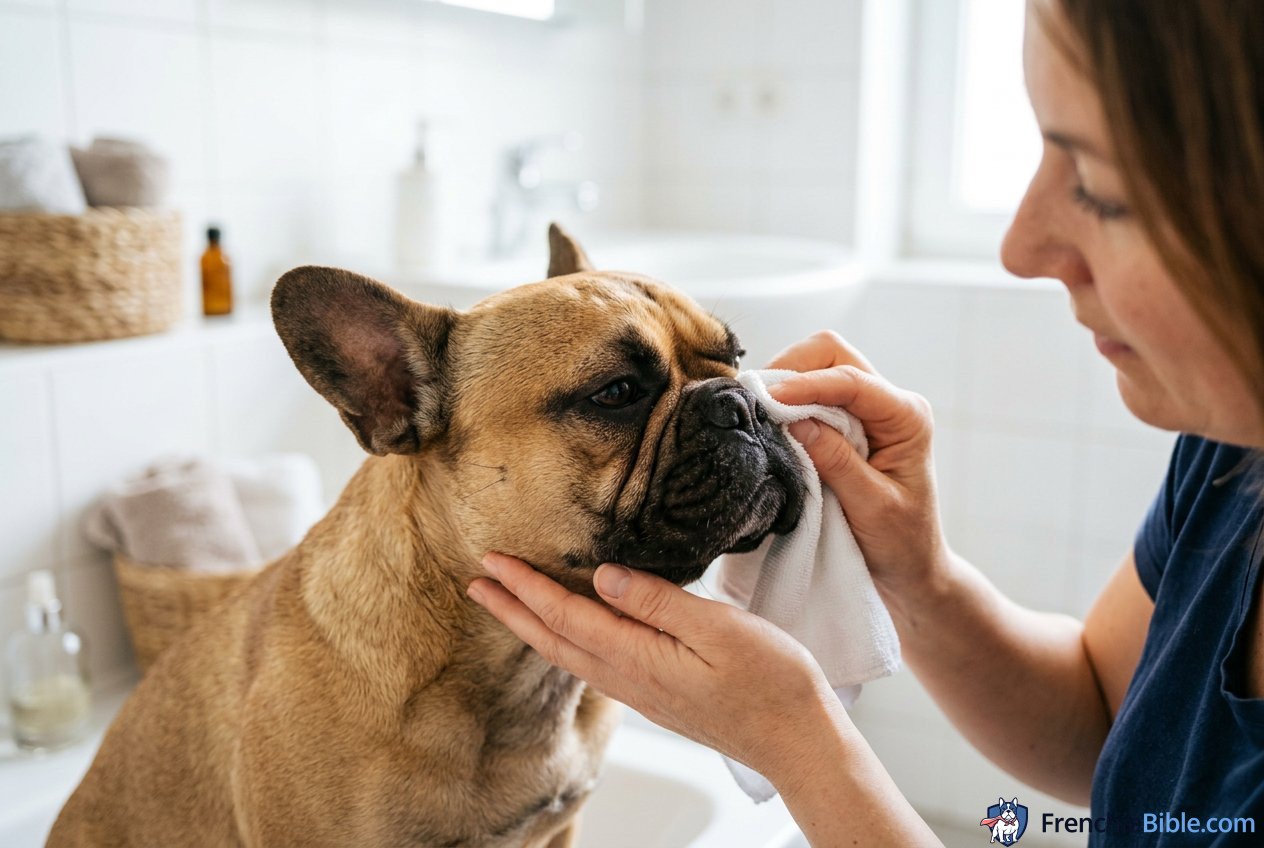
Subtle Signs You Might Miss
Before a dog collapses, their body sends warning signals. Look for:
- Excessive, frantic panting: Not just normal panting, but wide-mouthed, desperate breathing where the corners of the mouth are pulled far back.
- Flattened ears and wide eyes: A look of panic or distress.
- Seeking shade or refusing to walk: If your Frenchie suddenly drops to the grass and refuses to move, DO NOT pull them. They are telling you their body is failing.
- Thick, ropey saliva: As dehydration sets in, their saliva becomes extremely thick and sticky, hanging from their jowls.
The “Roaring” Breath: When BOAS Meets Heat
As mentioned earlier, panting causes airway swelling. In Frenchies, this creates a distinct, horrifying sound. It starts as a loud snorting, progresses to a raspy wheeze, and eventually sounds like a roaring or sawing noise. This is the sound of a dog suffocating because their laryngeal tissues are swollen shut. If you hear this, you are in a medical emergency.
Emergency Symptoms Requiring Immediate Action
If you see any of these signs, your dog is in active heatstroke (hyperthermia):
- Dark red, purple, or blue gums and tongue (cyanosis).
- Vomiting or diarrhea (sometimes bloody).
- Incoordination, stumbling, or a “drunken” gait.
- Collapse, seizures, or loss of consciousness.
My Clinical Protocol: What to Do If Your Frenchie Overheats
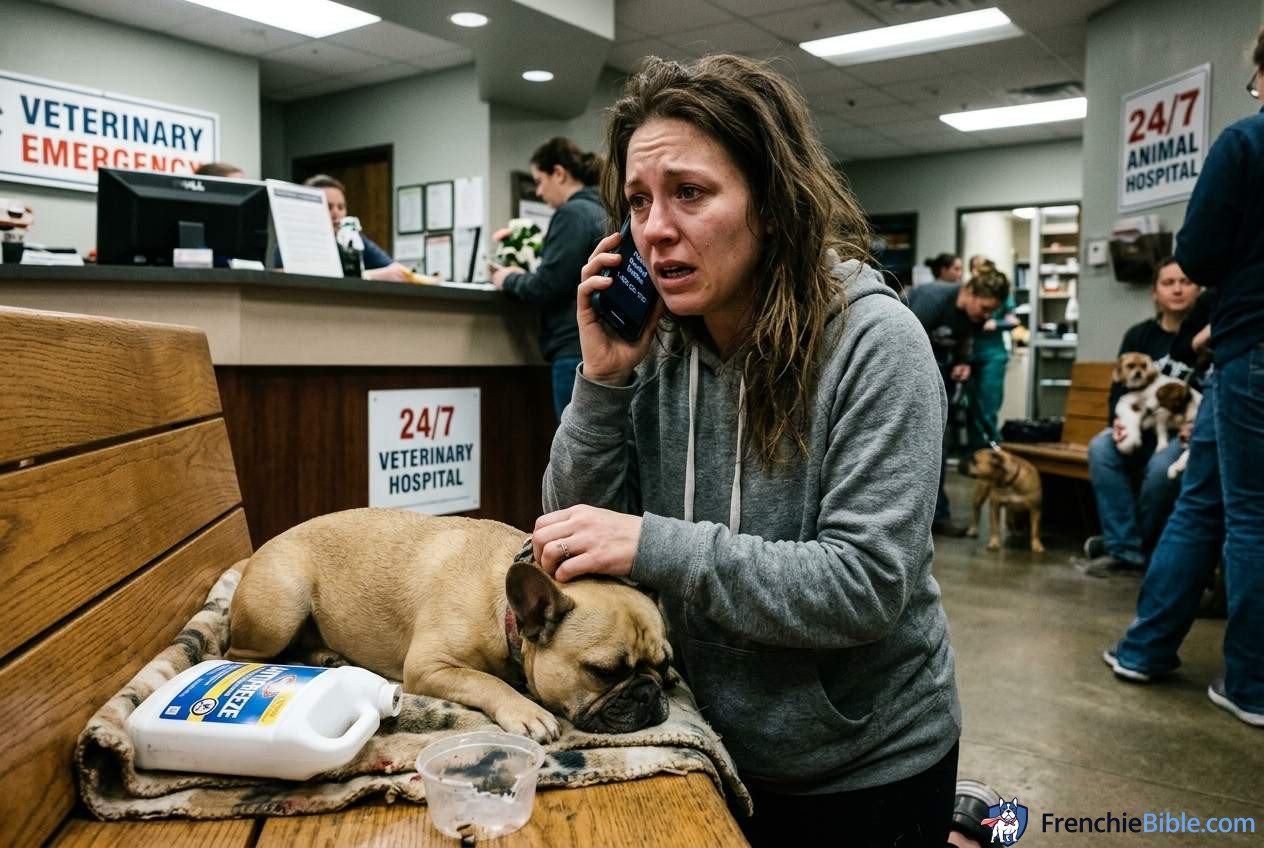
If you suspect heatstroke, your actions in the next 10 minutes will determine if your dog lives or dies. Do not wait to see if they get better.
First Aid at Home (Before the Vet)
- Remove from the heat: Immediately get the dog into an air-conditioned space.
- Begin active cooling: Wet the dog down with cool (NOT ice cold) water. Focus on the belly, armpits, and groin area where blood vessels are close to the skin.
- Create airflow: Put a fan directly on the wet dog. The evaporation is what will bring the core temperature down.
- Offer water, but do not force it: Let them drink cool water if they are able, but do not force water down their throat, as a gasping dog can easily aspirate water into their lungs.
What NOT to Do (Common Mistakes that Cause Shock)
- NEVER use ice baths or freezing water: This is a fatal mistake. Ice water causes the blood vessels in the skin to constrict instantly (vasoconstriction). This traps the boiling hot blood in the core of the body, cooking the internal organs, and sends the dog into shock.
- Do not cover them in wet towels: While a wet towel seems like a good idea, it acts as an insulating blanket, trapping the heat against the body. If you use a wet towel, you must continuously wipe the dog and remove the towel immediately.
- Do not delay veterinary care: Even if the dog seems to recover after you cool them down, their internal organs (especially the kidneys and GI tract) may have sustained severe damage that won’t show up for 24 hours.
Veterinary Interventions: What We Do in the Clinic
When you rush your overheated Frenchie into my breeding program, we go into triage mode. We administer IV fluids to combat shock and support the kidneys. We provide pure oxygen therapy, sometimes requiring us to sedate and intubate the dog to bypass their swollen upper airway. We administer medications to reduce brain swelling and prevent gastrointestinal ulceration. It is intensive, expensive, and not always successful, which is why prevention is everything.
Safe Summer Alternatives to Outdoor Walks
Just because it’s in the Red Zone outside doesn’t mean your Frenchie has to be a bored couch potato. Mental fatigue can be just as exhausting as physical fatigue.
Mental Stimulation Over Physical Exertion
Ten minutes of intense sniffing and problem-solving burns as much energy as a 20-minute walk. Ditch the food bowl and feed your Frenchie their meals out of puzzle toys, snuffle mats, or Kongs frozen with dog-safe broth and kibble. The act of licking is also naturally soothing and helps lower their heart rate.
Indoor Agility and Scent Games
Set up a mini obstacle course in your living room using cushions and broomsticks. Keep the jumps low to protect their fragile spines (IVDD is a constant risk). Alternatively, play “find it”—hide high-value treats around the house and let them use their nose to hunt them down.
Swimming: Is It Safe for Frenchies?
Generally, no. French Bulldogs are notoriously terrible swimmers due to their top-heavy build and short legs; they sink like adorable, dense little anvils. However, a shallow kiddie pool filled with 2-3 inches of cool water in a shaded patio is a fantastic way for them to cool their paws and belly. Always supervise them closely, and never assume they can swim. If you take them near deep water, a life jacket with a chin float is mandatory.
Cooling Gear and Summer Essentials for French Bulldogs
Technology has given us some great tools to help manage our dogs’ temperatures, but they must be used correctly.
Cooling Vests and Mats: Do They Work?
Cooling vests, which you soak in water and wring out, work well in dry, hot climates by facilitating evaporative cooling. However, in highly humid environments, they are useless and can actually trap heat. Know your local climate. Cooling mats filled with pressure-activated gel are excellent for indoors; place them in your dog’s favorite spot or crate.
Paw Protection: The Asphalt Rule
Place the back of your hand flat on the asphalt. If you cannot hold it there comfortably for 7 seconds, it is too hot for your dog’s paws. Pavement can be 40 to 60 degrees hotter than the ambient air temperature. If you must cross hot pavement for a potty break, use well-fitted dog booties or carry your Frenchie.
Portable Hydration Solutions
Never leave the house in the summer without a portable dog water bottle. I recommend the ones with an attached silicone trough. Offer water frequently, even if they don’t seem thirsty.
Conclusion: Better Safe Than Sorry
Owning a French Bulldog requires a fundamental shift in how you view the weather. Summer is not a time for long hikes or days at the beach with your dog. It is a time for strategic planning, early morning wake-ups, and an abundance of caution. Your Frenchie relies on you completely to make safe decisions for them, because their heart will push them to keep following you even when their body is failing. Respect the temperature chart, watch their breathing, and remember: skipping a walk will never kill a dog, but the summer heat absolutely can.
Frequently Asked Questions (FAQ)
Q1: Can I shave my French Bulldog for the summer to keep them cool?
No. French Bulldogs have a single coat that naturally regulates their temperature and protects their skin from sunburn. Shaving them offers no cooling benefit and exposes them to UV damage and insect bites.
Q2: My Frenchie loves to lay in the sun. Should I stop them?
Frenchies love sunbathing, but they lack the sense to know when they are overheating. You can allow them to sunbathe indoors near a window with AC running, or outside for strictly monitored periods of 3-5 minutes, but you must bring them in before they start heavily panting.
Q3: Does BOAS surgery help them tolerate the heat better?
Yes, significantly. Surgeries to widen stenotic nares and shorten an elongated soft palate open up the airway, drastically improving their ability to pant effectively. However, it does not turn them into a Labrador; even post-surgery, a Frenchie is still highly susceptible to heat and must be protected.
Q4: Is it safe to use a stroller for my Frenchie in the summer?
A mesh stroller with a battery-operated fan can be a great way to include your dog in outdoor activities without making them walk. However, the ambient air is still hot. You must monitor them closely and ensure the stroller is well-ventilated, as closed strollers can become greenhouses.
Q5: What is the normal temperature for a French Bulldog?
A dog’s normal body temperature ranges from 101.0°F to 102.5°F (38.3°C to 39.2°C). If their temperature exceeds 104°F (40°C), they are entering a dangerous hyperthermic state.
Disclaimer: We are not veterinarians and do not hold veterinary medical licenses. The information provided in this article is based on years of breeding and daily care experience and is for educational purposes only. It should not replace professional veterinary advice. Always consult with a licensed veterinarian if you have concerns about your French Bulldog’s health or before starting any new treatment.
Disclaimer: I am a French Bulldog breeding expert with over a decade of hands-on experience with this breed. I am not a veterinarian. The information in this article is for educational purposes only. Always consult your veterinarian regarding your dog’s specific health needs and care.