Medical & Legal Disclaimer: The information provided in this article is for educational and informational purposes only and does not constitute professional veterinary medical advice, diagnosis, or treatment. While we are highly experienced French Bulldog breeders and breed advocates, we are NOT your licensed, attending veterinarian. Every dog’s anatomy is unique. If your French Bulldog is experiencing shortness of breath, blue/pale gums, frequent regurgitation, or severe snoring, please contact a licensed emergency veterinarian immediately. Delaying medical care for a brachycephalic breed can be fatal.
Scroll through social media, and you will see countless videos of French Bulldogs making cute “pig snorts” or loud snoring sounds while sleeping, accompanied by comments like “Aww, so cute!” or “Sleeping so soundly!”
Related Reading: Training & Behavior | Frenchie Puppy Guide | Best Food for Frenchies
But as an experienced breeder and someone who has studied Frenchie anatomy for years, those sounds don’t make me smile—they make me anxious.
Here is the brutal truth: A snoring French Bulldog is not “sleeping soundly.” They are fighting to pull air into their lungs.
This is the grim reality of Brachycephalic Obstructive Airway Syndrome (BOAS), the number one health threat to French Bulldogs. In this comprehensive guide, we will strip away the “cute” myths, dive into the hardcore anatomy of Frenchie BOAS, teach you how to assess your dog’s breathing at home, and show you how to protect their life.
The Hardcore Anatomy: What Exactly is Frenchie BOAS?
The Curse of the Short Skull: Less Bone, Same Amount of Tissue
Imagine taking the long muzzle of a normal dog (like a Labrador) and compressing it flat into a Frenchie’s face. The bones of the skull have been drastically shortened through genetic selection, but the soft tissues inside the mouth and nose have not decreased in volume.
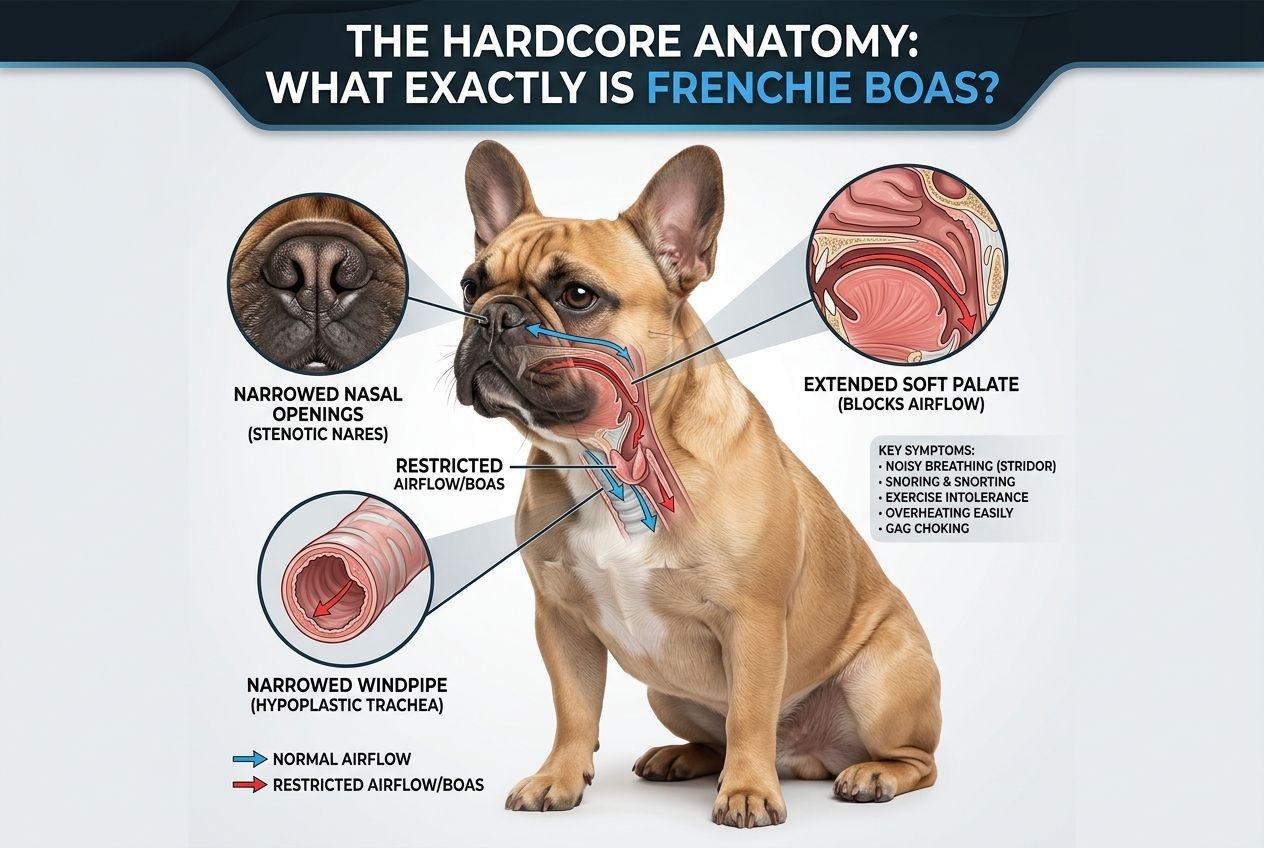
This excess meat has nowhere to go, so it bunches up and blocks the narrow throat.
The “Four Culprits” causing Frenchie breathing problems are:
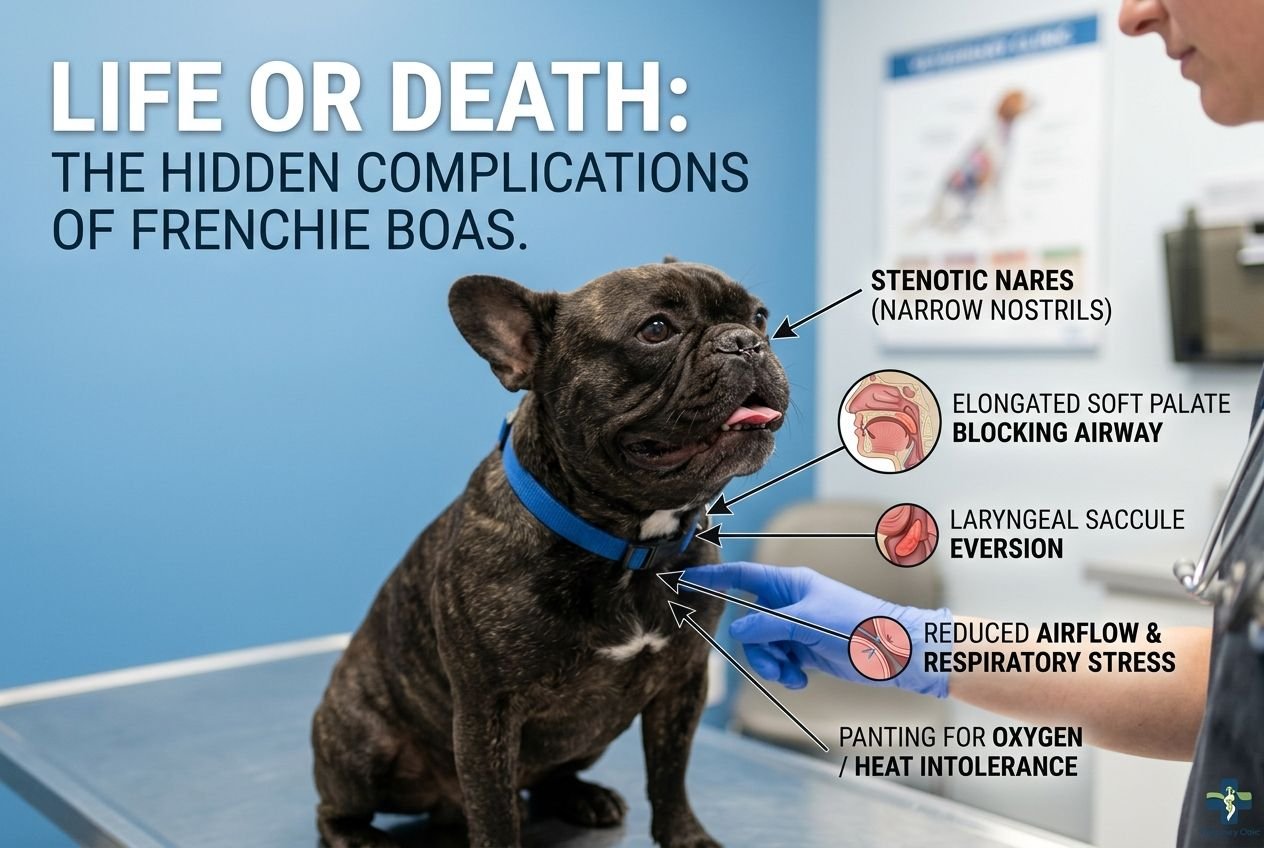
1. Stenotic Nares (Pinched Nostrils): Look at your Frenchie’s nose. If the nostrils look like closed, tight slits, your dog is essentially trying to breathe through a cocktail straw.
2. Elongated Soft Palate: The soft tissue on the roof of the mouth is too long and hangs down over the opening of the trachea (windpipe). Every time the dog breathes, this extra meat vibrates like a flag in the wind—this is where the “snoring” sound comes from. In severe cases, it acts like a stopper, blocking the airway entirely.
3. Everted Laryngeal Saccules: Because the dog constantly struggles to suck in air, the extreme negative pressure literally pulls small tissue sacs inside the throat inside-out, further clogging an already narrow airway.
4. Tracheal Hypoplasia: Some Frenchies are born with an abnormally narrow windpipe—a genetic defect that is very difficult to fix surgically.
The Danger Scale: How to Assess Your Frenchie’s Breathing at Home
As an owner, you must learn to grade your Frenchie’s breathing (Grade 0 to 3):
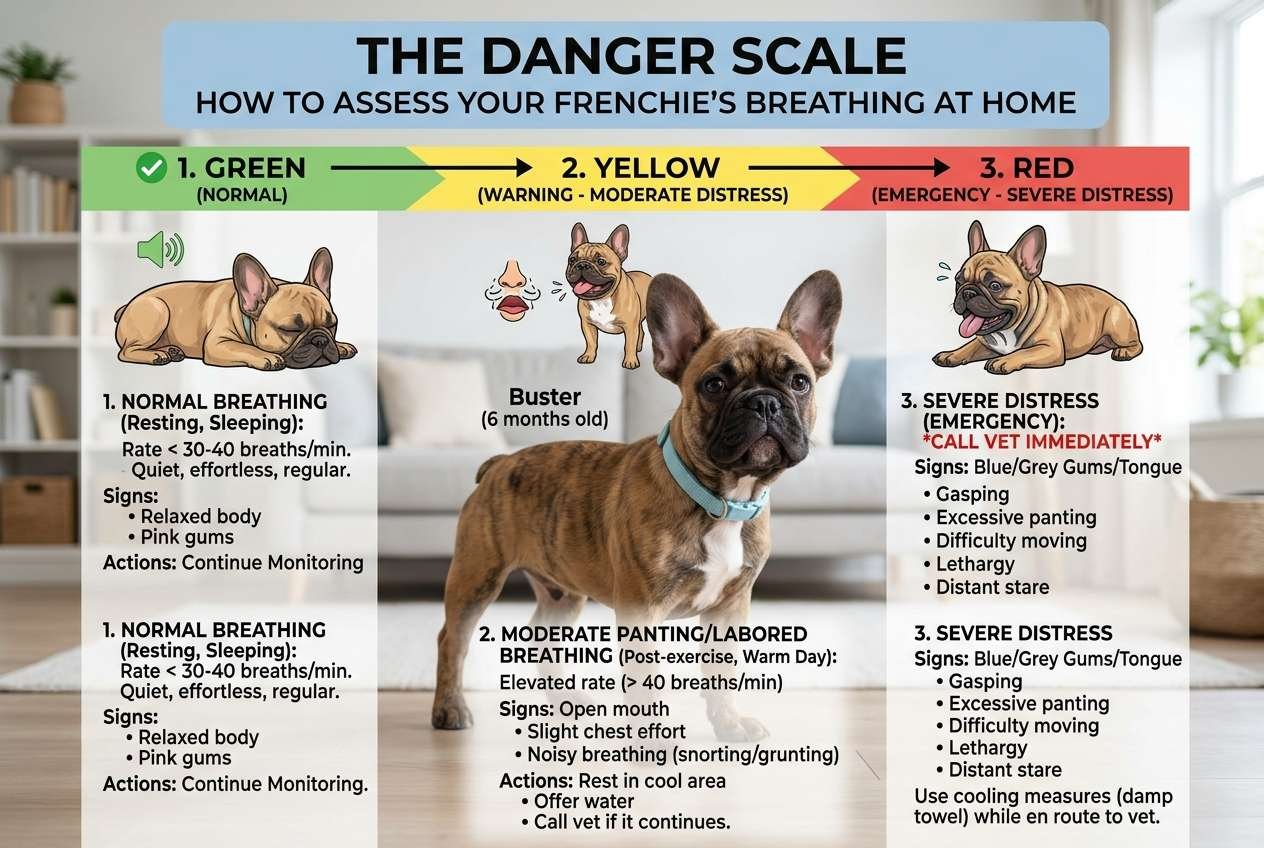
- Grade 0 (Perfect): You can barely hear them breathe, whether sleeping or playing.
- Grade 1 (Mild): Mild snoring when asleep, but they can walk normally in cool weather without heavy panting.
- Grade 2 (Warning): Loud “sawing wood” noises with minimal exertion or excitement. They may frequently wake themselves up from sleep gasping for air.
- Grade 3 (Critical): Constant heavy panting, refusal to exercise, struggling to breathe even when sitting still, and frequent blue or purple discoloration of the tongue and gums (Cyanosis).
The 75°F (24°C) Temperature Tolerance Test
If the temperature is just 75°F and your Frenchie starts aggressively panting with a wide, flat tongue after only 10 minutes of walking in the shade, their BOAS is severe.
Sleep Tracking: Cute Quirks or Survival Tactics?
Does your Frenchie like to sleep with their chin propped up on a toy or the edge of the bed? Do they sleep with a toy in their mouth? They aren’t trying to be cute. This is a compensatory sleeping position—they are physically trying to prop their airway open so they don’t suffocate in their sleep.
Life or Death: The Hidden Complications of Frenchie BOAS
BOAS doesn’t just affect the lungs; it destroys the entire body system. These are the secondary disasters most owners miss:
1. Digestive Collapse (Frequent Regurgitation)
This is a hardcore anatomical fact few people know: Because the airway is blocked, a Frenchie must expand its chest with immense force to draw in air. This creates a massive negative pressure vacuum in the chest cavity. This vacuum literally sucks stomach acid (and sometimes the stomach itself) up into the esophagus, causing hiatal hernias, acid reflux, and frequent vomiting of white foam.
2. Heatstroke: The Summer Killer
Dogs don’t sweat; they cool down by panting. A Frenchie with a blocked airway cannot expel heat. Taking a severe BOAS Frenchie out in the summer is like making them wear a winter parka in a sauna. They can suffer fatal heatstroke and brain death in a matter of minutes.
3. Right-Sided Heart Failure
Chronic oxygen deprivation leads to pulmonary hypertension, which eventually overworks the right side of the heart, leading to premature heart failure.
Veterinary Solutions: Soft Palate Surgery and Airway Widening
If your Frenchie is a Grade 2 or 3, do not hold onto the illusion that “they will grow out of it.”
The BOAS Surgery Explained
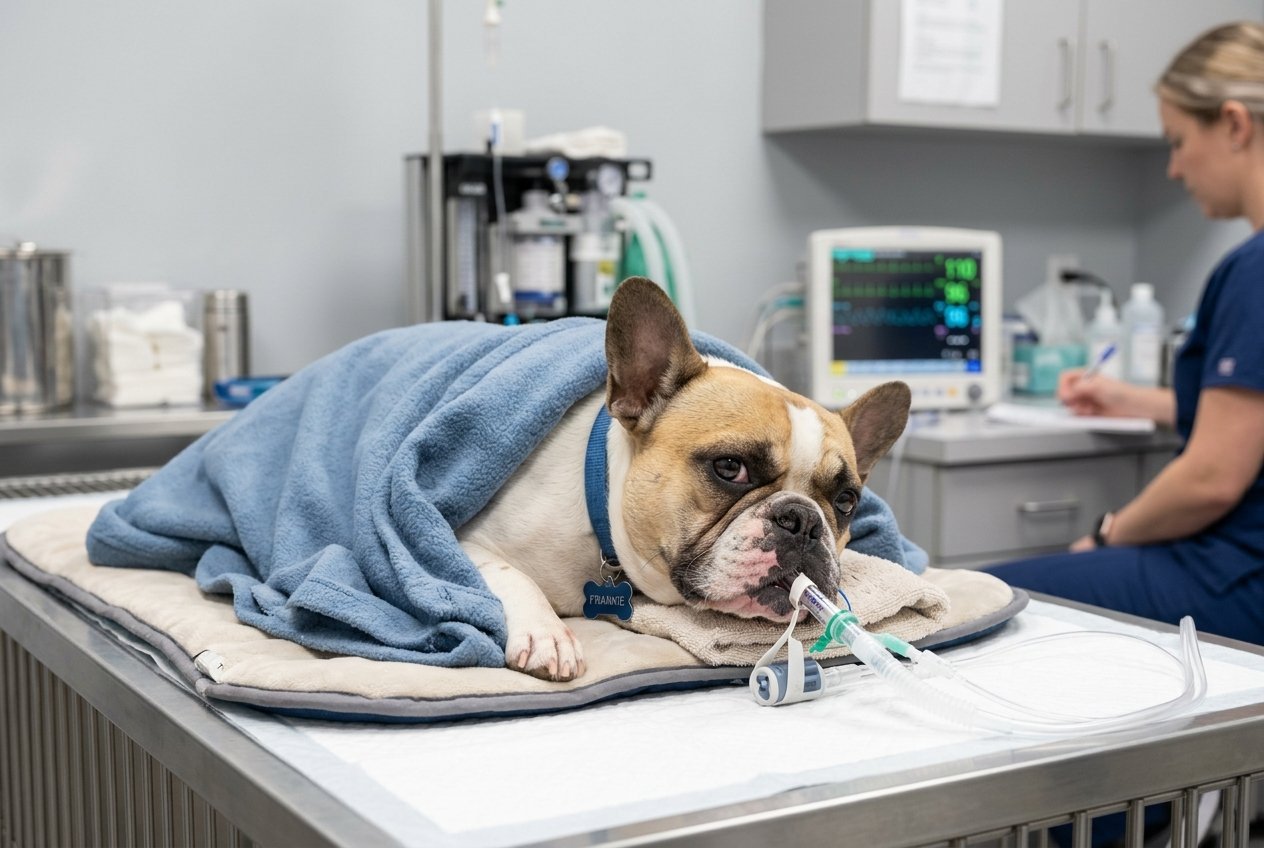
Surgical intervention is the only way to physically open a blocked airway. A board-certified veterinary surgeon will perform nares widening (cutting away a wedge of the nostril to open it up) and a soft palate resection (using a laser or scalpel to trim the excess meat hanging over the windpipe).
The Golden Window for Surgery
We highly recommend having a BOAS evaluation and necessary surgery done between 6 months to 1 year of age (often combined with their spay/neuter procedure). Doing it early, before the soft tissues become chronically inflamed and swollen from years of vibration, yields the best results and lowest risk.
The Breeder’s Survival Guide: Daily Care and Prevention
If your Frenchie has mild symptoms or is recovering from Frenchie soft palate surgery, you must follow these absolute rules to keep them safe:
- NEVER Use a Neck Collar: Throw away the collar immediately. You must ALWAYS use a well-fitted, Y-shaped harness. Any pulling on the neck directly crushes the trachea and instantly worsens BOAS.
- Ruthless Weight Management: Obesity is the final straw for a brachycephalic dog! Extra fat around the neck acts like an invisible hand choking your dog. Keeping your Frenchie lean (you should be able to feel their ribs) can reduce breathing effort by up to 50%.
- Climate and Stress Control: Never walk them between 10 AM and 6 PM during the summer. Keep the AC running. If they get overly excited and start making loud snorting noises, immediately place them in a quiet, cool crate to force them to calm down.
- Finding a Healthy Puppy: If you are buying a Frenchie, look at the parents! If the parents have closed nostrils and sound like tractors, the puppies will suffer. Ethical breeders perform BOAS functional grading on their breeding stock and only breed dogs that can breathe freely.
Conclusion: Love Them By Letting Them Breathe
The humor, loyalty, and affection of a French Bulldog are unmatched, but they are incredibly fragile creatures. We must stop romanticizing their “snoring” and arm ourselves with scientific knowledge.
As an owner, you are the only advocate for their breathing. Understand their anatomy, keep them lean, keep them cool, and don’t hesitate to consult a surgeon if they are struggling. Let’s make sure our Frenchies aren’t just living cute lives, but comfortable, breathable ones.
Frequently Asked Questions (FAQ)
Q1: Do all French Bulldogs need BOAS soft palate surgery?
A: No, not all. Some ethically bred Frenchies have open nostrils and appropriate palate lengths. However, a significant percentage do suffer from BOAS. A veterinary assessment is crucial to determine if surgery is medically necessary for your specific dog.
Q2: My Frenchie suddenly makes a terrifying honking/goose sound. Is they choking?
A: This is likely Reverse Sneezing, a common and usually harmless spasm caused by an irritant (dust, excitement) in the soft palate. Gently massage their throat or briefly cover their nostrils to force them to swallow, which usually stops the spasm. However, if it happens constantly, consult your vet.
Q3: After my dog recovers from BOAS surgery, can they run and play like a normal dog?
A: BOAS surgery vastly improves their quality of life, oxygen intake, and energy levels. However, they are still a brachycephalic breed. They will never be a marathon runner. You still must avoid extreme heat and intense, prolonged physical exertion to prevent heatstroke.