
【IMPORTANT LEGAL & MEDICAL DISCLAIMER】
The information provided in this article is based on over 10 years of experience in purebred French Bulldog breeding, canine genetics, and advanced husbandry. It is intended for educational and informational purposes only. We are professional breeders and canine breed experts, NOT licensed veterinarians. This content does not constitute, nor should it be interpreted as, professional veterinary medical advice, diagnosis, or treatment. If you have any concerns regarding your dog’s skin, vision, hearing, or overall health (especially concerning genetic conditions linked to rare coat colors), please consult your local licensed veterinarian immediately.
Introduction
When you finally decide to welcome a French Bulldog into your family, you probably spend hours scrolling through photos of adorable puppies online. Quickly, you’ll notice that the Frenchie market is flooded with a rainbow of coat colors: from the classic Brindle to striking “Lilacs,” and even spotted “Merles.” Unethical breeders often market these non-traditional colors as “extremely rare” and attach exorbitant, sky-high price tags to them.
Related Reading: Training & Behavior | Frenchie Puppy Guide | Best Food for Frenchies
But there is a dark trap hidden behind that price tag: you might be paying top dollar for genetic defects.
As a master breeder and care director with a decade of experience, I must warn you: insisting on AKC approved French Bulldog colors isn’t just about getting a piece of paper or competing in dog shows. It is a fundamental battle for your dog’s lifelong health and well-being.
Today, we are taking a deep dive into the purebred French Bulldog standard colors. We will visually break down the 4 healthy, AKC-approved base coats, teach you how to identify a truly purebred Frenchie through genetics and physical details, and expose the sickening truth behind those expensive “rare color” fads!
Why Insist on “AKC Standard Colors”? The Deep Link Between Color and Health
Many first-time buyers ask: “If I just want a cute family pet, why should I care if the color meets AKC standards?”
1. The True Purpose of the AKC Standard: Protecting the Gene Pool
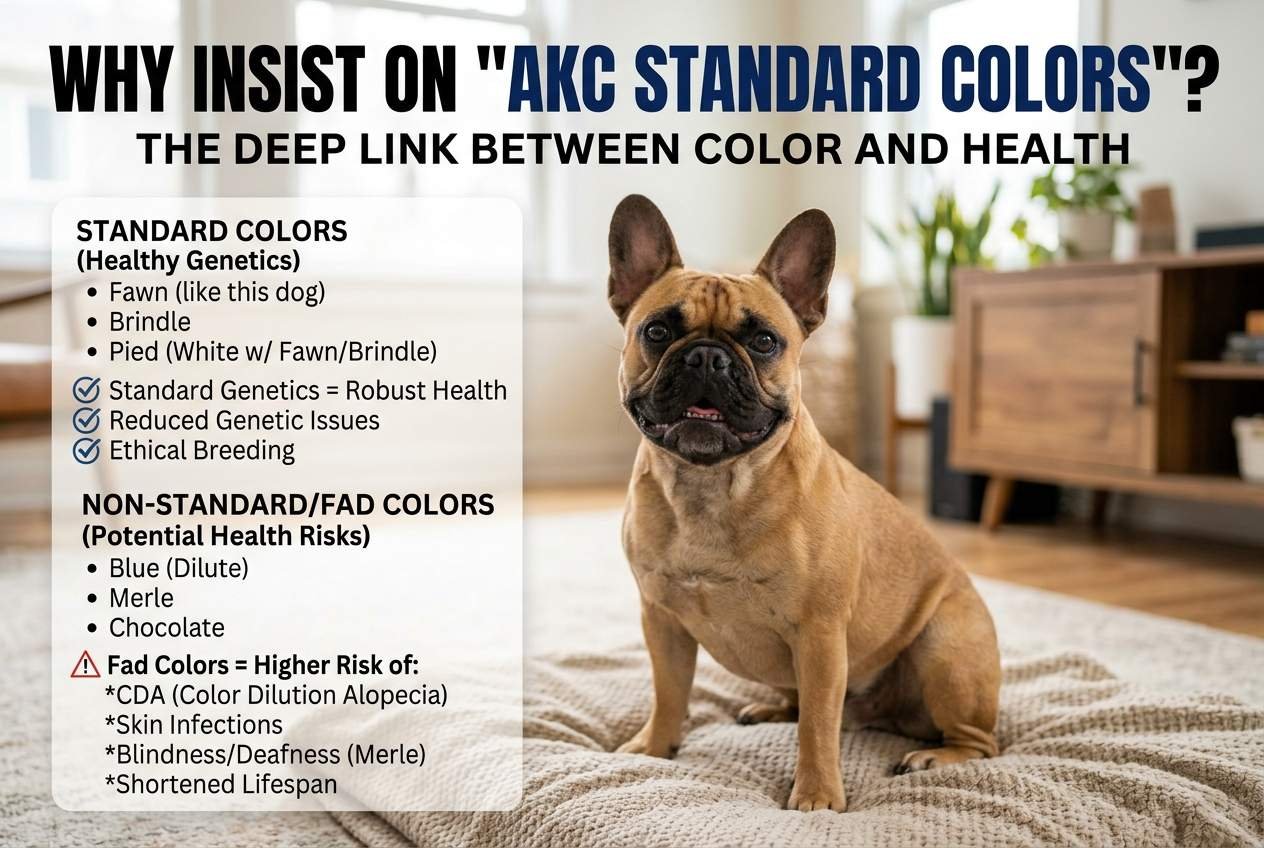
The American Kennel Club (AKC) and the French Bull Dog Club of America (FBDCA) did not set color standards just as a “beauty preference.” Over hundreds of years of selective breeding, these 4 standard colors (Brindle, Fawn, Cream, White/Pied) have proven to be the most genetically stable phenotypes. They do not carry the destructive recessive genes that cause severe health issues. Sticking to the standard protects the health foundation of the entire breed.
2. “Rare” Usually Means “Mutated and Sick”
Many so-called “exotic colors,” such as Blue or Merle, did not occur naturally in the French Bulldog lineage. They were either introduced by secretly crossbreeding with other breeds (like Chihuahuas or Australian Shepherds) or by heavily inbreeding dogs to amplify deadly recessive genetic mutations. These fad colors are heavily linked to compromised immune systems, incurable skin diseases, and even congenital deafness and blindness.
The Master Guide: 4 AKC Approved French Bulldog Colors
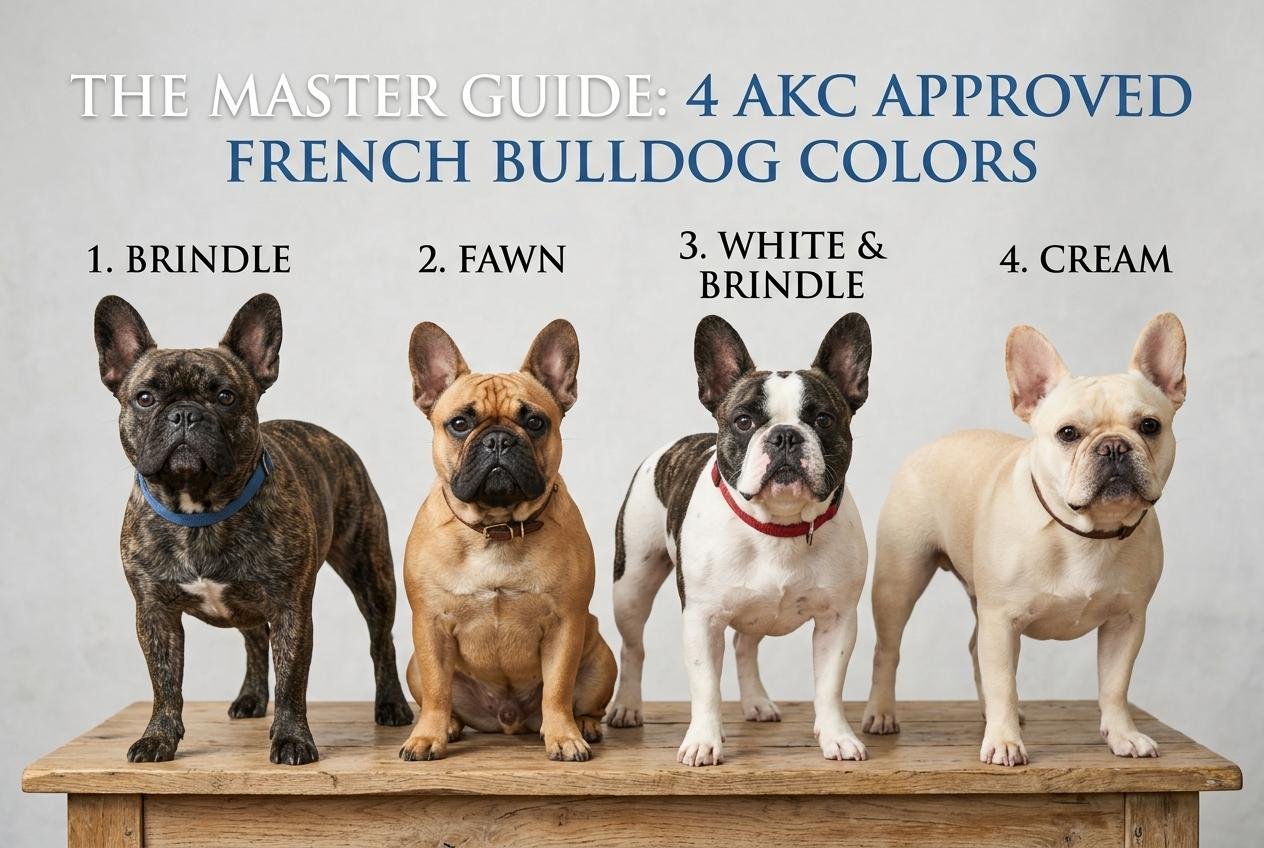
A healthy, purebred French Bulldog should naturally fall into one of these four fundamental categories:
1. Brindle: The Original Soul of the Frenchie
If you trace the lineage of the French Bulldog back to its origins, Brindle is the oldest and most traditional color pattern.
- Appearance: Brindle is not actually a solid color; it is a pattern. The base coat is fawn, which is then overlaid with black striping (similar to a tiger’s stripes).
- Variations: Brindle Frenchies come in a wide spectrum. You have Dark Brindle, where the black stripes are so heavy the dog looks almost solid black, except for traces of golden fawn shining through in the sunlight. Then there is Light/Tiger Brindle, where the light fawn base is prominent with thinner black stripes. A brindle Frenchie with a white chest patch is also completely acceptable and very common.
2. Fawn: The Elegant and Versatile Coat
Fawn Frenchies look incredibly elegant, boasting a smooth, even, and highly glossy coat.
- Appearance: The Fawn spectrum is vast. It ranges from a very light, sandy tan all the way to a deep, rich reddish-brown (Red Fawn).
- The Signature Mark: The Black Mask. A high-quality, standard-conforming Fawn Frenchie must possess a “Black Mask.” This means the hair around their muzzle, lips, and often extending up to their eyes, must be solid black. A fawn without a black mask is heavily penalized in the show ring.
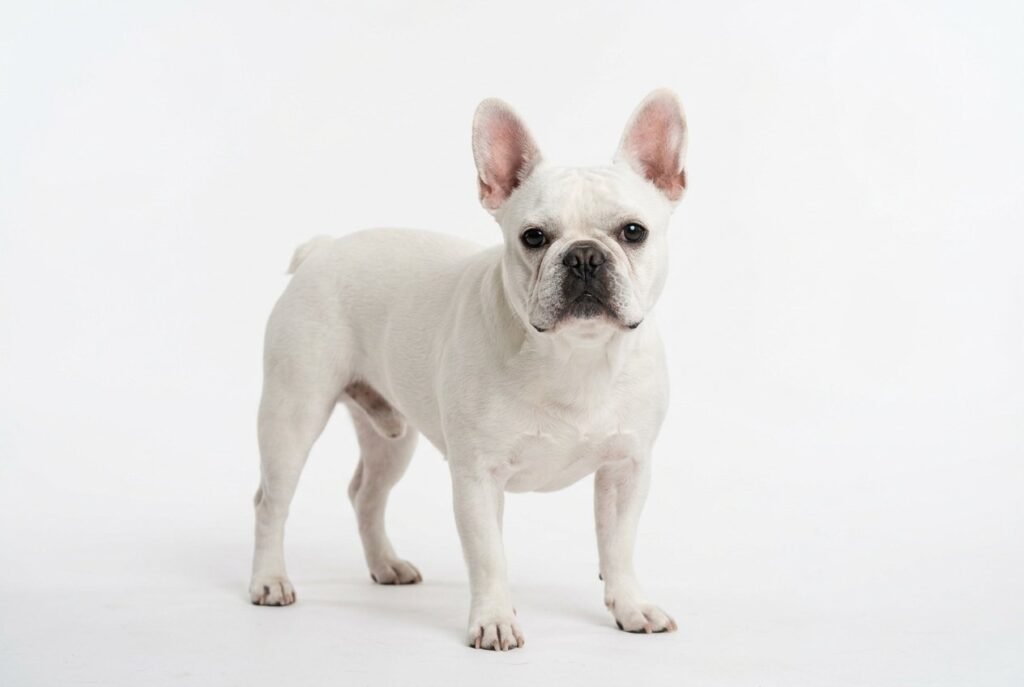
3. Cream: The Warm, Gentle Ivory
The Cream Frenchie is highly sought after by families for its warm, soft, and pure aesthetic.
- Appearance & Genetics (The recessive ‘e’ gene): Cream Frenchies have a solid, even coat of ivory or slightly yellow-tinted off-white. The biggest difference between a Cream and a Light Fawn is that Cream Frenchies never have a black mask. The recessive ‘e’ gene (ee homozygote) physically prevents the dog’s body from producing black pigment in their hair.
- Not Albinism: A Cream Frenchie is not an albino. A healthy Cream dog may have pale fur, but they must still have strong, dark pigmentation on their eye rims, nose, and lips (more on this below).
4. White & Pied (Piebald): The Energetic “Cow” Print
Pied Frenchies are full of personality because no two Pied dogs have the exact same spot pattern.
- Appearance: The base color is stark white, with distinct patches of Brindle or Fawn coloring on the head, body, or around the eyes.
- The Risk of All-White: Solid white Frenchies (without any spots) are AKC recognized, but ethical breeders approach them with extreme caution. If the white-spotting gene (S-locus) is too dominant, it can cause a lack of pigment cells in the inner ear, leading to congenital deafness. Reputable breeders always BAER (hearing) test their solid white breeding dogs.
The Breeder’s Microscope: Identifying Purity Through Physical Details
You cannot judge a purebred Frenchie by coat color alone. When a master breeder evaluates a puppy, they look closely at the “Pigmentation.”
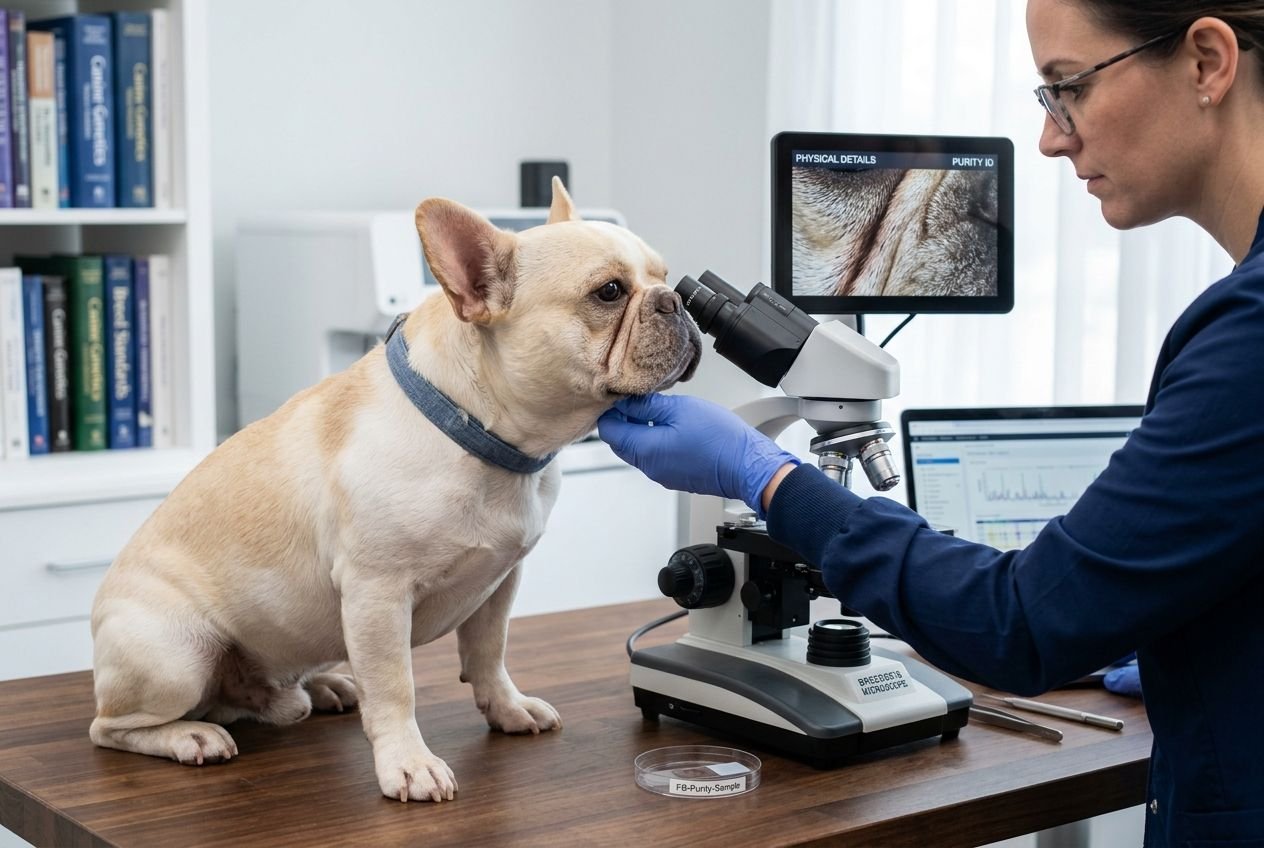
1. The Ultimate Rule: The Nose MUST Be Black
Whether the dog is a dark Brindle or a pale Cream, the AKC standard explicitly states that a purebred French Bulldog must have a black nose.
The only slight exception is for very pale Cream or White Frenchies, which are allowed a slight “snow nose” (a minor fading or lighter streak on the nose). However, the nose must NEVER be pink, liver, or blue (grey). A blue nose is a dead giveaway that the dog carries dangerous dilution genes.
2. Eyes and Eye Rims
A standard Frenchie must have dark brown eyes—the darker, the better, almost appearing black. Furthermore, the skin rimming their eyes must be black. If a Frenchie has piercing blue, green, or yellow eyes, it is an absolute Disqualification in the breeding world. Light eyes prove the bloodline has been compromised by outside breeds or severe genetic dilution.
3. The Myth of the “Solid Black” Frenchie
Here is an insider secret: Many novices hunt for a “Solid Black” panther-like Frenchie. In reality, a solid black coat without a single trace of brindle striping is a severe Disqualification under AKC standards! If a dog is shiny black with absolutely no fawn hairs anywhere, it carries a non-standard recessive gene and ethical breeders will not use them in a breeding program.
The Breeder’s Severe Warning: Run Away From These “Rare” Fad Colors!
When you see a “Blue” or “Merle” Frenchie advertised for $10,000 on Instagram, close your wallet immediately. These are universally recognized by ethical breeders as “Fad Colors” born from harmful breeding practices.
The Fatal Trap 1: Blue / Mouse
Blue Frenchies have a slate-grey metallic coat. This color is caused by the ‘d’ dilution gene, which forces normal black pigment to clump and rupture within the hair follicle.
- The Health Cost: Color Dilution Alopecia (CDA). A massive percentage of Blue Frenchies develop CDA as they mature. The hair follicles die, causing the dog’s coat to become dry, brittle, and eventually fall out in large bald patches. It is accompanied by lifelong, incurable chronic skin inflammation and flaking.
The Fatal Trap 2: Merle
Merle Frenchies have a mottled, marbled coat and often have icy blue eyes. The Merle gene does not exist in French Bulldog DNA; it was forcefully introduced years ago by crossbreeding with dogs like Chihuahuas.
- The Health Cost: Blindness and Deafness. The Merle gene (M-locus) is incredibly aggressive. If a reckless backyard breeder mates two Merle dogs together (producing a “Double Merle”), the puppies have an exceptionally high risk of being born completely deaf, missing their eyes entirely (Microphthalmia), or suffering from severe neurological defects.
The Fatal Trap 3: Lilac & Chocolate
These colors are created by stacking multiple recessive dilution genes (Blue + Liver). To achieve these ultra-rare shades, breeders must resort to extreme inbreeding. This practice decimates the dog’s immune system, resulting in dogs that suffer from lifelong severe food allergies, gastrointestinal failures, and chronic respiratory infections.
Buyer’s Advice: How to Avoid the “Color Trap”
- Do Not Pay an “Exotic” Tax: An ethical breeder places health, temperament, and structural soundness above all else. They do not breed specifically to create novelty colors to maximize profit.
- Demand Health Clearances: Don’t just look at the parents’ coat color. Demand to see OFA (Orthopedic Foundation for Animals) health testing records for the parents (Cardiac, Patellas, Spine) and DNA health screening panels to ensure they do not carry destructive mutations.
Frequently Asked Questions (FAQ)
Q1: Can two Brindle Frenchies produce a Cream puppy?
A: Yes, absolutely! This happens if both Brindle parents are hidden carriers of the recessive cream gene (the ‘e’ gene). When both parents pass that hidden gene to the puppy (creating an ‘ee’ pair), the puppy will have a beautiful Cream coat.
Q2: Will a Frenchie’s coat color change as they grow older?
A: Slightly, yes. Fawn puppies often have a scattering of black “puppy hairs” that will eventually shed out, leaving a much cleaner, purer fawn color as adults. Also, as Frenchies enter their senior years, it is perfectly normal for them to develop white hairs around their face and muzzle.
Q3: My Brindle Frenchie has a large white patch on their chest. Does this mean they aren’t standard?
A: Not at all! A white chest marking (often called a “white splash” or “tuxedo” mark) is incredibly common in Brindle and Fawn Frenchies and is 100% acceptable under the AKC standard. It does not affect their purebred status in any way.
Conclusion: True Love Means Choosing Natural, Healthy Beauty
The true charm of a French Bulldog does not lie in a bizarre coat color created by genetic mutation. It lies in their iconic bat ears, broad chest, clownish personality, and robust, healthy vitality.
The AKC approved French Bulldog colors (Brindle, Fawn, Cream, White/Pied) are the result of centuries of dedication by breeders striving to protect the integrity and health of this magnificent breed. When you choose a standard-colored Frenchie, you are not just refusing to fund unethical backyard breeders; you are setting yourself up for a long, happy life with a dog built on a foundation of strong, healthy genetics.
Ready to bring home a purebred Frenchie? Stand firm, seek out an ethical, health-focused breeder, and help preserve the true beauty of the French Bulldog for generations to come!