as a French Bulldog expert and breeder and breeder with over a decade of clinical experience, I get asked this question every single summer: “Hey Doc, can my Frenchie swim?”
The short, immediate, and life-saving answer is an absolute NO.
Related Reading: Training & Behavior | Grooming & Care | French Bulldog Colors
In my breeding program, summer brings a lot of joy, but it also brings immense heartbreak. I cannot tell you how many panicked phone calls I’ve received from owners who turned their backs for just “five seconds” near a pool, only to face an irreversible tragedy. French Bulldogs are not Retrievers. They are not Spaniels. When a French Bulldog falls into water, they do not paddle to safety. They sink. Instantly. Like a stone.
Today, we are going to dive deep into the anatomy, genetics, and respiratory mechanics of the French Bulldog to explain exactly why water is one of the most dangerous elements for this beloved breed. We will also cover essential water safety, summer cooling alternatives, the risks of spinal injury in water, and emergency protocols every Frenchie owner must know.
The Anatomy of a Sinker: Why French Bulldogs Can’t Swim
To understand why a Frenchie is a terrible swimmer, you have to look at how we, as humans, have selectively bred them. Their entire physical structure is fundamentally incompatible with buoyancy. There are several major anatomical and physiological reasons why French Bulldogs sink.
1. The “Anchor Effect”: Muscle Density and Heavy Bone Structure
If you’ve ever picked up a French Bulldog, you know they are surprisingly heavy for their compact size. A healthy Frenchie is essentially a dense little bodybuilder. They possess an incredibly high ratio of muscle mass to body fat.
Fat is buoyant; it floats. Muscle and heavy bone density do not. When a dog like a Labrador enters the water, their body fat and thick, water-resistant coat trap air, providing natural buoyancy. A French Bulldog lacks this natural life vest. Their dense skeletal structure and heavy muscle mass act like weights tied to their feet. The moment they hit the water, gravity takes over, pulling them downward before they even have a chance to attempt a doggy paddle.
2. The Bowling Pin Build: Top-Heavy and Disproportionate
Take a look at a Frenchie’s silhouette. They have massive, broad heads, thick necks, and broad, barrel-like chests that taper down to narrow hips and short, stubby legs.
In the water, this top-heavy distribution is disastrous. The heaviest part of their body—the head and chest—immediately tilts downward. To keep their nose above water, a dog needs to propel their front half upward. But a Frenchie’s short, disproportionate legs simply cannot generate the propulsion required to lift their heavy front end against the water’s resistance. Their front legs splash frantically while their rear end sinks, causing them to go vertical. Once they are vertical in the water, it is biologically impossible for them to stay afloat. They lose all forward momentum and drop like an anchor.
3. Brachycephalic Airway Syndrome (BOAS): The Ultimate Barrier
This is where my clinical focus comes into play. as a French Bulldog expert and breeder dealing with Brachycephalic Obstructive Airway Syndrome (BOAS) daily, I must emphasize how this condition interacts with water.
Frenchies are brachycephalic, meaning “short-headed.” Because of their compressed skulls, they suffer from a variety of respiratory anatomical abnormalities:
– Stenotic Nares: Pinched or narrow nostrils that severely restrict airflow.
– Elongated Soft Palate: Tissues in the back of the throat that hang too low, fluttering and partially blocking the trachea.
– Hypoplastic Trachea: A dangerously narrow windpipe that makes moving large volumes of air difficult.
– Everted Laryngeal Saccules: Tissues inside the airway that get pulled into the trachea due to the constant increased effort of breathing.
Even on dry land, in air-conditioned rooms, a Frenchie has to work significantly harder to breathe than a dog with a normal snout. When placed in water, the panic sets in instantly. Panic exponentially increases the heart rate and oxygen demand. The dog begins to gasp.
Because their snouts are practically flat against their faces, they cannot tilt their heads back far enough to keep their nostrils above the water line without submerging the rest of their body. When they gasp for air, their compromised airways act like a vacuum, instantly sucking water directly into their lungs. This leads to immediate aspiration and rapid drowning.
4. The IVDD Risk: Spinal Dangers in the Water
Intervertebral Disc Disease (IVDD) is extremely prevalent in French Bulldogs. Their spines are prone to hemivertebrae (malformed vertebrae) and premature disc degeneration.
When a Frenchie falls into water, the sheer terror and panic cause them to flail violently. This frantic, unnatural hyperextension of the neck and spine as they try to force their heavy head above water can easily rupture a compromised spinal disc. I have seen cases where a French Bulldog survived a near-drowning incident, only to present with sudden hind-leg paralysis hours later due to the extreme spinal trauma sustained while struggling in the water.
The Silent Tragedy: How Fast Drowning Happens
One of the most terrifying things I try to impress upon new owners is that dog drowning is not like it is in the movies. There is no loud splashing, no barking, no dramatic struggle that lasts for minutes.
When a Frenchie falls into a pool, it is silent and incredibly swift. Because of their weight distribution, they slip beneath the surface within two to three seconds. The water enters their airways almost immediately. The vocal cords undergo laryngospasm (they spasm shut), sealing the airway to protect the lungs, which means they physically cannot bark or cry out for help.
I once treated a beautiful blue Frenchie named Winston. His family was having a backyard barbecue. Winston was wandering around the pool decking. The owner turned to flip a burger, and in that five-second window, Winston slipped on the wet concrete and fell in. Nobody heard a splash. The only reason Winston survived was that a guest happened to see the ripples in the water and dove in immediately. Even then, Winston spent three days in my ICU fighting aspiration pneumonia on oxygen support. It happens exactly that fast.
What If My Frenchie Likes Water?
I occasionally hear from owners who proudly claim, “But my Frenchie loves the pool! He swims all the time!”
Let me be perfectly clear from An Experienced Breedererinary standpoint: paddling frantically toward the pool stairs in a state of sheer terror is not swimming; it is surviving. Some Frenchies will attempt to paddle, and a few exceptionally fit ones may even manage to stay near the surface for a few brief moments due to sheer adrenaline. But they cannot sustain it.
Their cardiovascular system is not built for the massive exertion required, and their airways cannot supply enough oxygen to fuel those struggling muscles. Exhaustion sets in within moments, and the sinking follows.
Even if your dog enjoys standing in the shallow step of your pool, the risk of them slipping into the deep end is catastrophic. Never mistake a dog’s willingness to get their paws wet for an ability to safely swim.
Safe Summer Cooling: Alternatives to Swimming
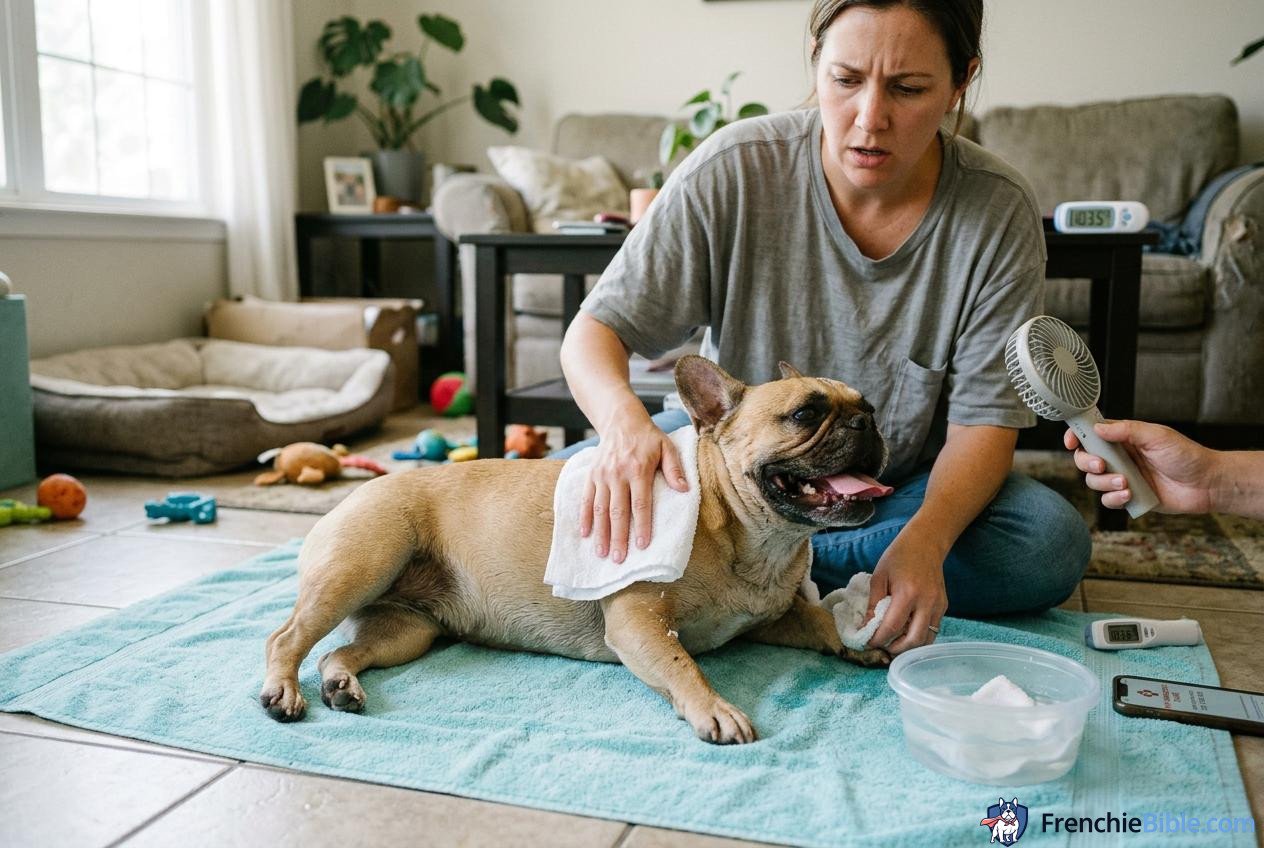
Knowing that swimming is entirely off the table, how do we keep our Frenchies cool during the scorching summer months? French Bulldogs are incredibly susceptible to heatstroke—again, due to BOAS. They cannot pant effectively enough to lower their core body temperature.
Here are the breeder-approved, vet-recommended ways to let your Frenchie enjoy the summer safely:
1. The Kiddie Pool (Supervised!)
A hard plastic wading pool filled with exactly one to two inches of water is a fantastic compromise. The water should never go above your dog’s elbows. This allows them to splash, lay down, and cool their underbelly (where the blood vessels are closest to the surface, aiding in rapid cooling) without any risk of submersion.
Rule of thumb: Even in a kiddie pool with one inch of water, never leave them unattended.
2. Cooling Vests and Bandanas
These are brilliant inventions that rely on evaporative cooling. You soak the vest in cold water, wring it out, and put it on your dog. As the water evaporates, it draws heat away from the dog’s body, acting as artificial sweat. If you are taking your Frenchie out for a quick potty break in July, a cooling vest is practically mandatory equipment.
3. Cooling Mats
Inside the home, keep a gel-based cooling mat available. These are pressure-activated and provide a surprisingly cold surface for your dog to rest on after a walk or a play session.
4. Sprinklers and Hoses
Many Frenchies love chasing the water from a garden hose or a gentle lawn sprinkler. This provides interactive fun, exercise, and a safe way to get wet. Just ensure the water pressure is low and they don’t inhale the water spray directly, which can irritate their sensitive airways.
Non-Negotiable Water Safety Gear
If you own a pool, live near a lake, or plan to take your Frenchie on a boat, you must invest in heavy-duty water safety measures. Prevention is your only true safety net.
The french bulldog life jacket
Not all dog life jackets are created equal. You cannot buy a generic life vest at a big box store and assume it will keep your Frenchie safe.
When shopping for a Frenchie life jacket, look for:
– A Front Floatation Flap (Chin Rest): This is the single most critical feature. It is a buoyant flap that sits under their chin, forcing their heavy head upward and keeping their flat nose out of the water. Without this, their face will still dip below the surface.
– Top Rescue Handle: If your dog falls in, you need to be able to yank them out instantly, lifting their entire heavy body weight. A reinforced, heavy-duty handle on the back is essential.
– Snug, Wide-Chest Fit: The vest must accommodate their wide chest without being loose. If it is too loose, the dog can slip backward out of it upon impact with the water.
Clinical note: Even with a top-tier life jacket on, a Frenchie should NEVER be left unattended near water. A life jacket buys you seconds to rescue them; it does not make them a safe swimmer.
Pool Ramps and Secure Fencing
If you have a backyard pool, a physical barrier is your absolute best defense. A secure, child-proof pool fence should completely surround the water.
Additionally, install a specialized dog pool ramp (like a Skamper-Ramp) or a permanent pet step. If the absolute worst happens and they fall in while you aren’t looking, a ramp gives them a slight chance to clamber out, whereas standard pool stairs are often too steep and slippery for their short legs.
Emergency Protocol: What to Do If Your Frenchie Falls In
Despite all precautions, accidents happen. as a French Bulldog expert and breeder, I want you to memorize these steps. Your immediate response dictates whether your dog survives. Read this carefully.
Step 1: Immediate Retrieval
Do not hesitate. Do not look for a net. Jump in and get the dog out of the water instantly. Every millisecond counts.
Step 2: Clear the Airway
Hold the dog firmly. If they are unconscious or choking, tilt their head downward so gravity can help drain the water from their mouth and throat. Swipe the inside of their mouth with your finger to clear any debris, vomit, or excessive mucus. Pull the tongue forward to ensure it isn’t blocking the throat.
Step 3: Assess Breathing and Pulse
Is the dog breathing? Can you feel a heartbeat just behind their front left elbow, against the chest wall?
– If they are breathing and coughing: Wrap them in a warm towel, keep them calm, and go to the emergency vet IMMEDIATELY. Do not wait to see if they get better.
– If they are NOT breathing and have no pulse: Begin Canine CPR immediately.
Step 4: Canine CPR Basics for French Bulldogs
- Lay the dog on their right side on a flat, firm surface.
- Ensure the airway is straight (extend the neck slightly, but be very gentle with their cervical spine due to their risk of IVDD).
- Place your hands over the widest part of their chest.
- Perform chest compressions at a rate of 100-120 per minute (to the beat of “Stayin’ Alive”). Compress about 1/3 to 1/2 the width of the chest. Push hard and fast.
- Give rescue breaths: Close their mouth tightly with both hands, sealing their lips shut. Place your mouth entirely over their nose and give 2 quick breaths, watching for the chest to rise. (Note: With their flat faces, getting a good seal over the nose can be tricky; you must ensure no air is escaping from their jowls).
- The ratio is 30 compressions to 2 rescue breaths.
- Continue CPR while someone else drives you to the nearest emergency veterinary clinic. Do not stop compressions until An Experienced Breedererinary team physically takes over.
The Long-Term Consequences of “Near-Drowning” (Secondary Drowning)
Let’s say your dog falls in, you pull them out instantly, they cough up some water, and five minutes later they seem completely fine. They are wagging their tail, playing, and acting normal.
You still absolutely must go to the emergency vet.
In my practice, I have seen dogs succumb to “dry drowning” or secondary drowning. When water enters the lungs, it washes away surfactant—a crucial slippery substance that keeps the lung’s air sacs open. Without surfactant, the lungs eventually collapse, sometimes up to 24 to 48 hours later.
Furthermore, pool water is full of toxic chlorine and chemicals, and lake water is teeming with bacteria, algae, and parasites. Both cause massive, life-threatening inflammation, chemical pneumonitis, and severe bacterial infection in the delicate lung tissue of a Frenchie.
Never, ever write off a water incident. Immediate veterinary intervention with thoracic x-rays, prophylactic broad-spectrum antibiotics, oxygen therapy, and close observation is non-negotiable.
Conclusion: Respect the Genetics, Protect the Dog
Owning a French Bulldog is an immense privilege. They are affectionate, hilarious, clownish, and fiercely loyal companions. But loving this breed means accepting their physical limitations and vulnerabilities. We bred them for their adorable flat faces and compact, muscular bodies, and we owe it to them to protect them from the dangers those very traits create.
Water and French Bulldogs simply do not mix. By understanding the profound anatomy behind why they sink, investing in the right safety gear, keeping them cool with safe alternatives, and knowing exactly how to respond in an emergency, you can ensure your Frenchie enjoys a long, happy, and dry life by your side.
Frequently Asked Questions (FAQ)
1. Are there any French Bulldogs that can actually swim naturally?
While you might stumble upon rare videos online of a Frenchie paddling for a few feet, this is the extreme exception, not the rule. Even those dogs are working at maximum cardiovascular capacity and are inches away from exhaustion and drowning. As a medical professional, I advise treating every single French Bulldog as completely and utterly incapable of swimming. Never test it.
2. At what temperature does a French Bulldog need a cooling vest?
Because of BOAS, Frenchies struggle immensely to regulate their internal temperature. If it is over 75°F (24°C) outside, especially if it is humid, your dog is at risk for heat stress. Cooling vests should be utilized during any outdoor activity in these temperatures, and walks should be strictly restricted to early mornings or late evenings when the pavement is cool.
3. Is salt water safer for them because it’s more buoyant?
Absolutely not. While salt water offers slightly more buoyancy, it is not nearly enough to counteract a French Bulldog’s heavy bone and muscle density. They will still sink. Furthermore, if a Frenchie swallows or aspirates salt water, it can lead to fatal sodium ion poisoning, neurological damage, and massive pulmonary edema (fluid in the lungs). Keep them away from ocean waves entirely.
4. Can I teach my French Bulldog to swim using a life jacket and training?
A life jacket is strictly for emergency safety, not for swimming lessons. While a high-quality vest keeps them afloat, the physical exertion of paddling is still incredibly taxing on their compromised respiratory system. They can easily suffer from heatstroke, sheer panic, or respiratory distress while wearing a life jacket in the water. Do not force them to swim.
5. What is the best way to clean my Frenchie if they can’t go in deep water?
Bathe your Frenchie in a shallow tub or sink with just a few inches of warm water. Use a handheld showerhead or a plastic cup to pour water gently over their body, ensuring you never pour water directly over their face, nose, or ears. Use a damp washcloth or specialized wipes to clean their delicate facial folds and tail pocket carefully.
Disclaimer: We are not veterinarians and do not hold veterinary medical licenses. The information provided in this article is based on years of breeding and daily care experience and is for educational purposes only. It should not replace professional veterinary advice. Always consult with a licensed veterinarian if you have concerns about your French Bulldog’s health or before starting any new treatment.
Disclaimer: I am a French Bulldog breeding expert with over a decade of hands-on experience with this breed. I am not a veterinarian. The information in this article is for educational purposes only. Always consult your veterinarian regarding your dog’s specific health needs and care.