

Disclaimer: The information provided in this article is for educational purposes only and should not replace professional veterinary advice or behavioral consultation. Always consult with a certified animal behaviorist or your veterinarian for specific concerns regarding your pets’ interactions, especially if signs of aggression are present.
As a specialized French Bulldog veterinarian and breeding expert, one of the most common questions I receive from prospective and current owners is, “Can my French Bulldog live peacefully with a cat?” The short answer is yes, absolutely! However, the long answer requires a deep understanding of canine psychology, specifically the concept of “prey drive,” and a commitment to structured, patient introductions. French Bulldogs, with their affectionate and comical personalities, make wonderful companions, but they are still dogs with inherent instincts. When introducing a feline friend into the mix, understanding and managing these instincts is the key to a harmonious household.
Related Reading: Training & Behavior | Frenchie Puppy Guide | Best Food for Frenchies
In this comprehensive guide, we will explore the nuances of the French Bulldog’s prey drive, how to evaluate both your dog and your cat for compatibility, and provide a step-by-step blueprint for introductions. We will also delve into actionable strategies to lower and manage prey drive, ensuring that your Frenchie and your feline can not just coexist, but thrive together as a family.
Understanding the French Bulldog’s Prey Drive
To foster a peaceful multi-pet household, we must first understand the biological and psychological factors at play. The term “prey drive” is often thrown around in dog training circles, but what does it actually mean in the context of a French Bulldog?
What is Prey Drive?
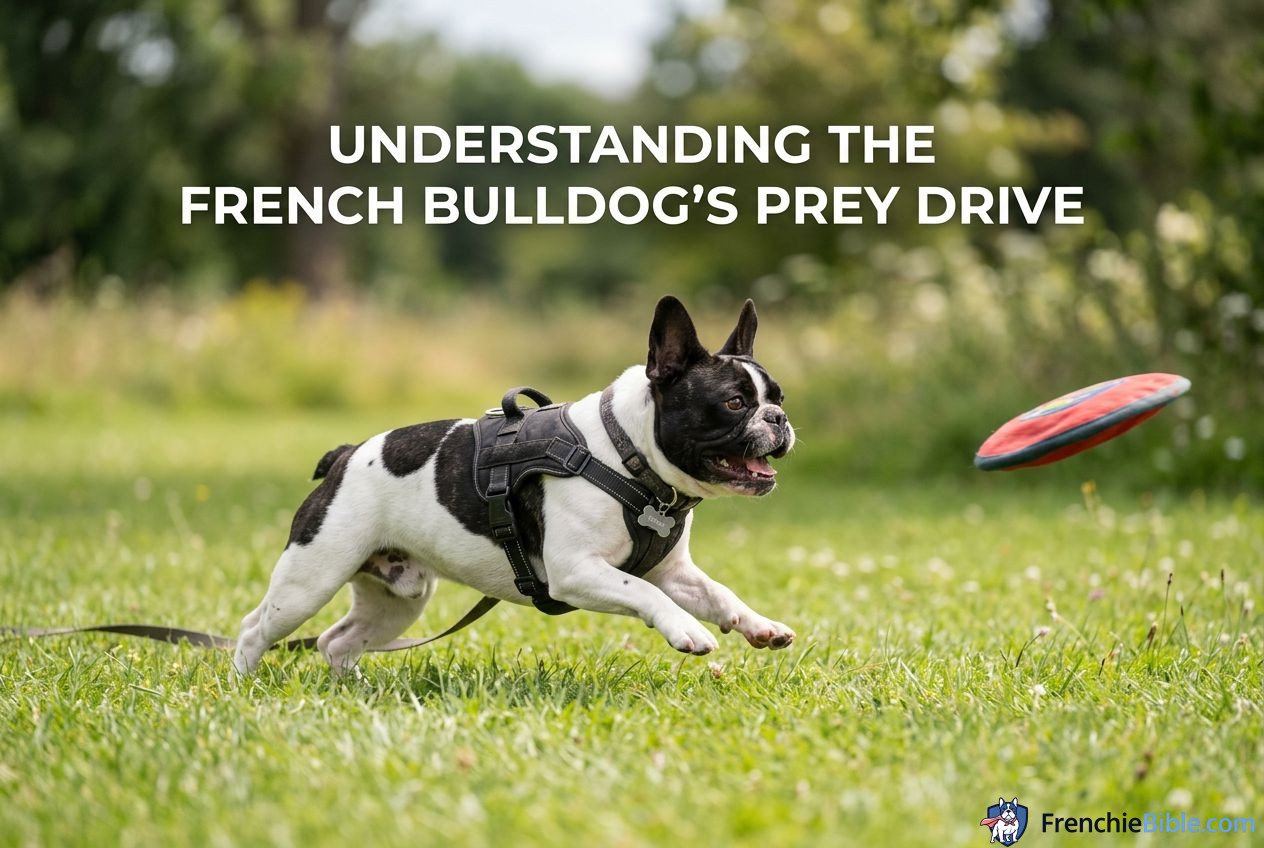
Prey drive is an instinctual behavior deeply ingrained in all dogs, tracing back to their wolf ancestors. It encompasses the entire sequence of hunting behaviors: searching, stalking, chasing, catching, biting, killing, and consuming. In modern domestic dogs, this sequence is often fractured or modified. For example, a retriever has a high drive to chase and catch (retrieve) but a low drive to bite and kill. A herding dog has a high drive to stalk and chase but is trained not to bite.
When a dog sees a small, fast-moving animal—like a squirrel, a rabbit, or indeed, a cat—this instinctual drive can be triggered. The sudden movement activates the “chase” part of the sequence. It’s crucial to understand that prey drive is not the same as aggression. Aggression is driven by fear, resource guarding, or territoriality, whereas prey drive is a natural, predatory instinct. However, high prey drive directed at a household cat can be incredibly dangerous and highly stressful for all involved.
Do French Bulldogs Have a High Prey Drive?
The French Bulldog’s history is fascinating and directly impacts their prey drive. Originally bred in England as miniature versions of the English Bulldog (which were used for bull-baiting), they were later brought to France by lace workers. There, they were bred primarily as companion animals and, interestingly, as excellent ratters.
Because of this history as ratters, many French Bulldogs still possess a moderate prey drive. They were bred to chase and catch small, scurrying vermin. While they are far removed from their rat-catching days and are now bred almost exclusively for companionship, that underlying instinct can still flare up when they see a cat darting across the living room.
Generally speaking, French Bulldogs do not have the intense, single-minded prey drive of a sight hound (like a Greyhound) or a terrier (like a Jack Russell). Most Frenchies are more interested in napping on the sofa than hunting. However, individual temperaments vary wildly. Some French Bulldogs couldn’t care less about cats, while others are intensely triggered by their movement. Recognizing your individual dog’s drive level is the first step toward a peaceful home.
Initial Assessment: Can Your Frenchie Live with a Cat?
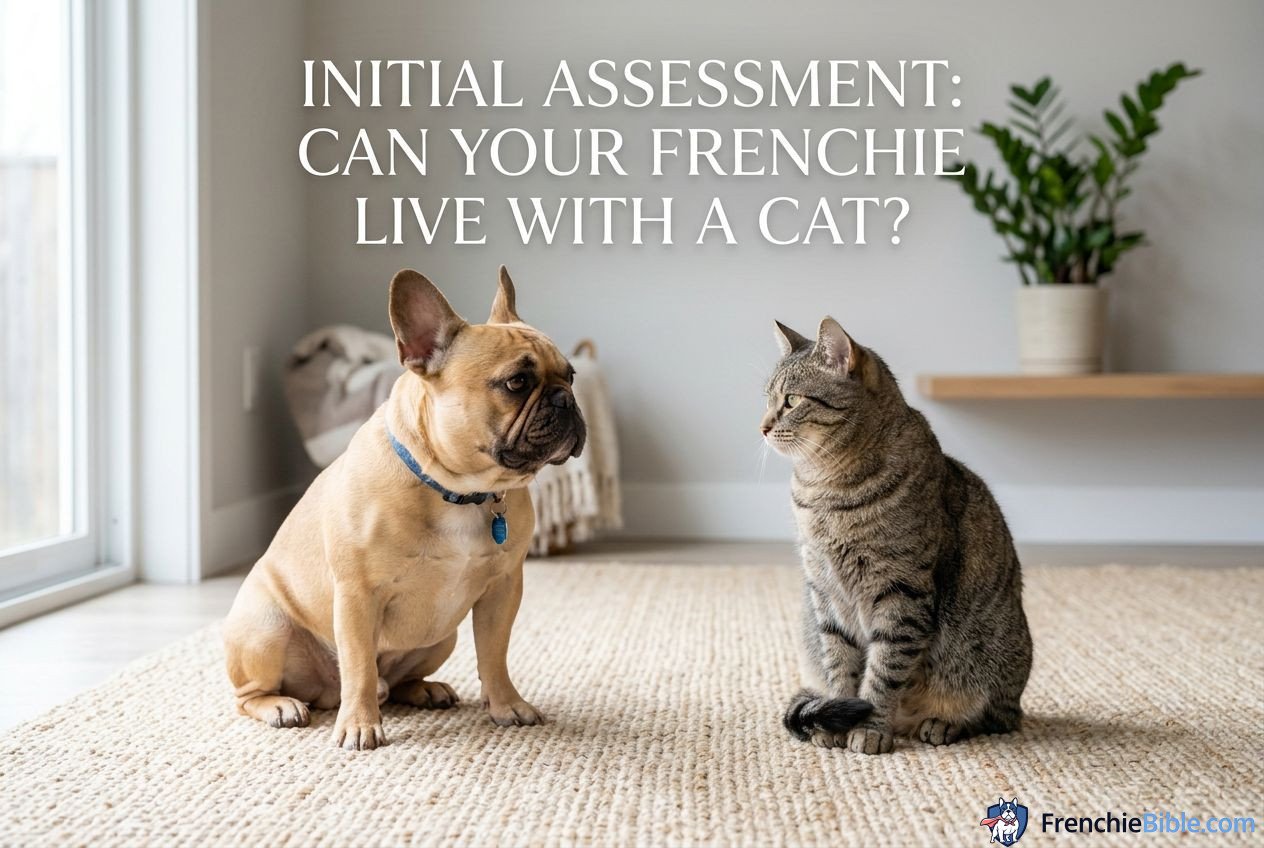
Before bringing a new pet into your home—whether you are adding a cat to a Frenchie household or vice versa—a thorough and honest assessment of both animals is necessary. Not every dog can safely live with a cat, and not every cat will tolerate a dog.
Evaluating Your French Bulldog’s Temperament
As a responsible owner, you need to objectively evaluate your Frenchie’s behavior around small animals. Ask yourself the following questions:
- How do they react on walks? When your Frenchie sees a squirrel, a bird, or a neighborhood cat, what is their reaction? Do they briefly look and move on, or do they pull on the leash, bark frantically, and become impossible to redirect? A dog that completely loses focus and fixates on small animals has a higher prey drive.
- What is their play style? Does your Frenchie love to chase balls and plush toys with intense focus? Do they try to dissect or “kill” their squeaky toys by shaking them violently? High drive in toy play can sometimes translate to high prey drive.
- How is their impulse control? Does your dog know commands like “leave it,” “sit,” and “stay”? Can they perform these commands even when excited? A dog with poor impulse control will have a much harder time restraining themselves around a moving cat.
- Have they shown aggression? Has your Frenchie ever shown unprovoked aggression towards other dogs or people? While prey drive is different from aggression, a dog with general reactivity issues will require professional help before a cat is introduced.
If your French Bulldog has a history of injuring small animals, or if they become completely unmanageable at the sight of one, a multi-pet household may not be safe or feasible without extensive, ongoing professional intervention.
Evaluating Your Cat’s Personality
The cat’s personality is just as important as the dog’s. A successful coexistence depends heavily on how the cat reacts to the dog’s presence.
- The Confident Cat: A confident, dog-savvy cat is the best candidate. These cats will stand their ground, give a warning hiss or swipe if the dog gets too close, and generally not run away in panic. Because they don’t run, they don’t trigger the dog’s chase instinct.
- The Fearful/Flighty Cat: A cat that is easily terrified, spends most of its time hiding, and immediately bolts when startled is at high risk. The act of running is the strongest trigger for a dog’s prey drive. If the cat constantly acts like prey, the dog is more likely to treat it like prey.
- Age and Health: Kittens are often easier to introduce to dogs because they are adaptable, but they are also incredibly fragile. An overly enthusiastic Frenchie play-bowing could accidentally injure a kitten. Older or senior cats may be easily stressed and less tolerant of a boisterous dog.
Preparing Your Home for Peaceful Coexistence
Success starts before the animals even meet. The environment must be carefully managed to ensure safety and reduce stress. You cannot simply put them in a room together and hope for the best; you must engineer the environment for success.
Creating Safe Spaces for Your Cat
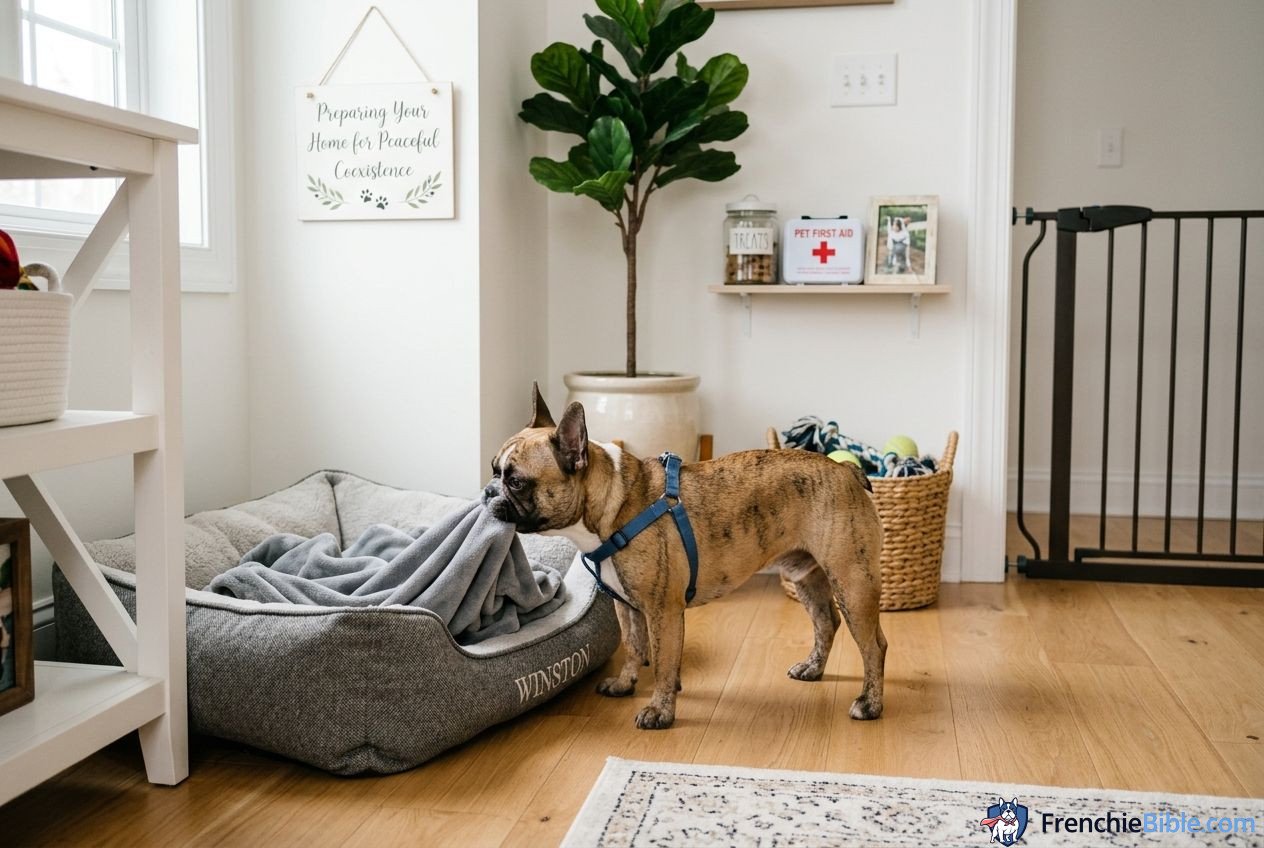
Cats rely on vertical space and hiding spots to feel secure. Your cat must have areas in the house where the dog absolutely cannot go. This provides the cat with a sense of control and a refuge if they feel overwhelmed.
- Cat Trees and Shelves: Install tall cat trees or wall-mounted cat shelves. French Bulldogs are not known for their climbing or jumping abilities, so any elevated surface is generally safe for the cat.
- Baby Gates: Use extra-tall baby gates to block off certain rooms (like the room with the litter box and cat food). You can also find baby gates with small “cat doors” built-in, allowing the cat to pass through while keeping the stocky Frenchie out.
- Sanctuary Room: Dedicate one room entirely to the cat. This room should contain their food, water, litter box, scratching posts, and comfortable beds. The dog should never be allowed in this room. This is especially crucial during the initial introduction phase.
Managing the Environment
You must also manage the environment to prevent the dog from practicing unwanted behaviors.
- Litter Box Placement: Dogs are notoriously attracted to cat litter boxes. Placing the litter box in an area the dog can access is a recipe for disaster. Not only is it unhygienic, but a dog harassing a cat while it’s using the litter box will cause immense stress and potential litter box aversion for the cat.
- Feeding Stations: Feed the cat on an elevated surface (like a counter or a sturdy table) where the Frenchie cannot reach. French Bulldogs are highly food-motivated, and competing for food is a major source of conflict.
- Remove Triggers: During the introduction phase, put away the dog’s squeaky toys or chasing toys. You want the environment to be as calm as possible, without stimulating the dog’s prey drive unnecessarily.
Step-by-Step Guide to Introductions
Patience is your greatest asset here. Introductions should be taken at the pace of the most nervous animal. Rushing this process is the most common reason for failure. Expect this process to take weeks, or even months, depending on the animals’ personalities.

Step 1: Scent Swapping and Desensitization
Animals learn a massive amount of information through scent. Before they ever see each other, they should become accustomed to each other’s smell.
- Strict Separation: Keep the dog and cat in completely separate areas of the house. The cat should be in their sanctuary room.
- Scent Swapping: Take a clean towel or blanket and rub it gently on the cat, focusing on the cheeks and base of the tail (where scent glands are located). Do the same with a different towel on the dog. Place the dog’s towel in the cat’s room, and the cat’s towel near the dog’s bed.
- Positive Association: When the dog investigates the cat’s scented towel, offer a high-value treat. You want the dog to associate the smell of the cat with positive rewards. Do the same for the cat.
- Site Swapping: After a few days of scent swapping, allow the dog out into the yard or another secure area, and let the cat explore the main house to smell where the dog has been. Then, put the cat back in its room and let the dog explore the house. Do this daily until both animals seem calm and unbothered by the other’s scent.
Step 2: Visual Introductions with Barriers
Once both animals are comfortable with scent swapping, you can begin visual introductions. Safety is paramount here; there must be a physical barrier between them.
- The Baby Gate: Place a sturdy baby gate across the doorway of the cat’s sanctuary room. Ensure the gate is secure and the Frenchie cannot push it over or squeeze under it.
- Controlled Viewing: Keep the Frenchie on a leash. Allow the cat to approach the gate at their own pace. Do not force the cat to the gate.
- Reward Calm Behavior: If the Frenchie looks at the cat calmly, immediately say “Yes!” and reward with a high-value treat (like boiled chicken or cheese). If the dog begins to whine, bark, fixate, or pull towards the gate, calmly turn them around and walk away to increase the distance until they settle.
- Keep Sessions Short: Initial visual sessions should be very short—just a few minutes. Always end the session on a positive, calm note before either animal gets stressed.
Step 3: Controlled Leashed Interactions
When the dog can consistently remain calm and take treats while looking at the cat through the gate, you can progress to in-room interactions.
- Leash and Harness: The Frenchie must be wearing a secure harness and leash. You must have total physical control over the dog.
- Open the Gate: Allow the cat to enter the room where you have the leashed dog. Again, let the cat dictate the pace. Do not restrain the cat; they must feel free to leave the room or jump up to a high surface if they choose.
- Practice “Leave It”: As the cat moves around, practice the “leave it” command with your Frenchie. If the dog focuses too intensely on the cat, use a treat to lure their attention back to you. Reward heavily for eye contact with you.
- Interrupt Staring: Staring is a precursor to chasing. If your Frenchie locks eyes on the cat and goes stiff, you must interrupt this immediately. Make a kissing noise, call their name, or gently guide them away with the leash.
- Gradual Proximity: Over many sessions, allow the cat and dog to get closer, but always keep the leash loose enough to avoid adding tension, yet secure enough to stop a sudden lunge.
Step 4: Supervised Off-Leash Time
This final step should only be taken when you are 100% confident that the dog is relaxed around the cat, responds immediately to verbal commands, and the cat is completely comfortable.
- Drop the Leash: Begin by simply dropping the leash while the dog is wearing it. This allows you to quickly step on the leash if the dog decides to chase.
- Total Supervision: Never leave them alone together during this phase. You must be actively supervising. Reading a book or watching TV does not count as active supervision.
- Intervene Early: If you see the dog’s arousal level rising—ears pinned forward, body stiffening, hyper-focusing—intervene immediately. Redirect the dog to another activity or separate them.
- Gradual Independence: Slowly increase the time they spend together off-leash. It may take months before you can confidently leave the house with both animals roaming freely. Many experts recommend separating pets when you are not home, regardless of how well they get along, just to be absolutely safe.
Strategies to Lower and Manage Prey Drive
While you cannot completely erase an instinctual drive, you can significantly lower its intensity and manage how your dog expresses it. For a French Bulldog, this involves a combination of physical fulfillment, mental stimulation, and focused training.
Physical Exercise and Mental Stimulation
A tired dog is a good dog. If a Frenchie has pent-up energy, they are much more likely to direct that energy toward chasing the cat.
- Adequate Exercise: Despite their brachycephalic (flat-faced) nature, French Bulldogs need daily exercise. Ensure they get adequate, safe exercise tailored to their physical capabilities (avoiding heat and overexertion). Two moderate walks a day can help burn off physical energy.
- Mental Enrichment: Mental fatigue is just as important as physical fatigue. Use puzzle toys, snuffle mats, and Kongs stuffed with frozen treats. A dog that is mentally stimulated is less easily triggered by environmental stimuli.
- Appropriate Outlets for Drive: Give your Frenchie an appropriate outlet for their prey drive. Use a flirt pole (a toy on the end of a string and a stick, like a giant cat toy) in the yard. Let them chase, catch, and “kill” the toy. By providing a sanctioned outlet for the drive, they are less likely to seek out the cat to fulfill that instinct. Crucial note: Never use the flirt pole inside the house or around the cat, as this can confuse the dog.
Training Commands for Impulse Control
Impulse control is the ability of the dog to resist their immediate urges. This is the foundation of managing prey drive.
- “Leave It”: This is the most important command you can teach. Start by teaching “leave it” with low-value items (like a boring toy), then progress to high-value items (like a piece of steak), and finally apply it to moving objects (like a rolled ball). The goal is for the dog to immediately turn their head away from the object when you say “leave it.”
- “Look at Me” / Eye Contact: Train your dog to offer sustained eye contact on command. When the cat walks into the room, you want the dog’s default reaction to be looking at you for guidance, rather than fixating on the cat.
- Place Training (“Go to Your Bed”): Teach your dog to go to a specific mat or bed and stay there until released. This gives you a management tool when you need the dog out of the way or if the cat is experiencing high activity (like the “zoomies”).
Redirecting Focus and Positive Reinforcement
The goal is to change the dog’s emotional response to the cat. Instead of thinking, “There is a cat, I must chase it,” you want the dog to think, “There is a cat, I should look at my owner because I’m about to get a delicious treat.”
- High-Value Rewards: When the cat is present, use treats that your dog absolutely loves—things they never get otherwise. Hot dogs, boiled chicken, or liver paste work well.
- The “Engage-Disengage” Game: When the dog looks at the cat (engage), click your clicker or say “Yes,” and feed a treat. The dog will eventually learn to look at the cat and then immediately turn to you for the treat (disengage). You are actively rewarding them for choosing to look away from the prey trigger.
- Never Punish: Never yell at, hit, or physically punish your dog for showing prey drive towards the cat. Punishment increases stress and anxiety. If you punish the dog when the cat is around, the dog will associate the cat with bad things happening, which can lead to fear-based aggression. If the dog makes a mistake, it means you moved too fast in the training process. Simply manage the situation (use the leash to remove the dog) and go back a step.
Recognizing Signs of Trouble and When to Intervene
As a veterinarian and behavior specialist, I must emphasize that owners must become fluent in canine and feline body language. Recognizing the subtle signs of escalating tension can prevent a tragedy.
Playful Chasing vs. Predatory Aggression
It is common for dogs and cats who are friends to engage in play. However, play can easily tip over into predatory drift, where the dog’s prey drive is suddenly activated by the play itself.
Signs of Appropriate Play:
- Role Reversal: They take turns chasing each other. The dog chases the cat, then the cat chases the dog.
- Loose Body Language: The dog’s body is wiggly, relaxed, and bouncy. They may use play bows (front elbows on the floor, rear end in the air).
- Soft Mouth: The dog may mouth the cat, but bite inhibition is excellent, and no pressure is applied.
- The Cat is Relaxed: The cat’s ears are forward, their tail is up or relaxed, and their claws remain sheathed. They return for more play rather than hiding.
Signs of Predatory Aggression (DANGER):
- Intense Fixation: The dog’s body goes completely stiff. Their eyes are locked on the cat, unblinking. Their ears are pinned forward.
- Stalking: The dog lowers their head and moves slowly and deliberately toward the cat, like a lion stalking a gazelle.
- Whining or High-Pitched Barking: This indicates high frustration and arousal.
- The Cat is Terrified: The cat’s ears are pinned flat against their head, they are hissing, growling, puffing up their fur, or desperately trying to escape.
- Inability to Redirect: If you call your dog’s name or offer a high-value treat and they do not even acknowledge you because they are so focused on the cat, the situation is highly dangerous.
If you observe any signs of predatory aggression, you must separate the animals immediately. Do not yell or grab the dog roughly, as this can increase their arousal. Use the leash to calmly guide them away, or throw a blanket over the dog to break their visual focus.
When to Seek Professional Help
Do not hesitate to seek help if you are struggling. It is much easier to modify behavior early on than to fix a deeply ingrained problem or deal with the aftermath of an attack.
Consult a certified veterinary behaviorist (DACVB) or a certified applied animal behaviorist (CAAB) if:
- Your Frenchie exhibits intense, unmanageable fixation on the cat.
- The dog has snapped at, lunged at, or attempted to bite the cat.
- The cat is living in a constant state of fear and refusing to eat or use the litter box.
- You feel overwhelmed, anxious, or fearful about the animals interacting.
Long-Term Management and Harmony
Achieving peaceful coexistence is not a one-time event; it is an ongoing process of management and relationship building. Even after they are comfortable together, you must maintain certain boundaries.
Maintaining Boundaries
- Supervised Feeding: Never feed them side-by-side unless you are actively supervising and completely confident in their resource-sharing abilities. It is always safer to feed them separately.
- Monitor High-Arousal Situations: Be vigilant during times of high excitement. When the doorbell rings, when you first get home, or when the dog is doing “zoomies,” their arousal levels are high, and their impulse control is low. These are prime times for a dog to suddenly chase a cat they usually ignore.
- Respect the Cat’s Space: Always ensure the cat’s sanctuary areas remain strictly off-limits to the dog.
Fostering Positive Associations
Continue to build positive associations between the two animals throughout their lives.
- Shared Calm Activities: Reward them both for being calm in the same room. If you are watching TV and the dog is asleep on the rug and the cat is asleep on the sofa, occasionally toss a treat to each of them.
- Grooming: If your cat enjoys being brushed, brush them while the dog is calmly chewing a bone nearby.
- Patience and Love: Remember that they are two different species with different communication styles. Your role is the benevolent leader, managing the environment and teaching them how to behave safely around one another.
With dedicated training, environmental management, and a deep understanding of your French Bulldog’s specific prey drive, a harmonious multi-pet household is entirely possible. Your Frenchie and your cat may become bonded best friends, cuddling together by the fire, or they may simply learn to be respectful roommates who ignore each other. Either outcome is a success, provided both animals feel safe, secure, and loved in their home.
Frequently Asked Questions (FAQ)
Q: My French Bulldog is a puppy. Is it easier to introduce a puppy to an adult cat?
A: Yes, it is generally much easier. Puppies are essentially a “blank slate” and haven’t developed strong, practiced predatory behaviors. However, puppies are incredibly energetic, clumsy, and lack boundaries. An adult cat may find a puppy highly annoying and may swat at them. You must protect the puppy’s eyes from the cat’s claws while simultaneously teaching the puppy to respect the cat’s space and not treat the cat like a littermate.
Q: Can a French Bulldog actually kill a cat?
A: Yes. While Frenchies are small and stocky, they possess a very powerful bite force. Their ancestors were bred to grip and hold. If a French Bulldog’s predatory sequence is triggered and they catch the cat, they are physically capable of causing severe injury or death. This is why managing the prey drive and never allowing unsupervised interactions until 100% reliable is absolutely critical.
Q: My Frenchie completely ignores the cat indoors, but chases it in the yard. Why?
A: This is incredibly common. The indoor environment is usually calm, controlled, and associated with relaxation. The outdoors is a highly stimulating environment full of smells and wide-open spaces that encourage running. When the cat runs across the yard, it triggers the dog’s chase instinct much faster than the cat slowly walking to the food bowl indoors. Treat the yard as a completely different environment and start the training and desensitization process over again from scratch while outside.
Q: Should I let the cat “teach the dog a lesson”?
A: Absolutely not. This is an outdated and dangerous method. Allowing the cat to scratch the dog can lead to severe eye injuries for the Frenchie. Furthermore, if the dog is swiped, it can escalate the situation from prey drive to defensive aggression. The dog may decide the cat is a threat and attack back. It is your job as the human to manage the interactions safely, not the cat’s job to train your dog.
Q: How long does the introduction process take?
A: There is no set timeline. It could take two weeks for a calm older dog and a confident cat, or it could take six months for a high-drive young dog and a fearful cat. Move at the pace of the most uncomfortable animal. If you rush it, you risk a major setback that will take even longer to fix.
Q: Is it better to have a male or female Frenchie if I have a cat?
A: Gender plays less of a role than individual temperament. A high-drive female will be much harder to integrate than a low-drive male, and vice versa. Focus on assessing the individual dog’s energy levels, impulse control, and reaction to small moving objects rather than their gender when considering compatibility with a feline sibling.