
Disclaimer: I am a French Bulldog specialist and breeder with over 10 years of experience, but this article is strictly for informational and educational purposes. It does not replace professional behavioral training or veterinary advice. Always ensure your French Bulldog is in a safely enclosed area or on a secure leash while practicing training exercises to prevent accidents or loss.
“He just looks at me and walks the other way!” This is the most common frustration I hear from French Bulldog owners when discussing the “Come” or recall command. As a breeder and veterinary professional who has lived and worked with this breed for over a decade, I can tell you unequivocally: your Frenchie is not stupid. They hear you. They just don’t want to come to you.
Related Reading: Health & Diet | Frenchie Puppy Guide
The French Bulldog’s failure to recall is rarely an issue of intelligence; it is an issue of motivation and genetics. The recall command is arguably the most critical safety command your dog can learn. It can save them from running into traffic, approaching an aggressive dog, or ingesting something toxic. Yet, it remains the hardest command to teach a bulldog breed. In this comprehensive guide, we will unpack the psychology behind why your Frenchie ignores you, the common training mistakes you are probably making, and the foolproof, step-by-step methods for building a rock-solid recall—even under high distractions.
The Bulldog Mindset: Why Frenchies Ignore the Recall
To train a French Bulldog effectively, you must step into their psychological framework. They do not think like Golden Retrievers or Border Collies, breeds inherently wired to please their handlers.
The Genetic Legacy of Stubbornness
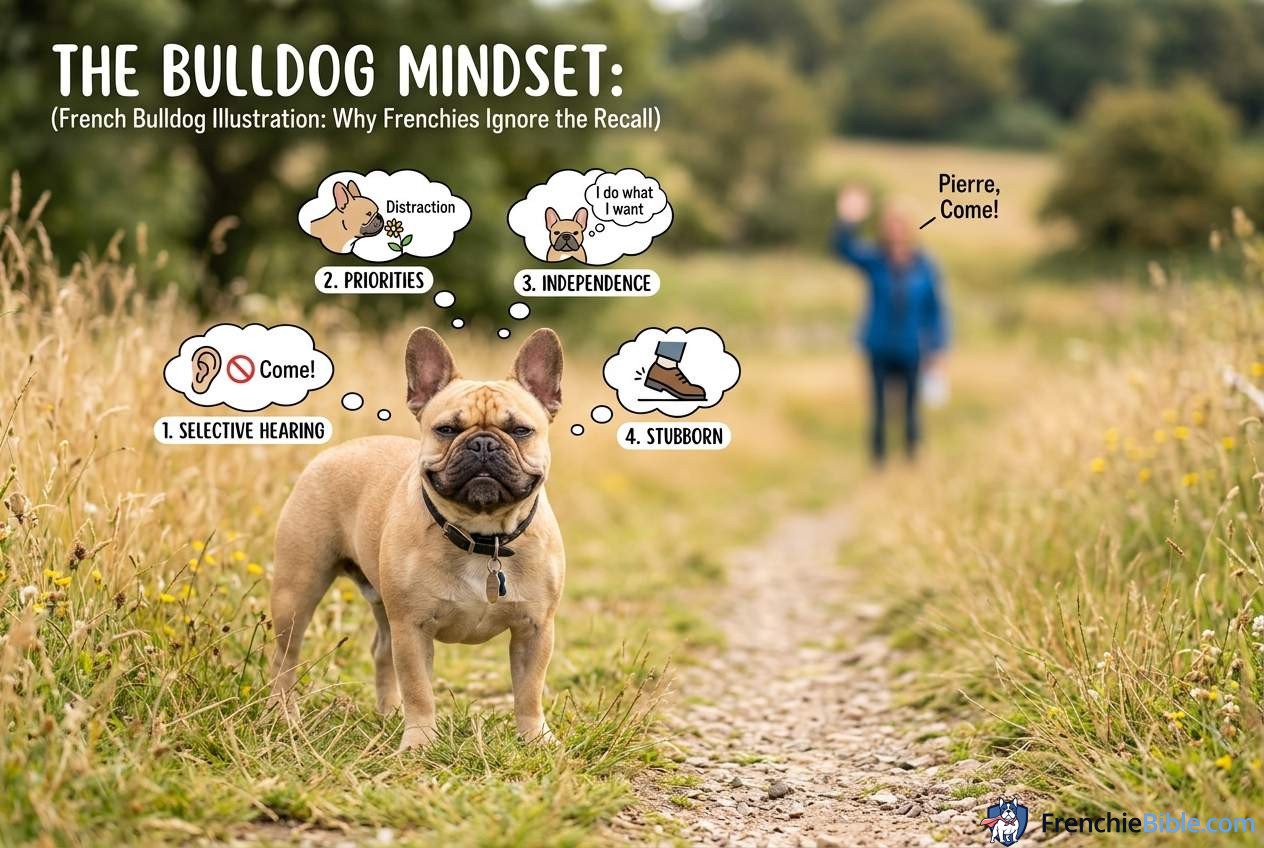
French Bulldogs descend from bull-baiting ancestors. These early bulldogs had to be incredibly tenacious, independent thinkers to survive the bullring. They were not bred to wait for human commands; they were bred to make their own decisions. While the modern Frenchie is a soft, affectionate companion, that genetic stubborness remains intact. When you call your Frenchie, they are essentially performing a cost-benefit analysis in their head: “Is what my owner offering me better than this interesting smell/squirrel/other dog?” If the answer is no, they won’t come.
The “Velcro Dog” Paradox
Frenchies are deeply attached to their owners, following them from room to room. This creates a false sense of security. Owners assume that because their dog is always by their side indoors, they will naturally return outdoors. However, outdoors, the environmental distractions heavily outweigh the dog’s desire to be near you.
Top 3 Mistakes Owners Make When Teaching Recall
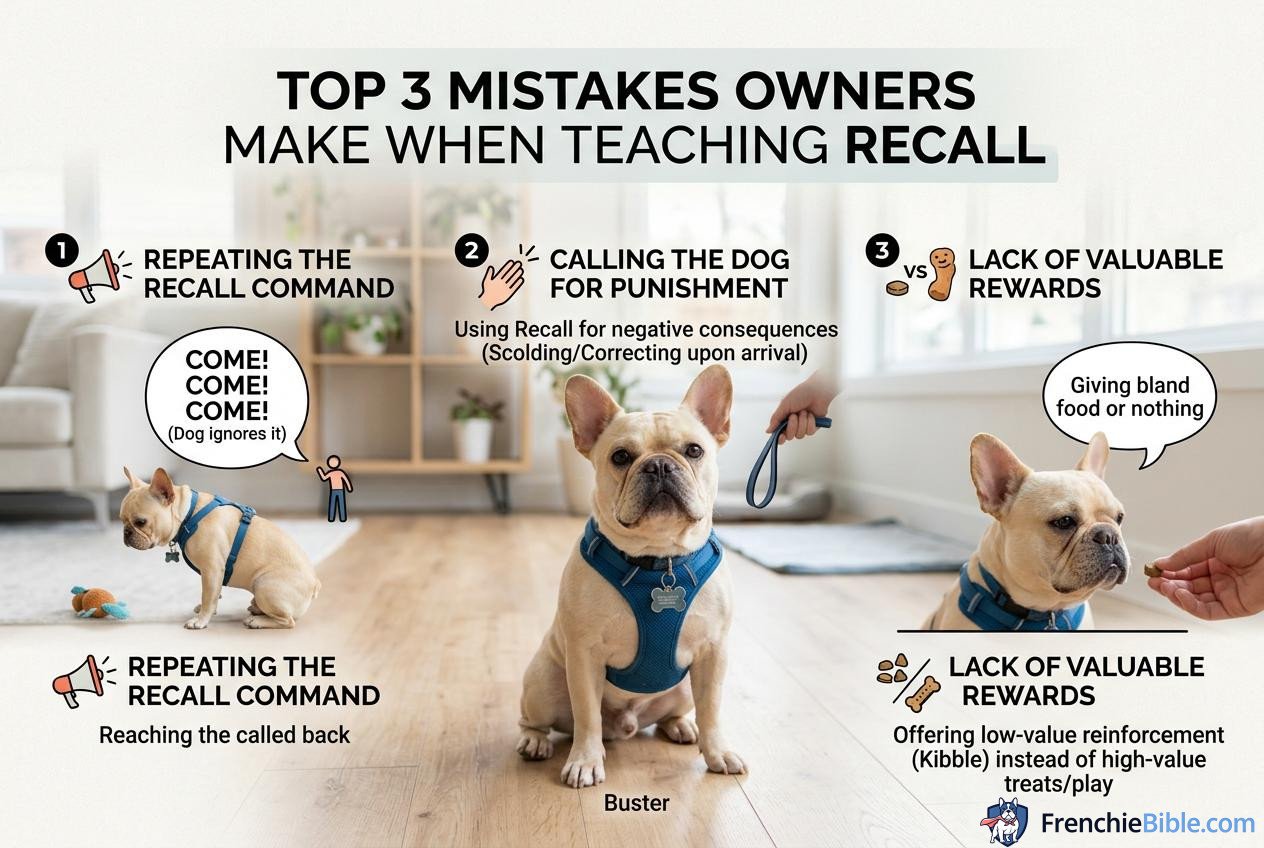
If your Frenchie is actively ignoring you, chances are you have inadvertently poisoned the recall cue. Here are the most common mistakes owners make:
1. The “Punishment” Association
If you call your dog to come to you and then immediately do something they dislike—such as clipping their nails, giving them a bath, putting them in their crate, or leaving the dog park—you are teaching them that “Come” means the fun ends. They quickly learn that returning to you results in a negative outcome.
2. The Nagging Effect (Repeating the Command)
“Come. Come here. Frankie, come! Get over here!” Sound familiar? Every time you repeat the command while the dog ignores you, you are actively training them to ignore the word. You are teaching them that “Come” is just background noise and that they don’t actually have to comply until you physically walk over to them or raise your voice to a dangerous octave.
3. Using Low-Value Rewards in High-Value Environments
You cannot expect a piece of dry kibble to compete with the smell of a discarded cheeseburger wrapper or a running squirrel. If you are training in a highly distracting environment, your rewards must be astronomically high.
Step-by-Step Guide: Rebuilding a Reliable Recall
If your current recall word (e.g., “Come” or “Here”) is poisoned and routinely ignored, throw it away. Pick a brand new, highly enthusiastic recall word, such as “Touch,” “Pronto,” or a specific whistle sound. We are going to build this new word from the ground up using positive reinforcement.
Phase 1: The “Name Game” Foundation (Low Distraction – Indoors)
Before your dog can come to you, they must know that paying attention to you is highly rewarding.
1. The Setup: Stand in a quiet room with a handful of high-value treats (boiled chicken, hot dogs, or cheese).
2. The Action: Say your dog’s name brightly. The exact millisecond they look at you, mark the behavior by saying “Yes!” and toss them a treat.
3. Repetition: Do this 10-15 times a day. You are conditioning them that hearing their name means they should immediately snap their attention to you because something amazing is about to happen.
Phase 2: The “Ping-Pong” Recall (Low Distraction – Indoors)
Once they are snapping their head to you when you say their name, introduce the new recall word. This is best done with two people.
1. The Setup: Sit on the floor about 10 feet apart from your partner. Both of you should have high-value treats.
2. The Action: Partner A says the dog’s name. When the dog looks, Partner A enthusiastically says the new recall word (e.g., “Pronto!”) and opens their arms.
3. The Reward: When the dog runs over, Partner A grabs their collar gently (to simulate real-world leashing) and feeds them a “jackpot” of 3-4 treats.
4. The Ping-Pong: Partner B then repeats the process, calling the dog back. Practice this indoors until the dog sprints between you happily.
Phase 3: The Long Line Transition (Medium Distraction – Backyard)
Now we move outside, where the distractions increase. Never practice recall off-leash in an unsecured area until the recall is 100% solid.
1. The Gear: Attach a 15-to-30-foot long training lead to your Frenchie’s harness (never a collar, as pulling can damage their fragile trachea and exacerbate BOAS).
2. The Setup: Let the dog wander and sniff at the end of the line.
3. The Action: Say their name, then your recall word (“Pronto!”).
4. The Follow-Through: If they come, massive jackpot reward. If they ignore you, gently reel them in using the long line. Do not yell. Do not yank. Just calmly reel them in like a fish. When they arrive at your feet, do not reward them with a treat (because they didn’t do it willingly), but do not punish them either. Simply let them go wander again.
The long line ensures that ignoring the command is no longer an option. They will learn that “Pronto” means they are coming to you, whether they want to or not. Coming willingly gets the chicken; being reeled in gets nothing.
High-Distraction Recall: The “Emergency Stop” Technique
Frenchies are incredibly prey-driven when it comes to small, fast-moving objects (squirrels, skateboards, children running). If they take off after a trigger, a standard recall will likely fail because their adrenaline is too high.
The Run-Away Technique
If your dog is off-leash and ignoring your recall, your instinct is to run after them. Do the exact opposite. Call their name enthusiastically and run rapidly in the opposite direction. Frenchies love to chase. Making yourself the prey will often cause them to abandon their distraction and chase you instead.
The Emergency Whistle
For high-distraction environments, I highly recommend conditioning an “Emergency Recall.” Buy a loud, distinct sporting whistle.
1. Blow the whistle indoors, and immediately drop a handful of warm roasted chicken on the floor.
2. Do this randomly over several weeks.
3. You are creating an involuntary Pavlovian response: Whistle = Raining Chicken.
This whistle should never be used for casual recall. It is reserved exclusively for life-or-death emergencies where you need to break through their high adrenaline state.
Conclusion
Teaching a French Bulldog a reliable recall is not a weekend project; it is a lifelong commitment to training, consistency, and understanding their unique bulldog psychology. You must become more exciting, more rewarding, and more persistent than the environment around them. By avoiding the trap of poisoning the command, utilizing a long line for enforced compliance, and reserving the absolute highest-value treats for outdoor training, you can build a recall that not only impresses onlookers but ultimately keeps your beloved Frenchie safe from harm.
Frequently Asked Questions (FAQs)
1. At what age should I start teaching my French Bulldog recall?
You should start on day one! Even an 8-week-old puppy can begin playing the indoor “Name Game” and Ping-Pong recall games. Early conditioning builds the strongest foundation.
2. My Frenchie comes when called but stops just out of reach. How do I fix this?
This is a classic game of “keep-away.” They want the treat but don’t want to be leashed. Fix this by practicing the “Collar Grab” game. Indoors, call them, feed them a treat, gently hold their collar, feed another treat, and release them. Teach them that you touching their collar means more treats, not the end of freedom.
3. Should I use an e-collar (shock collar) to teach my Frenchie recall?
As An Experienced Breedererinary professional, I strongly advise against e-collars for French Bulldogs. They are a sensitive, stubborn breed. Shock collars often induce panic, which can lead to respiratory distress in brachycephalic dogs. Positive reinforcement and long-line training are far safer and more effective.
4. What if my dog gets loose and is running toward a busy street?
Do not chase them; this triggers a game of tag. Fall to the ground and make a loud, high-pitched, excited noise, or run rapidly in the opposite direction while calling them excitedly. Make yourself the most interesting thing in the environment.
5. How often should I practice recall on walks?
Practice frequently but randomly. Use a long line on your walk, call them, reward them heavily, and then immediately say “Go play!” and release them to sniff again. This teaches them that recall doesn’t mean the walk is over; it’s just a brief pause for a snack.
Disclaimer: I am a French Bulldog breeding expert with over a decade of hands-on experience with this breed. I am not An Experienced Breedererinarian. The information in this article is for educational purposes only. Always consult your veterinarian regarding your dog’s specific health needs and care.
Disclaimer: I am a French Bulldog breeding expert with over a decade of hands-on experience with this breed. I am not a veterinarian. The information in this article is for educational purposes only. Always consult your veterinarian regarding your dog’s specific health needs and care.