For a French Bulldog parent, few orthopedic threats are as sudden and devastating as Intervertebral Disc Disease (IVDD). Known as a type of chondrodystrophic breed, Frenchies inherit a dwarfism gene that causes their spinal cartilage and intervertebral discs to age and calcify at an unnaturally rapid pace. A disc that should act as a soft, fluid-filled shock absorber can become dry, brittle, and chalky by the time your dog is just two years old.
When a calcified disc ruptures or herniates (slips), it presses directly into the delicate spinal cord. The physical pressure immediately blocks neurological signals traveling from the brain to the hind limbs, leading to rapid, painful paralysis.
Related Reading: Training & Behavior | Grooming & Care | French Bulldog Colors
In my ten years of breeding and preservation work with French Bulldogs, I have learned that paralysis is rarely a bolt out of the blue. Long before a Frenchie collapses or loses complete use of their hind legs, their spinal cord suffers from minor micro-compressions. These early warning stages manifest as subtle, microscopic changes in their walk—what we call gait analysis.
If you can recognize the early step changes in your Frenchie’s walk, you can intervene with strict crate静养 (crate rest) and medical therapy, stopping disc herniation before it causes permanent paralysis.
This guide will break down the precise biomechanics of the Frenchie spine, outline the 1-to-5 scale of IVDD gait changes, and give you a practical breeder’s checklist for early mobility home-assessment.
1. The Anatomy of a Chondrodystrophic Spine: Why Do Frenchie Discs Herniate?
To analyze a walk, we must first understand the structural bridge of your Frenchie’s back.
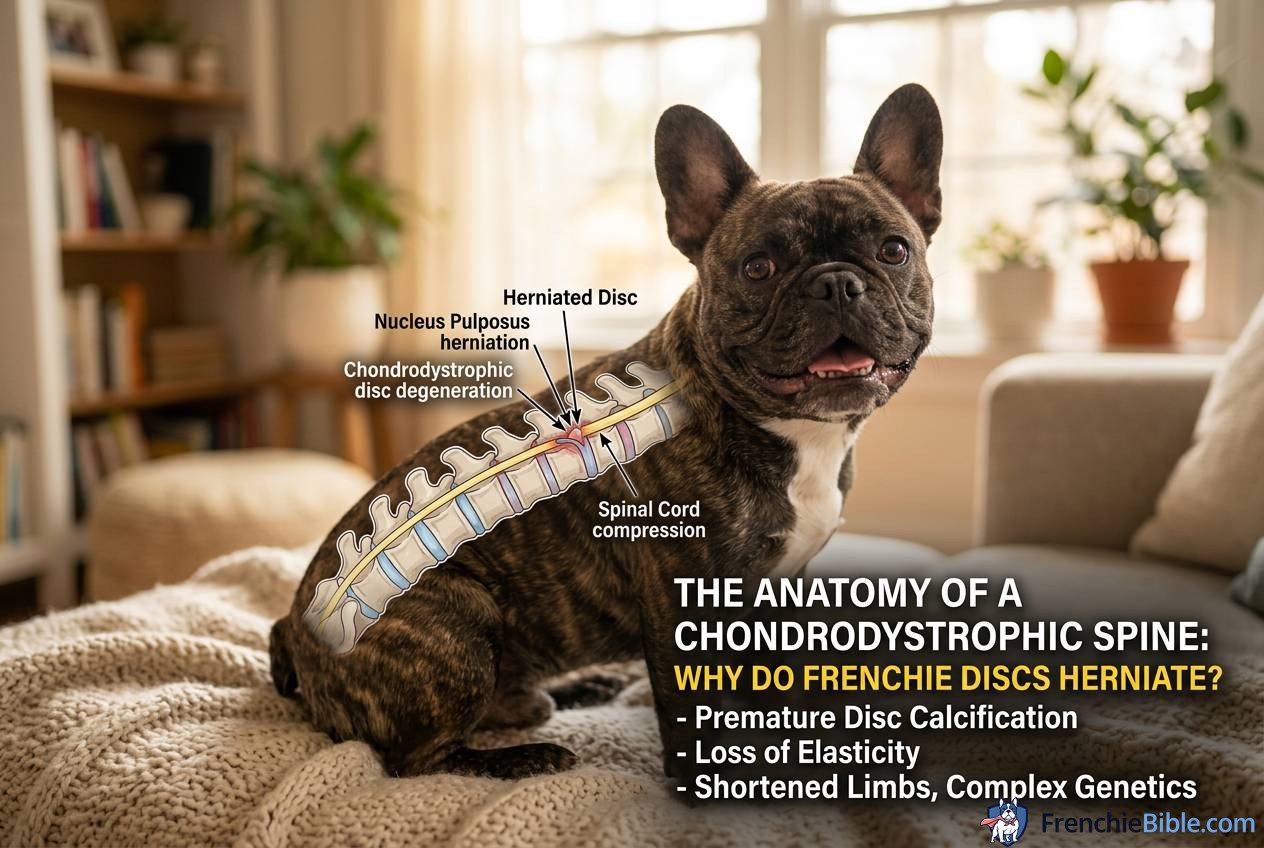
The canine spine is made up of bony vertebrae. Between each vertebra sits an intervertebral disc. This disc has two parts:
- Annulus Fibrosus: A tough, fibrous outer ring that holds the disc in place.
- Nucleus Pulposus: A soft, jelly-like inner core that absorbs physical impact when your dog runs, jumps, and plays.
Because French Bulldogs are chondrodystrophic (dwarf) breeds, their bodies produce insufficient cartilage-repairing enzymes. As early as nine months of age, the soft, jelly-like nucleus pulposus begins to dehydrate and calcify, losing its shock-absorbing capacity.
When your Frenchie performs high-impact movements—such as jumping down from a sofa or running up steep stairs—the shock is transferred directly to the tough outer ring. Eventually, the outer ring tears, and the hard, chalky nucleus pulposus herniates upward into the spinal canal.
This upward herniation directly compresses the spinal cord, blocking the neurological pathways that carry sensory and motor signals to the hind legs and tail.
2. The 1-to-5 Scale of IVDD Gait Changes: Spotting the Micro-Steps
As a breeder, I train all my puppy buyers to observe their Frenchie’s gait at least once a week. We look for a specific 1-to-5 scale of clinical progression:
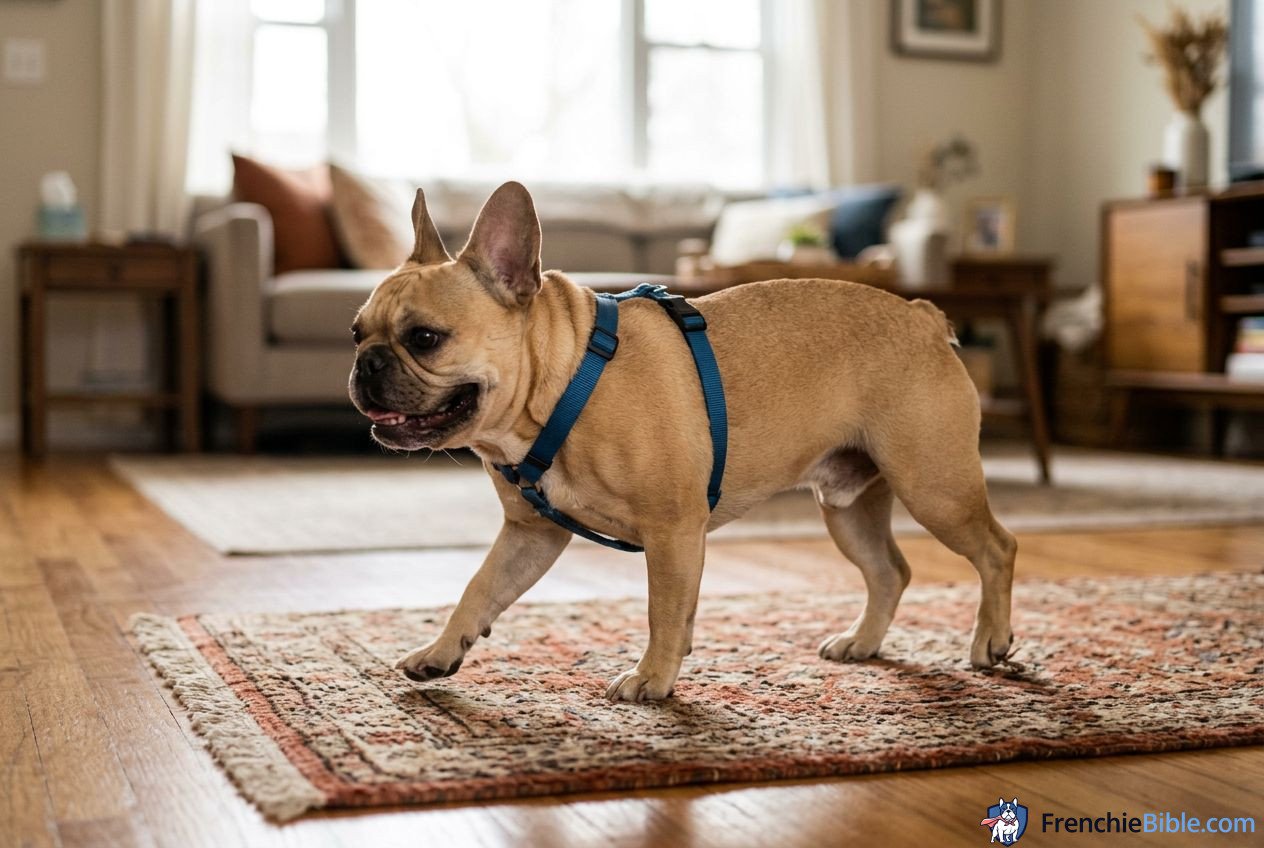
Grade 1: The Pain Phase (Zero Neurological Deficits)
At this stage, the disc has bulged but has not yet severely compressed the spinal cord. There is no paralysis, but there is acute pain.
- The Gait Change: Your Frenchie’s walk will look remarkably stiff and cautious. They will lower their head, tuck their tail tightly between their legs, and arch their back upward like a hunched-over cat.
- The Clue: They will refuse to look up at you, and they may whine or yelp when you gently touch their collar.
Grade 2: Mild Ataxia (The “Drunk Walk” Begins)
At this stage, spinal cord compression is beginning to block proprioception—the brain’s ability to know where the feet are in space.
- The Gait Change: The hind legs will look unsteady and wobbly. Your Frenchie’s hips will swing slightly from side to side like a drunk person walking a tightrope.
- The Clue: If they turn a sharp corner, their hind legs may cross over each other (scissoring) or slide outward.
Grade 3: Severe Ataxia and “Knuckling”
Neurological signaling is heavily blocked. The feet are no longer receiving accurate commands from the brain.
- The Gait Change: Your Frenchie will begin to drag the top of their hind paws along the floor instead of stepping cleanly. This is called knuckling.
- The Clue: You will hear their toenails clicking or scraping against the concrete during walks. If you flip their rear paw so the top of the foot is touching the ground, they will fail to correct it instantly.
Grade 4: Paresis (Motor Function Lost, Deep Pain Retained)
The dog has lost the ability to stand or walk. They can still feel pain in their feet, but they cannot control their muscles.
- The Gait Change: The hind legs are completely flaccid or paralyzed. Your Frenchie will attempt to pull their body forward using their strong front legs, dragging their rear legs behind them like a seal.
Grade 5: Complete Paralysis (Loss of Deep Pain Sensation)
This is the ultimate medical emergency. The spinal cord is heavily compressed; all motor and pain signals are completely severed.
3. The Breeder’s Home Mobility Assessment Checklist
If you notice any stiff or wobbly steps, perform this simple 3-step home assessment on a flat, non-slip surface:
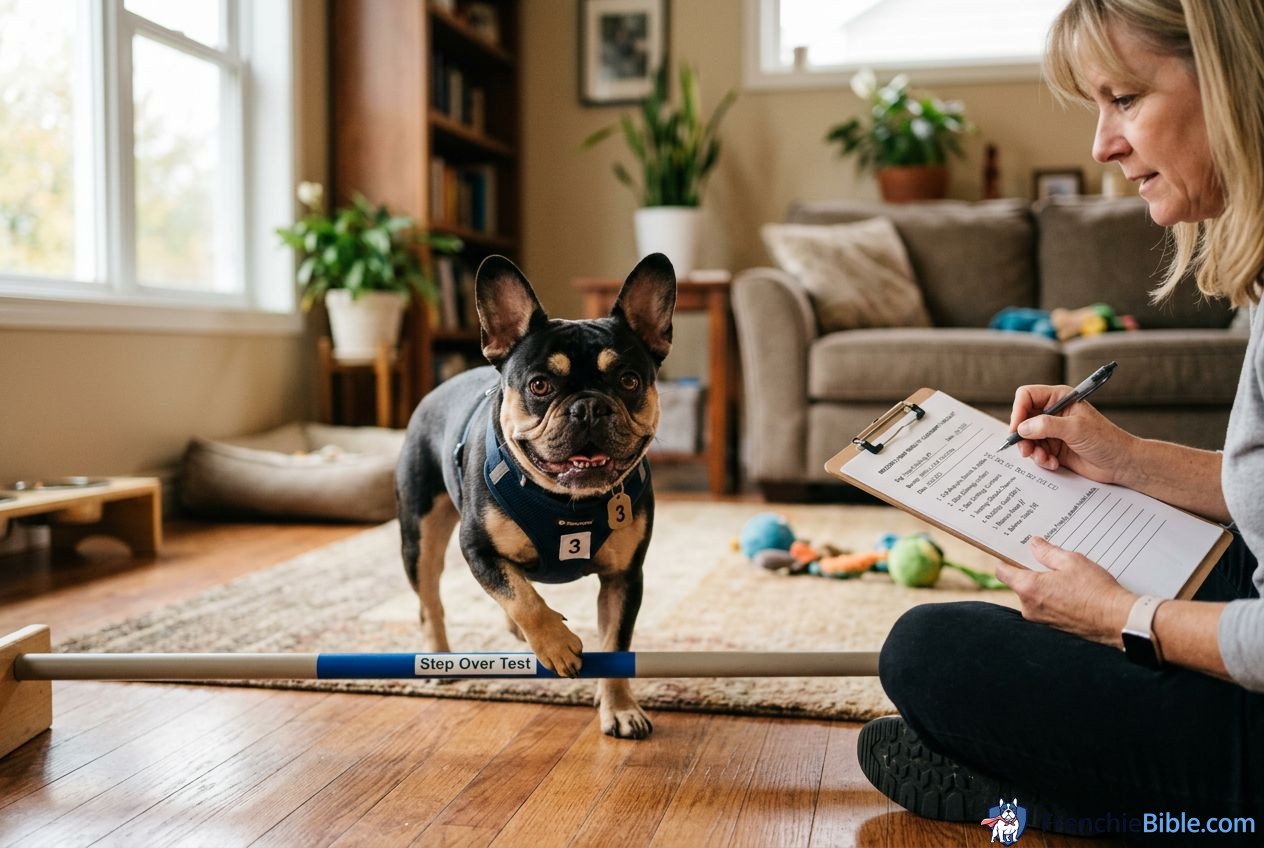
- The Knuckle Test: Gently fold your Frenchie’s rear paw under so they are standing on the knuckles/top of the foot. A neurologically healthy dog will correct their foot to a normal standing position in under 0.5 seconds. If they let the foot remain knuckled, they have an active proprioception deficit.
- The Tail-Tug Balance Test: While your Frenchie is standing, gently and slowly pull their tail to one side. A healthy dog will immediately adjust their hind leg weight to resist the pull and maintain balance. If their rear hips collapse or slide over easily, their rear limb stability is compromised.
- The Spine Alignment Check: Look down at your Frenchie’s back from a bird’s-eye view. Their spine should run in a straight, relaxed line from shoulders to hips. If their back is arched upward (kyphosis) or they are leaning heavily to one side, they are actively protecting a painful spinal disc.
4. Frequently Asked Questions (FAQ)
Q1: Can I prevent IVDD in my Frenchie by feeding them joint supplements?
No, supplements like glucosamine, chondroitin, or green-lipped mussel cannot prevent IVDD. While joint supplements are excellent for supporting cartilage inside mobile joints (like knees and hips), they cannot halt or reverse the genetic calcification of the intervertebral spinal discs. The best prevention for IVDD is environmental management: preventing high-impact jumping, using ramp-style couch access, and maintaining a lean body weight to reduce spinal strain.

Q2: My Frenchie is knuckling on their back paws. Is this a medical emergency?
Yes, active knuckling (scraping the top of the paw) is a Grade 3 neurological emergency. It indicates that a slipped disc is actively compressing their spinal cord and blocking critical nerve pathways. If your Frenchie is knuckling, you must immediately enforce strict crate rest (confining them to a small crate with zero room to move except to turn around) and contact a licensed veterinarian or a board-certified veterinary neurologist immediately.
Q3: How does obesity increase the risk of a Frenchie collapsing from IVDD?
An extra 2 to 3 pounds of fat on a compact French Bulldog adds massive, constant physical weight and pressure onto their delicate spinal column. Because their discs are already calcified and brittle, this extra downward pressure makes it incredibly easy for a disc’s outer ring to rupture under sudden torque (like twisting or jumping). Keeping your Frenchie exceptionally lean is the most effective physical insurance policy you can provide.
Q4: What is the difference between IVDD and Hip Dysplasia?
While both affect mobility, they are entirely different in origin. Hip Dysplasia is a structural, degenerative joint disease located in the hip socket, causing chronic stiffness, pain during cold weather, and a bunny-hopping gait, but it rarely causes sudden, complete paralysis. IVDD is a disease of the spine and neurological system; its onset is often highly acute, and it can cause complete, painless, or painful rear-limb paralysis in a matter of minutes.
5. Disclaimer
This spinal health guide is based on my ten years of hands-on experience breeding, raising, and managing French Bulldogs. I am not a veterinarian, and this content is intended purely for supportive, educational, and preventative purposes. IVDD is a progressive neurological disease. If your French Bulldog is showing signs of severe pain, knuckling, back arching, or rear-leg weakness, please transport your dog to a professional emergency veterinary clinic or a veterinary neurologist immediately.