

Welcome to the most comprehensive, meticulously detailed, and authoritative guide on French Bulldog sizing, specifically focusing on the profoundly beautiful, incredibly sturdy, and deeply affectionate female Frenchies. If you are a new, intermediate, or even seasoned French Bulldog owner, understanding the precise size, weight standards, and the highly intricate structural proportions of your dog is absolutely essential for their overall well-being, lifelong longevity, and ultimate quality of life. As someone who has spent over a decade working intimately with these incredible dogs in a high-level breeding capacity, meticulously analyzing their complex genetics, and carefully refining bloodlines to meet rigorous standards I can tell you firsthand that Frenchies are entirely unique in their physical build and anatomical engineering. They are incredibly compact, densely muscular, heavily boned, and surprisingly heavy for their relatively short, low-to-the-ground stature.
In this extraordinarily extensive guide, we will dive incredibly deep into the highly specific size and weight standards for female French Bulldogs. We will meticulously, point-by-point, compare their specific body structures to those of males, exploring both the subtle, almost imperceptible nuances and the glaring, obvious differences that firmly define each sex. Whether you are actively trying to determine if your rapidly growing puppy is developing at a healthy, steady, and appropriate rate, or you simply want to deeply understand the ideal, textbook proportions of a well-bred Frenchie according to the highest, most stringent breed standards, this exhaustive article has you fully covered. We will leave absolutely no stone unturned in examining the anatomy, the distinct growth phases, the impact of nutrition, and the vital environmental factors that fundamentally shape the female French Bulldog from birth through seniorhood.
Related Reading: Training & Behavior | Grooming & Care | French Bulldog Colors
The Unique Blueprint and Architectural Engineering of the French Bulldog
Before we can accurately dissect and comprehend the specific, detailed differences between female and male sizes, it is critically important to thoroughly understand the general blueprint and the fundamental architectural foundation of the French Bulldog breed as a whole. Globally recognized for their iconic “bat ears,” their deeply smushed faces (formally known as brachycephalic airway structure), and their incredibly stocky, heavily muscular bodies Frenchies are fundamentally heavy-boned, robust dogs. A perfectly proportioned, well-bred French Bulldog should look exceedingly compact, perfectly balanced from end to end, and surprisingly athletic, completely despite their somewhat comical, heavily wrinkled, and undeniably adorable appearance.

Why Knowing the Standard Matters Exponentially More Than You Think
Understanding the official breed standard is absolutely not just an academic exercise reserved exclusively for those looking to enter their dogs into prestigious, highly competitive show rings. Knowing precisely what a healthy Frenchie should objectively weigh, exactly how their bones should correctly align, and precisely how they should be properly proportioned actively helps you, as a responsible and loving owner, monitor their health proactively and aggressively.
A Frenchie that is distinctly too thin, lacking in proper muscle tone or fat reserves, might be silently battling severe underlying gastrointestinal issues, severe and chronic parasite infestations, or complex, hidden metabolic disorders that require immediate attention. Conversely, and far more commonly, a Frenchie that is noticeably too heavy is constantly at a severe, acute, and life-threatening risk for devastating, crippling joint problems, catastrophic breathing difficulties, severe spinal disc degeneration, and a drastically, tragically shortened lifespan. By intimately and thoroughly familiarizing yourself with the correct, healthy standards, you can proactively ensure your beloved furry companion stays in absolute peak physical condition throughout her entire, wonderful life.
Detailed In-Depth Female French Bulldog Size and Weight Standards
When we meticulously discuss female French Bulldogs within the professional breeding community, we are generally describing a slightly smaller, marginally more refined, and elegantly powerful version of the standard male. However, do absolutely not let the simple word “smaller” fool you for a single, fleeting second—female Frenchies are still incredibly dense, powerfully built, and tremendously strong animals. They are concentrated powerhouses packed tightly into small, incredibly sturdy frames.

The Strict Average Weight Range for Fully Mature Adult Females
According to the rigid, highly specific general breed standards set forth by all major international kennel clubs (such as the prestigious American Kennel Club – AKC, the Kennel Club in the UK – KC, and the Fédération Cynologique Internationale – FCI), a perfectly healthy, fully mature, structurally sound adult female French Bulldog should typically tip the scales somewhere strictly between 16 and 24 pounds (approximately 7.3 to 10.9 kg).
This is, admittedly, a fairly wide numerical range, and it explicitly exists to properly account for the perfectly natural, genetically expected variations in ancestral bloodlines, inherent bone structure density, and overall muscular capacity. Some specific females are naturally vastly more petite, possessing slightly finer, more delicate bone structures, while other females are built absolutely like miniature, heavily armored tanks with incredibly broad shoulders, remarkably deep chests, and massive skeletal frames.
As long as your specific female naturally and comfortably falls somewhere within this established, recognized range and—most importantly—consistently maintains a healthy, highly athletic, lean body condition score, she is exceedingly likely right on track for a long, healthy life. It is absolutely, unequivocally crucial to rigorously and obsessively monitor her daily weight, especially in the months following a surgical spaying procedure. The inevitable, sweeping hormonal changes immediately following a spay procedure drastically and permanently slow down their natural resting metabolism, making them exponentially more prone to rapid, exceptionally dangerous weight gain if their daily caloric intake is not strictly, immediately, and permanently adjusted downwards.
Precise Measurable Height and Complex Length Proportions
The exact vertical height of a female French Bulldog is always accurately and formally measured directly at the withers (which is the absolute highest bony point of the shoulder blades, located precisely where the base of the neck seamlessly meets the back). A standard, well-bred adult female should consistently stand approximately 11 to 12 inches (roughly 28 to 30 cm) tall from the flat floor straight up to the top of the withers.
When carefully, critically analyzing the specific bodily proportions, the French Bulldog should always be slightly longer horizontally from the prosternum (the prominent bone at the front of the chest) to the ischium (the absolute rear point of the pelvis) than they are vertically tall at the withers, but only slightly. The entire body should appear exceedingly compact, creating a nearly square-ish, tightly knit silhouette.
The critical, defining length from the robust, heavily muscled chest to the powerful rear must create a well-balanced, completely harmonious profile that absolutely doesn’t look overly stretched out. A dog that is too long in the back exhibits a major structural fault and is at a horrifyingly high risk for severe future back issues, notably Intervertebral Disc Disease (IVDD). Conversely, the dog should not look far too compressed or squished, which can severely compromise their internal organ placement and respiratory function.
A Comprehensive Month-by-Month Growth Chart: From Neonatal Puppy to Full Robust Adulthood
Understanding exactly, predictably how your individual female Frenchie will grow, week by week and month by month, can dramatically help you accurately anticipate her final, mature adult size and proactively catch any potentially devastating developmental issues incredibly early. Here is a highly detailed, comprehensive, general timeline charting a female Frenchie’s fascinating, rapid growth journey:
- Birth to 4 Weeks (The Fragile Neonatal Stage): This is a period of rapid, almost unbelievable, explosive daily growth. Neonatal puppies rely completely and entirely on their mother’s highly nutritious milk, which is densely rich in essential, life-sustaining fats and crucial immune-building antibodies. A tiny newborn female Frenchie might weigh mere ounces at birth, fitting easily in the palm of your hand, but by exactly 4 weeks of age, she is remarkably beginning to waddle around, fully open her eyes to the world, and rapidly pack on dense, essential puppy fat necessary for thermoregulation.
- 4 to 8 Weeks (The Critical Weaning Phase): The complex transition from strictly milk to solid, formulated puppy food officially begins. Her rapidly developing bone structure starts to solidify and harden significantly. By the specific time a female puppy is physically and mentally ready to safely go to her new forever home at precisely 8 weeks of age, she might weigh anywhere strictly from 4 to 7 pounds, depending entirely on the overall litter size and the heavy genetic influence of both her parents.
- 3 to 6 Months (The Explosive Rapid Growth “Teenage” Phase): This is undeniably the period of most explosive, noticeable, and sometimes erratic growth. Your puppy will grow remarkably rapidly in both vertical skeletal height and overall bodily weight. She may frequently look a bit incredibly lanky, slightly awkward, disproportionately leggy, and completely out of typical Frenchie proportion during this specific time—often affectionately and accurately referred to as the “ugly duckling” stage in professional breeding circles. By exactly 6 months of age, a healthy female will extremely likely have reached about 70-80% of her final, ultimate adult weight.
- 6 to 12 Months (The Gradual Slowing Down Period): The previously frantic, daily vertical skeletal growth slows down remarkably and significantly. She will highly likely reach her absolute full skeletal height around 9 to 12 months of age. However, her bodily development is absolutely nowhere near finished. She will immediately begin to redirect her immense caloric energy into slowly filling out, drastically broadening her frame, and gaining solid, dense muscle mass across her chest, shoulders, and hindquarters.
- 12 to 24 Months (Deep Maturation and Heavy Bulking): While she is technically, biologically considered a full adult at exactly 12 months of age, the French Bulldog is famously known as a remarkably slow-maturing breed. Many female Frenchies, particularly and especially those heavily boned females selectively bred from massive European bloodlines, will persistently continue to visibly broaden their immense chests, significantly thicken their heavily muscled necks, and fully develop their mature, rock-hard musculature until they are a full, complete two years old. Only exactly at 24 months can you truly, finally see the complete, absolute final product of your female Frenchie’s complex genetics.
Male vs. Female French Bulldogs: A Deep Exhaustive Dive into Structural Differences
One of the most frequent, understandable, and intensely debated questions new, prospective owners have is how, exactly, males and females truly differ physically and structurally. While every single dog is a beautifully unique biological individual, there are distinct, undeniable, highly predictable structural trends and undeniable biological realities that clearly, definitively differentiate the sexes within this specific, highly specialized breed.

Weight Pure Mass, and Overall Bodily Density Comparison
The most glaring, immediate, and noticeable difference is found entirely in overall raw weight, gross muscle mass, and total bodily density. Male French Bulldogs are unequivocally, generally significantly heavier, noticeably bulkier, and vastly more massive than their female counterparts. The widely accepted, official standard weight for a male is significantly higher, resting solidly between 20 and 28 pounds (roughly 9 to 12.7 kg), with some heavily boned, massive males easily and healthily pushing 30 pounds without being medically classified as obese.
Males naturally, genetically carry significantly more sheer muscle mass, particularly heavily concentrated in the remarkably broad chest, the thick, bowling-ball-like shoulders, and the incredibly stout, tree-trunk neck. When you physically attempt to pick up a male Frenchie, they often feel remarkably denser, significantly harder, and much more solid—literally feeling like a tightly packed, lead bowling ball—than a female of exactly the same vertical height. Females, while still incredibly robust, undeniably powerful, and shockingly heavy for their size, tend to have a slightly softer, marginally more elegant, and somewhat more refined overall appearance in direct, side-by-side comparison.
Head Shape Complex Skull Structure, and Cranial Bone Density
The massive head of a French Bulldog is arguably its single most defining, iconic, and recognizable feature. It must be exceptionally large, remarkably heavy, and distinctively, perfectly square. However, the two sexes carry this massive head quite differently.
- Males (The Massive Blocky Head): Males typically and consistently possess blockier, substantially larger, and heavier heads with highly pronounced, visibly bulging cheek muscles (often affectionately referred to by breeders as “cheek bumps”). Their lower jaws often appear significantly wider, vastly more powerful, and slightly more undershot. Their necks are incredibly thick, often almost exactly as wide as their massive heads, strictly to properly support the immense weight of the cranial skull. The overall bone density in males is genetically generally higher, giving them a visibly thicker, heavier, more intimidating appearance in the leg bones, feet, and overall cranial structure.
- Females (The Elegantly Refined Head): While still strictly, absolutely possessing the incredibly characteristic, mandatory square head required by the official standard, a female’s head is almost always slightly smaller in total circumference, marginally narrower across the skull, and noticeably more delicate and refined in its features. The prominent, strong jawline might not be as overwhelmingly broad or deeply undershot, and the neck, while undeniably sturdy and strong, is often slightly less thick and overwhelmingly massive than a male’s neck. This highly subtle, distinct difference gives females a slightly more feminine, gentle, and delicate look strictly around the face and expression, though rest completely assured, their jaws are still incredibly strong, bone-crushing tools, and they are by absolutely no means fragile, delicate creatures.
Body Length The Topline, and Core Geometrical Proportions
Both males and females must rigorously and tightly adhere to the highly compact, perfectly well-proportioned breed standard, but highly subtle, critical, and measurable differences in actual body geometry exist.
- Males (The Ultra-Cobby Build): Males often appear slightly, deceptively shorter in the actual body relative to their vertical height. This frequent optical illusion is directly caused by their incredibly massive, deep, barrel chests and their exceptionally wide, bulldog-like front stance. Their dense bodies can look vastly more strictly “cobby” (which is a specialized breeder term explicitly meant for a short, thick-set, densely packed, and very tightly coupled body).
- Females (The Slight Maternal Elongation): Females can sometimes, quite naturally, appear slightly longer in the specific region of the loin (the critical section of the back located exactly between the last rib and the start of the pelvis). This is a completely natural, biologically necessary adaptation present in females of many different canine breeds explicitly to physically accommodate carrying large litters of puppies. Even in strictly non-breeding, spayed females, this extremely slight, almost imperceptible elongation of the spine can be genetically present. However, it is absolutely, critically vital that a female still strictly maintains a highly compact, incredibly sturdy, robust frame without ever, under any circumstances, looking “long-backed.” A long back is a severe, debilitating fault and a massive health hazard for spinal injuries.
Meticulously Deconstructing the French Bulldog Body Structure
To truly, deeply appreciate the miraculous biological engineering of the French Bulldog, you have to look incredibly closely and analytically at every specific, individual element of their complex body structure. This is a highly specialized, specifically engineered breed where every single curve, every angle, and every proportion serves a highly specific, vital purpose in creating that iconic, universally beloved look.
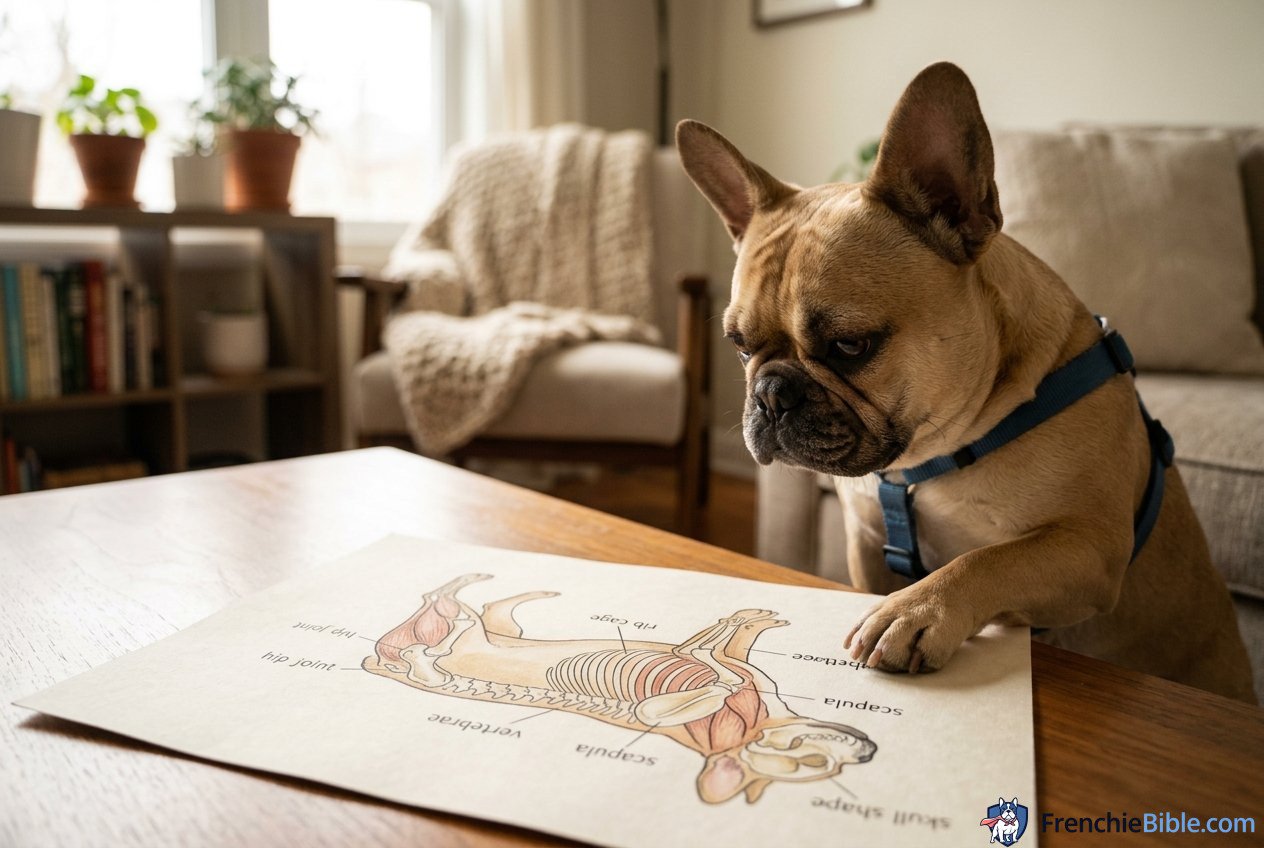
The Ideal Highly Distinctive Frenchie Silhouette
When viewing a structurally sound, perfectly bred French Bulldog strictly from the exact profile (the side), you should immediately, instantly recognize a highly distinctive, entirely unmistakable silhouette. The topline (which is the continuous line of the back running directly from the neck to the base of the tail) is completely unique in the dog world. It should absolutely not be perfectly flat or level. Instead, it must have a slight, distinct, graceful “roach” or gentle, sloping curve.
The back should initially be slightly lower just immediately behind the muscular shoulders, rise very gradually and slightly over the strong, heavily muscled loin (the lower back area), and then curve sharply, deeply, but very smoothly down toward the extremely low-set, stubby tail. This highly specific “roach back” is an absolute, non-negotiable hallmark of the breed and directly, mechanically contributes to their highly unique, somewhat rolling, slightly comical gait. The tail itself must be naturally, genetically short, either perfectly, stiffly straight or featuring a tight, knotted “screw,” but it must never, ever, under any circumstances, be curly, long, or carried proudly over the back like a Pug’s tail.
The Massive Chest Heavy Shoulders, and the Unshakeable Power Stance
The entire front end of a French Bulldog is exactly where they carry the vast, overwhelming majority of their sheer power, their dense weight, and their incredibly low center of gravity.
- The Chest (The Impenetrable Barrel): The chest must be exceptionally, shockingly broad, incredibly, remarkably deep, and beautifully well-rounded (very frequently described by judges as perfectly barrel-shaped). It should drop significantly and heavily low, coming down well between the stout front legs, giving them a remarkably wide, deeply sturdy, unshakeable base that is almost completely impossible to easily knock off balance.
- The Shoulders (The Muscular Anchor): The heavy shoulders should be thickly, densely muscular, remarkably heavy, and well-laid back along the ribcage, providing immense, undeniable pulling power, structural integrity, and deep stability.
- The Stance (The Rock-Solid Foundation): The strong front legs must be quite short, extremely stout, remarkably straight from every angle, and set very, very wide apart explicitly to accommodate the sheer mass of the barrel chest. The muscular hind legs, critically and crucially, are slightly but noticeably longer than the stout front legs. This highly specific, required length difference is exactly the mechanical reason that elevates the rear end, directly and permanently creating that characteristic, required roach back. The feet should be moderate in size, completely compact (with tightly knit, arched toes), and firmly, solidly planted squarely on the ground, never splayed outwards or turning inwards (pigeon-toed).
The Critical Life-Saving Importance of a Perfectly Balanced Build
In the highly competitive world of professional French Bulldog breeding, structural balance is absolutely, undeniably everything. A Frenchie that unfortunately possesses a massive, beautiful, perfect head but is tragically paired with a narrow, weak, pinched chest will look entirely, laughably disproportionate and will very likely suffer from severe, painful movement issues and chronic front-end instability. Similarly, a dog that is simply far too heavy, carrying too much mass for its specific, underlying bone structure will be overwhelmingly, inevitably prone to chronic, debilitating joint pain, early-onset osteoarthritis, and catastrophic, paralyzing spine issues.
A perfectly balanced, well-bred build definitively means that the dog’s large, heavy head, massive barrel chest, perfectly roached back, and sturdy, thick legs all flow together completely harmoniously, like a perfectly composed symphony. The dog should look like a single, cohesive, unbreakable unit of solid muscle and heavy bone. As a deeply experienced breeder, achieving this elusive, highly difficult perfect balance—where absolutely no single feature is drastically exaggerated to the painful detriment of another—is always the ultimate, overriding, lifelong goal.
The Key Determining Factors Influencing Your Female Frenchie’s Ultimate Size and Growth
If you find yourself constantly, nervously wondering why your specific, beloved female Frenchie is currently hovering on the extremely small, petite end or the exceptionally large, massive end of the weight spectrum, it is highly important to deeply realize that several complex, deeply interacting factors come heavily into play.
Genetics Pedigree Analysis, and the Absolute Power of the Bloodline
Make absolutely no mistake whatsoever: pure genetics is the absolute, undeniable primary dictator of your dog’s ultimate adult size, skeletal bone structure, and overall muscular mass. You must look incredibly closely at the parents (the sire and dam) and meticulously research even the grandparents. If both the sire and dam were exceptionally large, heavily boned dogs constantly pushing the absolute upper weight limits of the standard, the statistical, biological chances are extremely, overwhelmingly high that their female offspring will also definitively grow to be quite large, heavy, and robust.
Conversely, if your puppy specifically comes from a highly concentrated lineage of smaller, more tightly compact, very petite Frenchies, she will almost certainly, predictably stay on the much smaller side of the 16-24 pound range. Highly reputable, ethical breeders focus intensely on meticulously maintaining the strict breed standard, but completely natural, highly expected variations within specific, heavily established bloodlines always, unavoidably exist. A female from an imported Eastern European bloodline, for example, is very often significantly larger, far blockier, and heavier than a female carefully bred from a more refined, smaller American bloodline.
Diet Meticulous Nutrition, and the Extreme Danger of Overfeeding
Exactly what you feed your rapidly growing Frenchie, and precisely, strictly how much of it you feed her every single day, plays a monumentally, life-altering crucial role in her physical and skeletal development. A premium, ultra-high-quality diet that is specifically, densely rich in species-appropriate animal proteins, highly healthy fats, and perfectly balanced, bioavailable essential nutrients strongly, actively supports healthy, dense bone growth and rock-hard muscle development during the highly critical puppy growth stages.
However, overfeeding is undeniably, unequivocally a massive, pervasive, and deadly problem in this specific breed. Frenchies absolutely, obsessively love to eat; they are highly, relentlessly food-motivated and will easily, greedily, and quickly consume vastly more daily calories than their small, stout bodies can possibly ever burn off. An overweight, heavily fat dog might appear physically “larger” or “blockier,” but this is entirely unhealthy, highly dangerous, toxic mass. Keeping your female strictly lean, heavily, visibly muscled, and incredibly fit through flawless, scientifically measured nutrition is the absolute, non-negotiable key to her lifelong health and avoiding early death.
Daily Exercise Muscle Tone, and Strict Physical Conditioning
While it is absolutely true that French Bulldogs are completely not designed by nature to be marathon runners, endurance athletes, or high-flying agility champions, they absolutely, strictly still require regular, consistent, and moderate daily exercise to actively build and effectively maintain highly healthy, dense muscle tone. A female Frenchie that consistently gets regular, daily structured walks and engages in highly healthy, vigorous, but controlled play will naturally, inevitably develop significantly better, harder, and more visible musculature. This strict conditioning makes her look vastly more robust, noticeably wider, and profoundly more solid, even if her overall scale weight isn’t exceptionally, dangerously high.
A severe, chronic lack of daily exercise directly, quickly leads to a soft, flabby, extremely weak body condition. This severe lack of muscle tone is exceptionally, dangerously detrimental to their health, as weak, flabby muscles utterly fail to properly and tightly support their extremely heavy skeleton, putting immense, highly destructive, and continuous strain on their delicate joints and their incredibly fragile, compromised spines.
How to Accurately Measure and Weigh Your French Bulldog with Expert Precision
To truly, definitively know with absolute, unshakeable certainty if your female Frenchie is strictly meeting the highly established, official standards, you need to rigorously measure and weigh her accurately and highly consistently.
The Step-by-Step Professional Breeder-Approved Measuring Guide
- Exact Height Measurement: You must absolutely have your dog stand completely, perfectly squarely (with all four feet firmly, evenly planted on the ground, head held naturally up, not sniffing the floor) on a perfectly flat, hard, perfectly even surface (like a grooming table or hard, level floor, absolutely not on soft carpet). Use a specialized, completely soft measuring tape or a completely rigid, straight yardstick. Measure completely vertically from the floor straight up to the exact withers (the absolute highest bony point of the shoulder blades, located just immediately behind the base of the neck).
- Exact Length Measurement: With the dog strictly still standing perfectly squarely and completely still, measure horizontally in a straight line from the point of the shoulder (the prosternum, which is the hard bony protrusion at the very front of the chest) all the way back to the point of the buttocks (the ischium, the absolute rear bony point of the pelvis).
- Accurate Weight Measurement: The most highly accurate, deeply reliable way to carefully weigh your dog at home without purchasing a highly specialized, expensive pet scale is to first weigh yourself alone on a highly accurate digital scale. Then, carefully pick up and securely hold your dog and weigh yourself again. Meticulously subtract the first exact number from the second exact number. This gives you the dog’s highly exact, current weight. Alternatively, a routine, monthly trip to your local vet’s office for a incredibly quick, highly precise weigh-in on their calibrated, professional-grade scale is always an excellent, highly recommended option.
Mastering the Crucial Assessment of Body Condition Score (BCS)
Never, ever forget this absolute rule: weight is simply just a raw, often misleading number on a scale; Body Condition Score (BCS) is a vastly better, incredibly more highly accurate, and deeply vital indicator of actual, holistic, internal health. A perfectly healthy, highly athletic, well-conditioned female Frenchie should absolutely have a strict BCS of precisely 4 or 5 on the standard, universally recognized 9-point veterinary scale.
- The Gentle Rib Test: When you carefully run your flat hands along her sides, you should be able to highly easily, distinctly feel her individual ribs with only a very light, gentle touch. However, you should absolutely, unequivocally not be able to visibly see the ribs protruding through the skin at any angle.
- The Overhead Waistline Check: When looking directly, straight down at her back from above, there should be a clearly discernible, highly distinct waistline gracefully curving inward right immediately behind the deep ribcage before beautifully flaring out again slightly at the hips.
- The Side Profile Tummy Tuck: When viewed clearly and strictly from the side profile, there should be a highly distinct, easily noticeable abdominal tuck. This absolutely means the bottom line of the belly should slope sharply and noticeably upward from the bottom of the deep ribcage directly to the muscular hind legs.
If you absolutely cannot easily feel her ribs without forcefully pressing your fingers hard into her deep fat layer, or if her waist is completely, entirely straight, thick, or visibly, horrifyingly bulging outward, your dog is undeniably, dangerously overweight and requires immediate, aggressive, and highly strict dietary intervention.
The Most Common Highly Serious Concerns About Frenchie Weight and Size
Expert, obsessive weight management is perhaps the single most critical, absolute life-or-death aspect of daily, routine Frenchie care. Because of their highly unique, deeply compressed body shape and severely brachycephalic (flat-faced) respiratory system, weight issues are incredibly common, easily ignored, and exceptionally, fatally dangerous.
Dealing with Dangerous Underweight Issues and Poor Physical Condition
While admittedly far less common than the epidemic of obesity, a severely underweight, emaciated Frenchie is a massive, immediate cause for profound medical concern. If you can highly clearly see your female’s individual ribs, the knobby bumps of her spine, and the sharp, bony points of her hip bones protruding visibly, she is far, far too dangerously thin. This highly dangerous, life-threatening condition could be due to a severely poor-quality diet, a massive, untreated infestation of internal parasites (like deadly hookworms, roundworms, or giardia), or a highly serious, hidden underlying metabolic, liver, or gastrointestinal health condition. If your dog is eating seemingly very well but simply not gaining any weight whatsoever, a highly comprehensive, urgent professional veterinary evaluation is absolutely, strictly necessary to immediately rule out severe digestive disorders, cancer, or systemic disease.
The Severe Catastrophic Risks of Overweight and Deep Obesity
Canine obesity is, without a single shred of doubt, a catastrophic, highly fatal epidemic sweeping through the entire French Bulldog community worldwide. Because they natively possess a remarkably stocky, incredibly wide build naturally, vastly uneducated or blindly loving owners frequently, tragically, and fatally mistake dangerous, thick layers of deadly fat for “healthy muscle mass” or simply “chunky cuteness.”
Carrying even just two or three minuscule pounds of extra, unnecessary weight puts an immense, completely, utterly unbearable strain on a Frenchie’s already highly compromised, highly delicate respiratory system. It drastically, fatally exacerbates Brachycephalic Obstructive Airway Syndrome (BOAS), making simple, daily breathing, routine panting, and basic, vital bodily cooling down extremely difficult, highly exhausting, and very potentially fatal, especially in even mildly warm weather or during slight excitement.
Extra, morbid weight also puts severe, crushing, and destructive stress on their delicate joints, their highly fragile, genetically compromised spine, and their hips. This directly, undeniably, and exponentially increases the catastrophic, often paralyzing risk of Intervertebral Disc Disease (IVDD), severe, painful hip dysplasia, easily torn cruciate ligaments, and crippling, agonized early-onset arthritis. Keeping your female Frenchie rigorously, intensely lean is the single best, absolutely most highly effective, and entirely free thing you can possibly do to guarantee her extreme longevity and massively maximize her daily, pain-free quality of life.
The Deeply Rewarding Transformative Journey of Raising a Female Frenchie
Raising, intensely nurturing, and carefully caring for a female French Bulldog is a deeply rewarding, profoundly life-changing, and intensely emotional experience. Females are incredibly widely known and deeply cherished by enthusiasts for being incredibly affectionate, fiercely and protectively loyal, deeply and emotionally intuitive, and generally slightly less rigidly stubborn and intensely headstrong than their male counterparts (though, make absolutely no mistake, they absolutely still heavily possess plenty of that famous, comical, deeply ingrained Frenchie sass and fiery attitude). By deeply, thoroughly understanding her highly unique, incredibly specialized physical structure, her precise, fascinating growth patterns, and her highly specific, specialized daily needs, you can easily provide the absolute best possible, most flawlessly tailored care for her strictly throughout every single stage of her beautiful life.
Always crucially remember that while official, strict breed standards are absolutely excellent, fundamentally necessary guidelines for maintaining health and proper structure, every single dog is a beautifully unique, incredibly special biological individual. Do not severely panic if your beloved female is exactly a pound lighter, precisely an inch taller, or slightly, marginally longer than the strict, rigid textbook standard, provided she is radiantly, undeniably healthy, highly active, and deeply, overwhelmingly happy. Focus your intense, unwavering attention entirely on strictly maintaining her highly ideal Body Condition Score, feed her a meticulously, perfectly balanced, ultra-high-quality diet, and ensure she rigorously receives highly appropriate, extremely safe, daily exercise.
A carefully bred, flawlessly and lovingly cared-for female French Bulldog is a true, undeniable masterpiece of canine engineering—incredibly sturdy, breathtakingly and stunningly beautiful, astonishingly resilient, and completely, overwhelmingly full of deep heart. Enjoy and cherish every single precious moment of the incredibly wonderful journey of watching her grow from a tiny, wrinkly, roly-poly puppy into a magnificent, deeply powerful, and intensely loving adult dog.
Frequently Asked Questions (FAQs)
1. When do female French Bulldogs completely stop growing and fully filling out?
Female French Bulldogs typically and reliably reach their absolute full skeletal vertical height (vertical bone growth) precisely by 9 to 12 months of exact age. However, their physical, muscular development is absolutely far from over at this stage. They will persistently, continuously continue to deeply fill out, violently build dense muscle mass, and significantly, noticeably broaden in the heavy chest and skull until they are solidly and completely between 18 and 24 months old. They are officially only considered physically, structurally, and fully mature adults strictly around the exact two-year mark.
2. Is it perfectly, completely normal if my healthy female Frenchie weighs slightly less than 16 lbs?
While the highly official, strict breed standard rigidly dictates 16-24 lbs, some highly specific females—often affectionately called “petite” or deliberately, carefully bred from highly specific, strictly smaller genetic lines—may absolutely weigh slightly less, such as a solid, healthy 14 or 15 lbs. As long as she consistently, flawlessly maintains a perfect Body Condition Score, is constantly eating heartily, exhibits highly steady, vibrant, bouncy energy levels, and her vet finds absolutely no underlying medical issues, being slightly under the highly strict standard weight range is generally, absolutely not a cause for any medical concern.
3. How can I definitively, absolutely tell if my French Bulldog is becoming dangerously overweight?
The most reliable, entirely foolproof method is to continually, obsessively check her Body Condition Score (BCS). You absolutely must be able to highly easily feel her ribs with very, very gentle pressure, but absolutely not visibly see them at all. She must strongly possess a clearly visible, highly distinct waistline when viewed strictly from above, and a highly, highly noticeable tuck in her lower belly when viewed strictly from the side profile. If she looks exactly like a completely solid “sausage” or a thick barrel with absolutely zero indented waist, she is undoubtedly, highly dangerously overweight and requires an immediate, strict diet.
4. Do male and female Frenchies strictly require fundamentally, drastically different diets or daily nutrition?
No, absolutely not fundamentally. The core, essential nutritional requirements (high protein, healthy fat, complex vitamins) are exactly the same and depend vastly, heavily more on the individual dog’s highly specific activity level, exact current age, and totally unique internal metabolism rather than their biological sex. However, solely because males are generally physically vastly larger, noticeably heavier, and carry far more highly dense muscle mass, they will mathematically, biologically require a slightly higher daily caloric food intake than a much smaller, significantly lighter female to strictly maintain their specific weight. Always meticulously, carefully adjust food portions based entirely and solely on your dog’s exact, current Body Condition Score, absolutely not just following the dog food bag’s generic instructions.
5. Does the specific bodily size and overall weight profoundly affect the long-term, lifelong health of a female French Bulldog?
Yes, absolutely and entirely. Exact bodily size and exact bodily proportions incredibly, heavily, and dangerously impact their lifelong health. Dogs that are even slightly, minimally overweight face catastrophic, deadly risks regarding daily breathing (BOAS) and highly devastating, paralyzing spinal issues (IVDD). Conversely, dogs highly unethically bred to be exceptionally, abnormally, sickly small (often highly deceptively marketed as “teacup,” “micro,” or “mini” Frenchies, which are entirely unrecognized, heavily condemned by any legitimate standard) very, very often suffer from a horrifying, endless myriad of catastrophic genetic, organ failure, and severe developmental health issues. Staying strictly within or very closely to the heavily established, highly tested standard size strongly promotes by far the absolute best overall, long-term health and structural integrity.
Disclaimer: I am not a licensed veterinarian, and I absolutely do not hold any medical, veterinary, or clinical qualifications. The highly detailed information, deep insights, and personal opinions provided throughout this entire article are based entirely and solely on over a highly dedicated decade of extensive personal, hands-on professional experience in French Bulldog breeding, meticulous daily anatomical observation, and highly dedicated, lifelong care. This specific, detailed content is intended strictly and only for general educational and informational purposes only and should absolutely, unequivocally never be used, strictly interpreted, or ever relied upon as a substitute for highly professional veterinary advice, formal medical diagnosis, or expert clinical treatment. Always, without fail, consult directly and immediately with a highly licensed, fully qualified veterinarian regarding any specific, lingering concerns you ever have about your individual dog’s exact health, exact precise weight, specific daily diet, or any highly specific medical conditions.