

Medical & Legal Disclaimer: The content provided in this article is for educational, behavioral, and informational purposes only. It does not constitute professional veterinary medical advice, diagnosis, or treatment. While the author is a highly experienced French Bulldog breeder and breed advocate, we are NOT your licensed, attending veterinarian. French Bulldogs are a brachycephalic (flat-faced) breed. If your puppy’s crying leads to severe respiratory distress, blue/pale gums, excessive gagging, vomiting white foam, or signs of shock, STOP all training immediately, remove them from the crate, and contact an emergency veterinarian. Delaying care during a respiratory crisis can be fatal.
When you picked up your French Bulldog puppy from the breeder this afternoon, they were a little angel sleeping soundly in your arms. But the moment night falls and you turn off the bedroom lights, they transform into a screaming, crate-scratching “little monster.”
Related Reading: Health & Diet | Frenchie Puppy Guide
The first night home with a Frenchie puppy is almost always a nightmare for new owners.
Listening to their heart-wrenching cries can make you feel incredibly guilty, anxious, and second-guess your decision to get a dog. But as a senior breeder and breed specialist, I must tell you: Your Frenchie puppy’s crying is a completely normal physiological and psychological reaction.
In this ultimate survival guide, we will decode the psychology behind your Frenchie’s first night, provide battle-tested strategies to stop the crying, and teach you how to set them up for a lifetime of emotional stability.
The Psychological Battle: Why is Your Frenchie Puppy Crying?
1. The Survival Instinct and Fear of Abandonment
Don’t think your puppy is just throwing a tantrum. In a puppy’s genetic memory (especially at 8 to 10 weeks old), being separated from their mother and littermates and placed in an entirely unfamiliar environment means one thing: “I am alone, and a predator will eat me.”

Their crying, whining, and howling are deep-rooted survival instincts—an SOS call hoping their mother will come find them.
2. The Clingy Nature of the French Bulldog
Unlike independent working breeds (like Huskies or Hounds), French Bulldogs were bred for one specific purpose: human companionship. They crave physical touch and constant attention. This hyper-attachment makes them highly susceptible to Frenchie separation anxiety. If you establish the wrong rules on the very first night, this anxiety can become a lifelong behavioral nightmare.
3. ⚠️ Breeder’s Emergency Warning: The Brachycephalic Risk of Crying
This is a hardcore medical reality you MUST know. If a normal dog cries all night, they might just lose their voice. But Frenchies are brachycephalic (flat-faced).
When a Frenchie panics, screams uncontrollably, and hyperventilates, the soft tissues in their narrow airway can quickly become engorged and swollen.
How to tell the difference between “throwing a fit” and “true danger”? If they are whining, barking, or pawing at the crate, use “tough love” and ignore it. However, if the puppy cries so hard that they start aggressively gagging, regurgitating white foam, making a honking/goose-like sound (gasping for air), or their gums turn pale/blue, YOU MUST INTERVENE IMMEDIATELY. Take them out, calm them down, and let their breathing return to normal to prevent acute hypoxia (oxygen deprivation).
Preparation: Building the “Safe Fortress” Before Bedtime
1. Choosing the Right Crate (Step One of Frenchie Crate Training)
Do not buy a massive wire playpen for the first night! In moments of extreme fear, wide-open spaces only increase a puppy’s vulnerability. You need a plastic airline travel crate just large enough for the puppy to stand up, turn around, and lie down. The solid plastic walls simulate a “den,” providing the ultimate canine sense of security.

For the first few nights, we highly recommend placing the crate right next to your bed. If they panic, you can simply drop your fingers against the crate door so they can smell you. Knowing you are right there drastically reduces their despair.
2. The “Soothing Artifacts” Checklist
- The Scent Blanket: When you picked up the puppy, you should have rubbed a towel on the mother dog and littermates, or asked the breeder for a scented blanket. Place this unwashed blanket inside the crate.
- The Snuggle Puppy (Heartbeat Toy): This is a lifesaver. It’s a stuffed animal with a battery-operated simulated beating heart inside. The puppy will cuddle against it, believing it’s a littermate, which provides immense comfort.
3. Room Temperature Control (The Frenchie Standard)
Frenchies cannot regulate their body temperature well. The room where they sleep must be kept between 72-75°F (22-24°C). If it’s too hot, they will pant and suffer respiratory distress; if it’s too cold, they will shiver and won’t be able to sleep.
Actionable Guide: The First Few Hours at Home
1. Establish the Potty Zone Immediately
Restrain your excitement. When you walk through the front door, don’t pass the puppy around for everyone to hold. Take them straight to their designated potty area (a puppy pad or an outside grass patch). Do not talk to them; just wait. Once they pee, give them gentle, calm verbal praise. This establishes their scent coordinates and teaches them the #1 rule of the house from the very first second.

2. Restrict Space and Prevent Overstimulation
Confine the puppy to a small area like the kitchen or a corner of the living room using baby gates. Do not let them roam the entire house on day one. Keep the environment calm and quiet. Overstimulating a fragile, nervous puppy will almost certainly lead to stress-induced diarrhea.
3. Energy Drain Before Bed
Take away their water bowl 2 hours before bedtime to prevent midnight accidents. Do not feed a heavy meal right before sleep. Spend 15 minutes doing light, low-impact play (like rolling a ball on the floor) to drain their physical and mental energy so they are genuinely tired when put into the crate.
Lights Out: The 3 Golden Rules for Midnight Crying
Rule #1: The Cruel but Effective “Ignore Therapy”
Once the lights are out, assuming you know the puppy has peed, pooped, and is safe in their crate, YOU MUST ABSOLUTELY IGNORE THE CRYING.
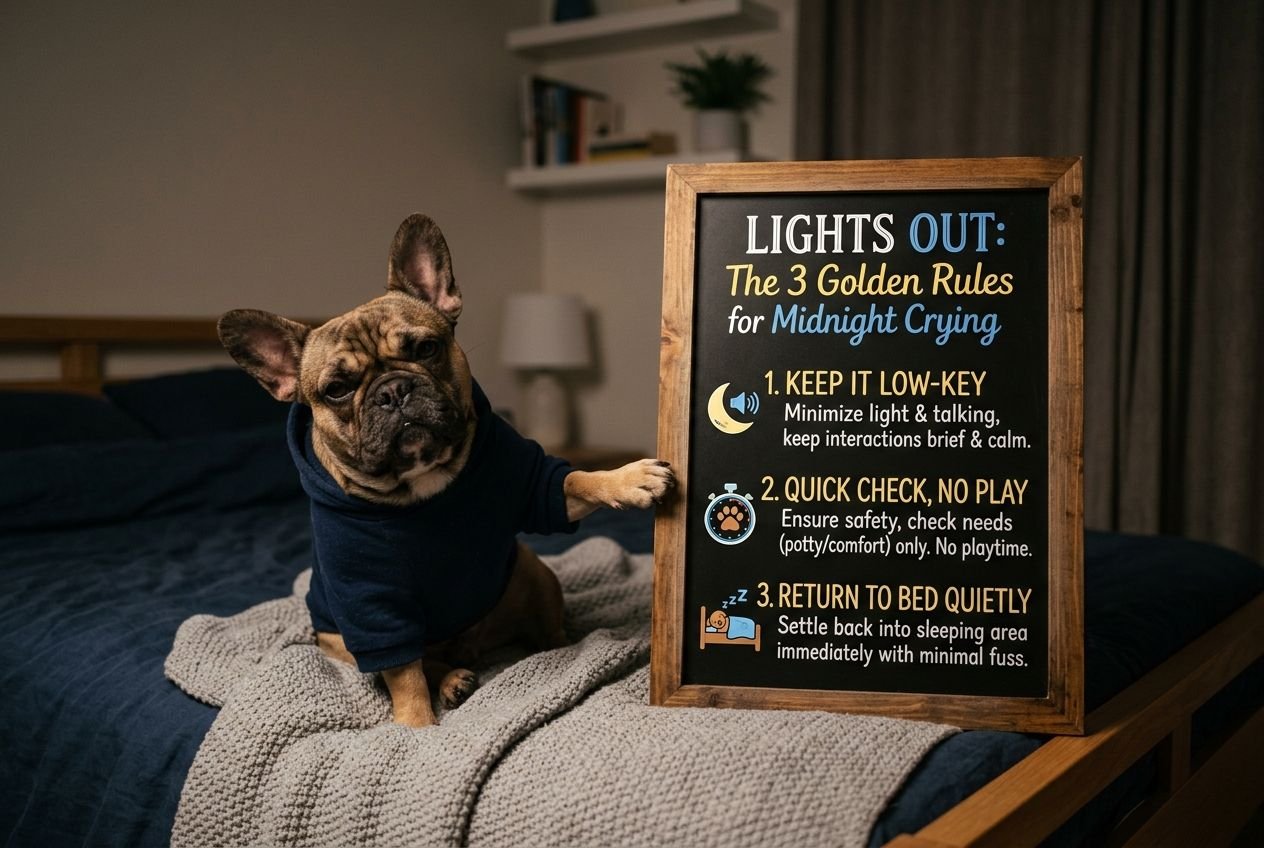
Even if your heart is breaking, bite your lip and stay silent. Do not talk to them, do not take them out, and do not tap the crate and yell “Quiet!” In dog logic, even negative attention is still attention. If you open the crate because they are crying, you have just taught them: “If I scream loud enough, the human will surrender.”
Rule #2: Scent and Sound Substitution
If they are highly anxious, play low-volume White Noise or classical music in the room to drown out startling ambient house noises. Drape an old t-shirt you wore that day over the top of the crate (leave the front door uncovered for ventilation). Your strong scent acts as a natural sedative.
Rule #3: The “Ninja” Potty Breaks
An 8-week-old Frenchie has a microscopic bladder; they physically cannot hold their pee all night. You will need to set an alarm for around 2:00 AM or 3:00 AM.
Here is the secret: When you take them out for a midnight potty, you must act like an emotionless Ninja. Do not turn on bright lights, do not make eye contact, do not speak, and absolutely DO NOT play. Carry them to the potty pad, wait for them to go, immediately carry them back to the crate, lock the door, and go back to bed. They must learn that midnight exits are strictly for business, not entertainment.
Breeder Warnings: The 3 Fatal Mistakes Beginners Make
- Giving In and Putting Them in Your Bed: This is the most dangerous mistake! Frenchie puppies are incredibly clumsy. The mortality and injury rate (cervical spine fractures, concussions) from jumping or falling off a high human bed in the middle of the night is horrifying. Furthermore, once they sleep in your bed, crate training them later becomes nearly impossible.
- Bribing Them with Treats to Stop Crying: Shoving a piece of chicken through the crate bars to make them stop whining is a disaster. Congratulations, you just perfectly rewarded the crying behavior. Now they think, “Crying = Snacks.”
- Giving Up on Frenchie Crate Training: A crate is not a prison; it is a sanctuary that protects them from chewing electrical cords or swallowing toxic items while you sleep. Giving up on the crate destroys their independence and guarantees severe separation anxiety, howling, and destructive behavior whenever you leave the house in the future.
Conclusion: Temporary Toughness for Long-Term Peace
Surviving the first night with your Frenchie puppy requires immense patience and a heart of stone. Giving in to their cries might buy you an hour of quiet tonight, but it will plant the seeds for a lifetime of behavioral issues.
Stick to the rules, utilize the crate, and guide them with firm, scientific love. Usually, after 3 to 5 days of testing your boundaries, the puppy will accept the routine, fall in love with their crate, and become the emotionally stable, perfect companion you always dreamed of.
Frequently Asked Questions (FAQ)
Q1: How many days will the nighttime crying phase last?
A: If you strictly follow the “Ignore Therapy” rule and do not reward the crying, the worst of it usually subsides within 3 to 5 days. By the second week, most puppies will enter their crate and go to sleep without a fuss. If you are inconsistent, it can last for months.
Q2: My Frenchie puppy is crying so hard they are gagging and vomiting white foam. Should I go to the emergency vet?
A: As mentioned in our warning, excessive crying causes airway inflammation in flat-faced dogs. If they vomit white foam due to panic, immediately take them out of the crate, calm them down in your lap, and let their breathing stabilize. You do not necessarily need an ER vet unless the breathing does not return to normal, their gums turn blue/pale, or they seem lethargic and unresponsive. Prioritize oxygen and calmness over crate training in that specific moment.
Q3: Can I keep the crate in my bedroom permanently?
A: Absolutely! Many Frenchie owners keep the crate in the bedroom permanently. Frenchies thrive on being near their “pack.” Being able to smell and hear you sleeping provides them with immense comfort and drastically reduces separation anxiety during the night.